

Inside the influence of institutional money
September 2026 | COVER STORY | FINANCE & INVESTMENT
Financier Worldwide Magazine
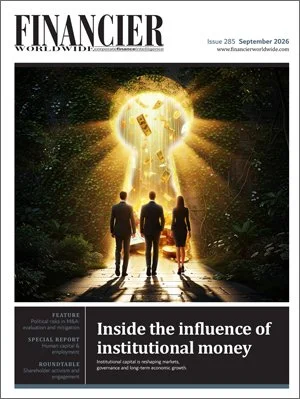
September 2026 Issue
Institutional investors have become a defining force in global financial markets, with pension funds, sovereign wealth funds (SWFs) and asset managers increasingly shaping capital flows, corporate governance and investment strategy.
Although they have long been part of the financial landscape, the rise of institutional investors began in earnest during the latter decades of the 20th century. The expansion of pension funds, the liberalisation of capital markets and the emergence of giant asset managers transformed institutional money into one of the dominant forces in global finance.
With trillions of dollars under management and growing influence over corporate governance, investment trends and economic policy, institutional investors have become one of the central pillars of the modern global economy.
Pension funds, SWFs, insurance companies and asset managers now control vast pools of capital, influencing everything from stock valuations and corporate governance to infrastructure investment and economic policy. Their growing scale and sophistication have transformed financial markets, making institutional money a key driver of capital allocation and long-term growth.
As these investors expand their reach across public and private markets, their decisions increasingly affect not only businesses and governments, but also broader issues such as sustainability, technological innovation and geopolitical stability.
Against this backdrop, technology has become central to modern institutional investing, according to Oliver Massmann, partner and general director at Duane Morris Vietnam LLC.
“Advances in data analytics allow investors to process vast amounts of information from financial markets, corporate disclosures, economic indicators and alternative data sources in ways that were previously impossible,” he explains. “Artificial intelligence (AI) is increasingly being used to identify patterns, assess risks, monitor portfolios and support investment decision making. AI-driven tools can improve forecasting, scenario analysis and stress testing, enabling investors to respond more effectively to changing market conditions. Technology is also enhancing operational efficiency, compliance monitoring and reporting capabilities.
“However, while technological tools provide valuable insights, human judgment remains essential,” he continues. “Investment decisions often require qualitative assessments of governance, regulatory developments, geopolitical trends and management quality that cannot be fully captured by algorithms alone. The most successful institutional investors are likely to be those that combine advanced technological capabilities with experienced investment and risk management expertise.”
With trillions of dollars under management and an ever-greater voice in boardrooms and policy debates, institutional investors are redefining the balance of power in the global economy. Yet as their influence grows, so too do questions surrounding concentration, accountability and the implications of entrusting so much economic power to a relatively small number of market participants.
According to recent Organisation for Economic Co-operation and Development research, asset managers hold approximately 65 percent of listed equity in the US and 59 percent in the UK, underlining the growing importance of institutional ownership in public markets. Globally, institutional investors account for a significant share of listed equity ownership, although their influence varies by country and region.
Likewise, according to Pensions & Investments and industry data, global institutional pools of capital held by pension funds, SWFs, insurance companies and asset managers exceed a combined $180 trillion. SWFs control approximately $16 trillion, pension funds oversee nearly $30 trillion, insurance companies hold approximately $36 trillion and the broader global asset management industry now manages well in excess of $125 trillion, with some estimates placing total assets under management above $140 trillion globally.
How institutional money moves the world
There have been many drivers behind the increased influence of institutional investors, including the expansion of pension systems, financial deregulation and globalisation. For Dr Massmann, the growing influence of institutional investors reflects a combination of scale, demographics and structural changes in global capital markets.
“Pension funds, SWFs, insurance companies and asset managers now control an unprecedented share of investable assets, driven by the continued accumulation of retirement savings and national wealth reserves,” he says. “At the same time, capital markets have become more complex and interconnected. Governments, corporations and infrastructure sponsors increasingly rely on large institutional investors capable of deploying substantial capital over long investment horizons. These investors also possess sophisticated risk management capabilities and global market access, allowing them to participate across multiple asset classes and jurisdictions.
“Furthermore, the rise of private markets, infrastructure investing and sustainable finance has expanded the opportunities for institutional capital to shape economic development. As a result, institutional investors are no longer passive providers of funding but influential participants in determining investment priorities, governance standards and long-term market trends,” he adds.
“With trillions of dollars under management and growing influence over corporate governance, investment trends and economic policy, institutional investors have become one of the central pillars of the modern global economy.”
This influence can be felt in a number of ways. Institutional investors direct vast pools of capital across public and private markets, shaping asset prices, sector growth and corporate behaviour. Their growing appetite for alternative assets, infrastructure and private credit is altering traditional capital flows, while their emphasis on long-term value creation, sustainability and active stewardship is influencing investment strategies worldwide.
Increasingly, their decisions determine which industries, technologies and regions attract funding, giving institutional money a pivotal role in defining the future direction of the global economy.
Dr Massmann says institutional investors are increasingly directing capital toward long-duration assets that align with their long-term liabilities and return objectives. This has accelerated investment into areas such as infrastructure, renewable energy, technology, logistics and private markets.
He also notes that capital allocation decisions increasingly reflect factors including political stability, regulatory predictability, demographic growth and supply-chain resilience, while institutional participation in private markets is reshaping financing structures and creating alternative sources of capital for businesses and governments.
As institutional investors have become more prominent, it is unsurprising that they have become more closely involved in corporate governance, board decision making and long-term business strategy, particularly in publicly listed companies where they often represent a substantial portion of the shareholder base.
As Dr Massmann explains, their influence extends beyond voting at annual meetings and increasingly involves ongoing engagement with boards and management teams regarding strategy, risk management, executive compensation and succession planning.
“The most influential institutional investors typically focus on governance frameworks that support sustainable long-term performance rather than short-term financial outcomes,” he points out. “Boards are increasingly expected to demonstrate clear oversight of material risks, capital allocation decisions and long-term value creation strategies. Failure to do so can result in shareholder activism, voting opposition or increased scrutiny.”
Stewardship, strategy and shareholder value
For institutional investors, as with all investors, value creation is the driving force behind everything they seek to achieve within an organisation. They aim to drive corporate value creation through active stewardship, capital allocation and operational engagement. Pension funds and asset managers often utilise proxy voting and board engagement to optimise business strategies, enforce financial discipline and curb short-termism.
According to Shamim Mohandessi, a partner at Seyfarth Shaw LLP, institutional investors are increasingly seeking longer-duration investment structures that allow capital to remain deployed for significantly longer than traditional private equity investment cycles. Where such structures do not yet exist, investors are increasingly working alongside sponsors to develop strategies that align the interests of both parties over investment horizons that may extend to 15 years or more.
Dr Massmann believes institutional investors have generally encouraged companies to place greater emphasis on long-term value creation through engagement on governance, sustainability, capital allocation and strategic planning. However, he notes that short-term market pressures remain influential, as companies continue to respond to earnings expectations, economic data and market sentiment. In his view, the most successful businesses balance consistent near-term performance with a clear long-term growth strategy.
The increased focus on value creation also extends into other areas of institutional investors’ influence, moving beyond traditional financial performance into the broader framework of corporate behaviour and accountability. As long-term stewards of capital, institutional investors are not only focused on returns, but also on sustainability and resilience. This has led to growing pressure on companies to integrate climate risk into strategic planning, improve disclosure on environmental and social impacts, and align executive remuneration with long-term performance rather than short-term gains.
Institutional investors are also placing greater emphasis on stakeholder considerations, encouraging boards to balance the interests of employees, customers and wider society alongside those of investors. Accordingly, value creation and corporate responsibility are becoming increasingly intertwined, with institutional investors acting as key architects of this evolving corporate agenda.
Dr Massmann argues that institutional investors increasingly regard sustainability, climate resilience, human capital management and governance quality as material contributors to long-term shareholder value. As a result, investors are demanding greater transparency around emissions, transition planning, workforce management, regulatory compliance and broader stakeholder issues that may affect long-term corporate resilience and performance.
When investment goes passive
While the growing emphasis on sustainable investment has reshaped how capital is allocated, encouraging investors to integrate environmental, social and governance considerations into portfolio construction and long term decision making, this shift is unfolding alongside a powerful structural change in global markets: the rapid rise of passive investing.
The expansion of index funds and exchange-traded funds has concentrated vast pools of assets within a small number of large asset managers, amplifying their collective influence over market dynamics. As ownership becomes more concentrated, these firms increasingly act as universal shareholders, holding stakes across entire economies and sectors.
This concentration has significant implications for corporate oversight, strengthening their voice in governance and stewardship while also raising questions about competition, market concentration and the balance of power between investors and the companies they effectively help to shape.
The growth of passive investing has fundamentally altered market dynamics, believes Dr Massmann. Large index fund providers now hold substantial ownership stakes across thousands of companies, giving them considerable influence over voting outcomes and governance matters.
“One benefit of passive investing is that it has broadened access to diversified investment products while reducing costs for investors,” he notes. “However, it has also concentrated stewardship responsibilities within a relatively small group of asset managers. This concentration has generated debate regarding the extent to which a handful of firms can effectively oversee such a large number of portfolio companies.”
Recent industry trends suggest that the evolution of passive investing is occurring alongside a broader convergence between public and private markets. Institutional investors are increasing allocations to private credit, infrastructure and other alternative asset classes, while advances in AI are improving portfolio construction, risk management and stewardship capabilities.
At the same time, governments are increasingly looking to pension funds and SWFs as sources of long-term capital for strategic priorities including energy transition projects, digital infrastructure and industrial development.
For Mr Mohandessi, however, the lower middle market – where there is a great deal of opportunity to deploy capital and capture value growth – is often overlooked as sponsors look to move capital at scale, leaving something of a vacuum.
“Where previously, lower middle market buyouts and growth equity could generate attractive returns, sponsors have moved upmarket in search of speed of deployment,” he observes.
Power, concentration and the road ahead
Although there are undoubtedly advantages to the rise of passive investing, including lower costs and broader market access, it has also intensified debate about the concentration of institutional capital and the potential systemic risks this may create.
“We are seeing a growing number of institutional investors recommitting to emerging sponsor strategies,” says Mr Mohandessi. “This focus creates a win-win for emerging sponsors and institutional investors.” He adds that this trend allows investors to gain exposure to new opportunities and specialist strategies, while helping smaller managers accelerate their growth and fundraising efforts.
Yet critics argue that when ownership and voting power are increasingly clustered within a small number of large asset managers, financial markets may become more vulnerable to correlated decision making and amplified shocks during periods of stress. These concerns raise important questions about resilience, particularly in scenarios where a limited group of institutions exerts outsized influence across entire indices and sectors.
Dr Massmann believes concerns regarding concentration are legitimate, particularly given the scale of assets managed by a relatively small number of global institutions. Large investors often hold similar positions across markets and sectors, potentially increasing market volatility during periods of stress if significant reallocations occur simultaneously.
“The appropriate response is not necessarily to limit institutional participation but to strengthen transparency, stress testing, liquidity management and regulatory oversight,” he suggests.
Addressing these risks is likely to require a combination of stronger regulatory oversight, enhanced transparency around stewardship practices and ongoing scrutiny of market structures. This will be particularly important in the coming years as institutional investors continue to become even more influential, driven by the growth of global pension assets, the expansion of SWFs and increasing demand for long-term capital across both developed and emerging markets.
Looking ahead, institutional investors will continue to evolve their purpose, their portfolios and their proficiency, becoming more resilient, flexible and responsive in the process.
For Dr Massmann, the role of institutional investors will increasingly extend beyond traditional portfolio management into areas such as infrastructure development, energy transition, digital transformation and long-term economic resilience.
“For companies, this means greater scrutiny of governance quality, risk management, transparency and long-term strategic planning,” he notes. “Access to institutional capital will increasingly depend on an organisation’s ability to demonstrate sustainable value creation and operational resilience. For policymakers, institutional investors represent an important source of long-term capital needed to finance major economic priorities.
“At the same time, regulators will need to address issues relating to market concentration, systemic risk and stewardship accountability,” he continues. “Overall, institutional investors are likely to play an even greater role in shaping both capital markets and economic development, reinforcing their position as key architects of long-term global investment trends.”
Beyond simply attracting capital, companies need to demonstrate adaptability. Those that embrace transparency, cultivate strategic agility and communicate a compelling long-term vision are more likely to earn institutional confidence.
© Financier Worldwide
BY
Richard Summerfield