Transactional risk insurance and the evolution of Japanese M&A
December 2026 | TALKINGPOINT | MERGERS & ACQUISITIONS
Financier Worldwide Magazine
December 2026 Issue
FW discusses transactional risk insurance and the evolution of Japanese M&A with Toshifumi Kajiwara, Shuko Shikatani, Takuya Miyazawa and Sumiyo Yamamoto at Time Machine Underwriters.
FW: What major developments have transformed Japan’s M&A landscape in recent years? Which opportunities and challenges are having the greatest impact on dealmaking today?
Shikatani: Japan’s M&A market continues to grow strongly, with transactions involving Japanese companies reaching a record level of more than 5100 deals in 2025. Key drivers include business succession needs, the growing role of M&A advisers, increased private equity (PE) activity, and more carve outs as large corporates reshape their portfolios. Warranty and indemnity (W&I) insurance is also becoming relevant to a wider range of transactions. It is no longer confined to large-size deals, with increasing use in small and mid-sized transactions below ¥10bn. We estimate that the number of insured transactions increased from around 60 to 80 in 2024, to approximately 100 to 120 in 2025.
“Claims arising from Japan-related transactions accounted for 40 percent of transactional risk insurance claims in Asia in 2025.”
FW: What factors are driving the growing adoption of transactional risk insurance within Japanese M&A transactions? How has its role changed over recent years?
Yamamoto: One important factor driving growth has been the development of the domestic underwriting market. Since around 2022, some insurers have been able to underwrite W&I insurance entirely in Japanese, reducing the perceived burden of the underwriting process for local deal teams. Brokers have also played an important role in developing the market and raising awareness, while increased market capacity has made insurance available for a broader range of transactions. Claims experience is also becoming more visible. According to Marsh, claims arising from Japan-related transactions accounted for 40 percent of transactional risk insurance claims in Asia in 2025. Marsh has also reported an $11m W&I claim payment arising from a compliance breach in Japan. As market participants see more examples of policies responding to actual losses, W&I insurance is increasingly recognised as a practical risk allocation tool.
“Attitudes toward transactional risk insurance in Japan have become more sophisticated as familiarity with the product has increased.”
FW: In what ways can transactional risk solutions help facilitate deal execution, improve certainty and bridge gaps between buyers and sellers during negotiations?
Miyazawa: Transactional risk insurance can help bridge gaps between buyers and sellers by enabling sellers to achieve a cleaner exit while giving buyers recourse under the policy. Where warranty breaches are insured, parties may also have less need to negotiate extensively over liability caps, survival periods and other limitations in the sale & purchase agreement (SPA). Insurance can also encourage fuller disclosure by sellers. The underwriting process often identifies areas where further disclosure or diligence would be helpful, giving buyers an additional basis to raise focused questions and, in some cases, allowing risks that might otherwise have remained unresolved to be addressed before signing. Policy enhancements such as knowledge and materiality scrapes can further reduce negotiation over warranty qualifications and thresholds. Overall, these solutions can reduce negotiation friction, improve certainty around risk allocation and facilitate smoother deal execution.
FW: How are PE investors incorporating transactional risk insurance into their acquisition strategies, particularly in competitive auction and take-private processes?
Kajiwara: PE investors are increasingly incorporating W&I insurance into their acquisition strategies, particularly in competitive auctions. In many auction processes, insurance is built into the transaction structure from the outset, with sellers increasingly obtaining indicative terms through a seller-buyer flip process before selecting a preferred bidder. This can facilitate a cleaner exit for the seller and streamline negotiations with bidders. In take-private transactions, there may be no suitable party to give warranties, particularly where there are no management shareholders. A synthetic structure, under which warranties are deemed to have been given for insurance purposes, may be used in such cases. In the Japanese market, however, there are also transactions in which the target company itself provides the relevant warranties. This may allow the parties to place W&I insurance without using synthetic warranties. As a result, synthetic structures have not yet become widespread in Japan.
“Warranty and indemnity insurance is becoming relevant to a wider range of transactions. It is no longer confined to large-size deals.”
FW: As transaction structures become more complex, what emerging legal, regulatory or operational risks are parties most focused on addressing through insurance solutions?
Yamamoto: More complex deal structures are creating a need for increasingly tailored insurance solutions. In carve-out transactions, for example, separation steps are often implemented between signing and closing, and insurers may provide cover for the legality and effectiveness of those steps, subject to agreed conditions. Take-private transactions present a different challenge because acquiring 100 percent ownership can take time and may require warranties to be repeated at multiple stages of the transaction. In addition, listed-company transactions may involve warranties relating to public disclosure, securities regulation and stock exchange requirements. These features require more bespoke policy structures and underwriting than would typically be required in a straightforward private M&A transaction.
FW: How have attitudes toward transactional risk insurance evolved among Japanese corporates, private equity firms and advisers? Where do you see the greatest areas of increased adoption?
Miyazawa: Attitudes toward transactional risk insurance in Japan have become more sophisticated as familiarity with the product has increased. W&I insurance is increasingly being considered earlier in the transaction process. We are now seeing due diligence conducted with insurance in mind, with additional diligence sometimes used to encourage further seller disclosure and SPA negotiations increasingly influenced by the scope of available insurance cover. Historically, most insured transactions involved PE on either the buy-side or sell-side. However, transactions involving only strategic corporates are gradually increasing. I expect this to be one of the main areas of future growth, as corporates increasingly view W&I insurance not only as protection against financial loss, but also as a transaction tool that can support diligence and disclosure, bridge negotiation gaps and facilitate deal execution.
“PE investors are increasingly incorporating W&I insurance into their acquisition strategies, particularly in competitive auctions.”
FW: Looking to the years ahead, what trends do you believe will shape the next phase of Japanese dealmaking and influence the continued development of transactional risk insurance?
Kajiwara: We expect Japan’s M&A market to become not only more active, but also more sophisticated. Corporate governance reforms and the continued focus on capital efficiency are likely to support further carve outs and take-private transactions, while business succession will remain an important structural driver of M&A activity. For transactional risk insurance, the next phase will be about deeper integration into the deal process rather than simply higher penetration. As the market matures and claims experience accumulates, the efficiency of the underwriting process and whether an insurer has experienced underwriters will become increasingly important factors in selecting an insurer. These developments should further establish W&I insurance as part of the broader M&A infrastructure in Japan.
Toshifumi Kajiwara is the chief underwriting officer at Time Machine Underwriters. Prior to this role, he worked at an IT company as the head of the legal & compliance department and served as the data protection officer. In addition to his in-house experience, he spent several years as an attorney at an international law firm. He can be contacted on +81 80 9358 3371 or by email: t.kajiwara@tmuws.com.
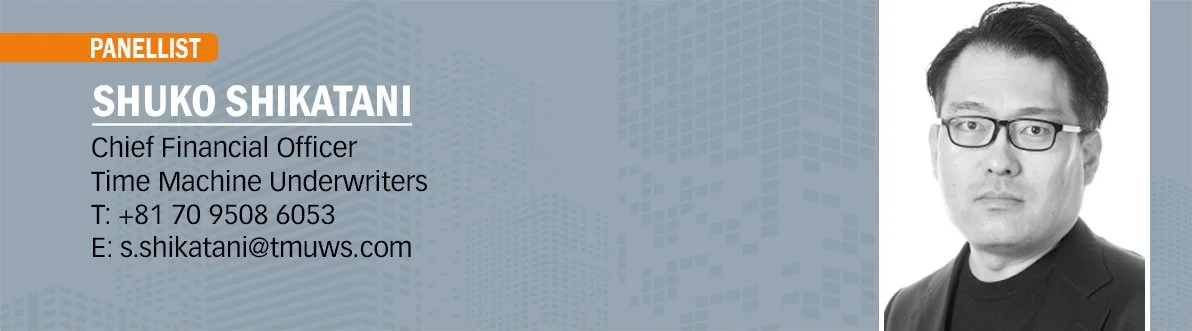
Shuko Shikatani is the chief financial officer and an underwriter at Time Machine Underwriters. Previously, he was an executive officer at Yamap Nature-Insurance Inc. He has also worked at PricewaterhouseCoopers Japan LLC, where he provided advisory services to insurance companies. He is a certified public accountant. He can be contacted on +81 70 9508 6053 or by email: s.shikatani@tmuws.com.
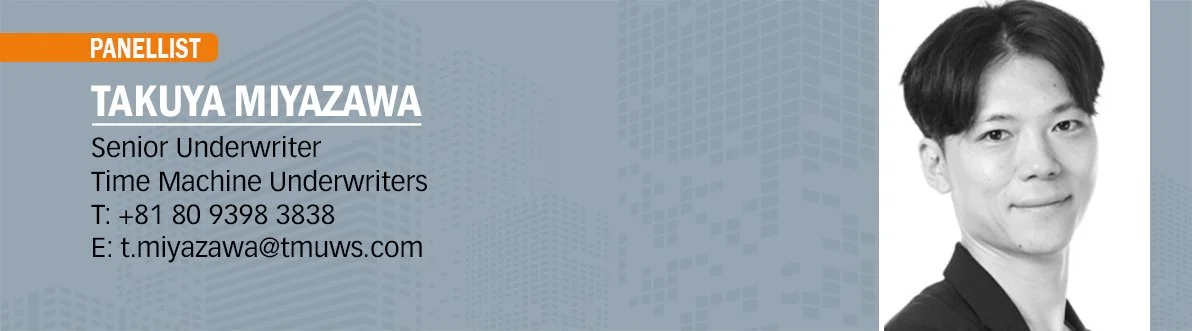
Takuya Miyazawa is a senior underwriter at Time Machine Underwriters. Prior to this, he was a senior underwriter at Tokio Marine & Nichido Fire Insurance, one of Japan’s leading general insurance companies, where he played a key role in underwriting financial lines and W&I insurance. He can be contacted on +81 80 9398 3838 or by email: t.miyazawa@tmuws.com.
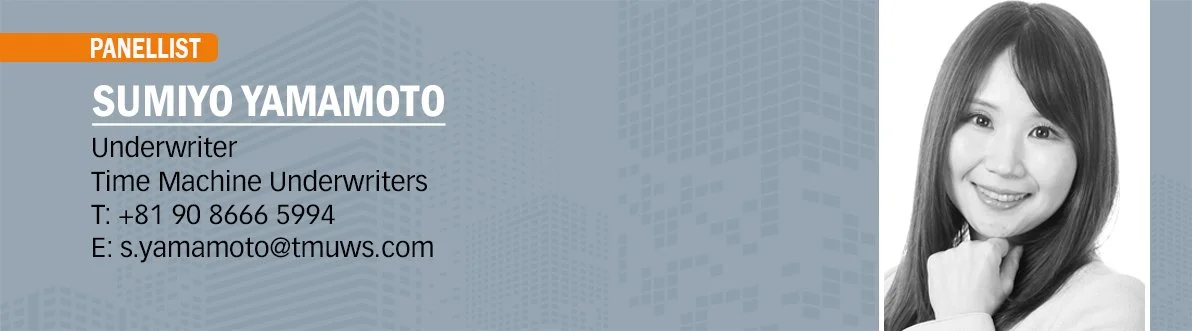
Sumiyo Yamamoto is an underwriter at Time Machine Underwriters. Prior to this, she was senior legal counsel at AIG General Insurance Company. She has also worked as an attorney at Anderson Mori & Tomotsune and Tokei Partners, advising clients on corporate matters, including M&A and litigation. She can be contacted on +81 90 8666 5994 or by email: s.yamamoto@tmuws.com.
© Financier Worldwide
THE PANELLISTS
Time Machine Underwriters