

AI reshaping corporate finance
January 2026 | COVER STORY | FINANCE & ACCOUNTING
Financier Worldwide Magazine
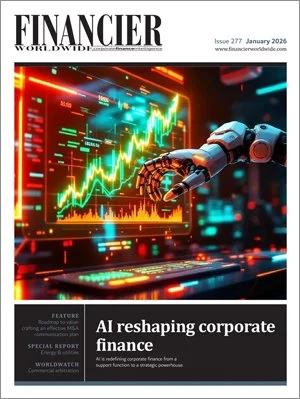
January 2026 Issue
Artificial intelligence (AI) has rapidly become one of the most transformative forces in both our personal and professional lives. From television screens and mobile devices to social media feeds and the modern workplace, AI is increasingly woven into the fabric of everyday experience.
Companies are applying AI to a vast array of practices and processes. Its applications are extensive, and businesses are utilising it in diverse ways. Machine learning (ML) and natural language processing (NLP), task automation, improved data analysis and enhanced decision making are all being enabled by AI. These capabilities are driving increased productivity, reduced costs, and improved customer and employee experiences.
AI is being embraced by more organisations. According to figures released by the Bank of England in early 2025, 75 percent of firms in banking, pensions and other financial services are already using AI, with a further 10 percent planning to adopt it over the next three years.
Lloyds’ Financial Institutions Sentiment Survey also suggests that UK financial firms are doubling down on AI. The study of some of the UK’s largest banks, asset and wealth managers and insurers reveals a sharp rise in AI adoption and impact, with 59 percent of institutions reporting improved productivity. As a result, 51 percent of firms surveyed intend to increase AI investment over the following 12 months, with a further 22 percent expecting to maintain current levels of spend.
This surge in adoption is not limited to large institutions. Small and medium-sized enterprises are increasingly exploring AI tools to streamline financial operations, reduce manual workloads and improve forecasting accuracy. Cloud-based AI platforms have made these technologies more accessible, allowing finance teams in smaller firms to benefit from automation and data-driven insights without the need for extensive infrastructure.
Accenture reports that the UK’s financial services sector is accelerating its adoption of AI, with institutions planning to increase investment to 16 percent of technology budgets in 2025, up from 12 percent in 2024. The UK is not an outlier in this regard. Financial institutions (FIs) globally are increasing their investments in AI technology. While AI is being deployed across a wide spectrum of sectors and tasks, corporate finance and financial services are among the areas most likely to benefit from its proliferation. Many companies in the corporate finance space have developed comprehensive AI roadmaps, incorporating multiple initiatives focused on value, feasibility and risk appetite.
AI as a catalyst for financial innovation
Many companies in the corporate finance sphere are already embracing AI, with generative AI (genAI) becoming central to transformative change. GenAI is helping companies and FIs redefine their operational and strategic horizons. Its capacity for creating new, original content represents a fundamental shift, propelling banking toward a future rich in innovation and efficiency.
Corporate finance is embracing AI not as a futuristic tool but as a core driver of operational excellence. According to Workday’s AI Indicator report, 98 percent of chief executives say AI and ML offer immediate business benefits. For chief financial officers (CFOs), AI is a transformative force, expanding finance’s impact beyond numerical reporting to becoming a strategic driver of smart decision making. Yet, fewer than half of organisations report being fully prepared to adopt and implement AI.
To bridge this readiness gap, many firms are investing in AI literacy and change management programmes. These initiatives aim to equip finance professionals with the skills needed to interpret AI outputs, challenge assumptions and integrate insights into strategic planning. Upskilling efforts are particularly focused on data fluency, ethical AI use and cross-functional collaboration, ensuring finance teams can operate effectively in increasingly digital environments.
For companies that have implemented AI, it is redefining corporate finance from a support function to a strategic powerhouse. Organisations are using AI to automate financial processes such as real-time invoice processing, reconciliations and fraud detection, significantly enhancing both speed and accuracy. ML-driven predictive analytics now support dynamic forecasting and scenario planning, enabling CFOs to anticipate market shifts and optimise decision making.
“The direction of travel is clear: AI is poised to become a strategic partner in corporate finance, helping to deliver long-term financial success.”
AI is also redefining the role of the CFO. Today’s CFO is expected to do more than report retrospectively. They play a crucial role in predictive and strategic leadership. The modern CFO helps improve operational efficiency through automation, with a core focus on data integration, scenario planning and ensuring robust data security. In the AI age, CFOs are expected to demonstrate data fluency, narrative capability and strategic oversight.
These changes are having a financial impact. More firms are realising significant business value from genAI. According to Bain & Company, US financial services firms are seeing productivity boosts, including more rapid software development and improved customer service. Given these gains, firms are maintaining heavy investment in AI technology.
Leading banks, particularly in North America, have been at the forefront of this shift. Many have invested heavily in AI to drive innovation, develop talent and enhance operational transparency. Their strategies span diverse use cases, including strengthening fraud detection systems and improving customer service through chatbots. These FIs are also securing essential hardware to power AI operations and making strategic investments in both technology and human expertise. This push is driven by a desire to refine existing processes, harness high-impact AI opportunities, and balance risks and rewards in fully operational solutions.
In addition to operational improvements, AI is enabling FIs to explore new business models. For example, some banks are using AI to develop personalised financial products based on customer behaviour and predictive analytics. This level of customisation enhances customer engagement and opens new revenue streams, demonstrating how AI can support both efficiency and innovation.
Automation meets intelligence: the new financial workflow
Companies are increasingly focused on modernising functions and maintaining competitive advantage. One common starting point is the automation of financial processes. Firms now use AI finance tools to process invoices, reconcile accounts, and input data quickly and accurately. This is often achieved through robotic process automation (RPA), which enables real-time processing of thousands of transactions simultaneously.
RPA tools offer extensive capabilities for automating manual processes and accelerating data handling. Meanwhile, AI-powered predictive analytics can examine large volumes of transactional data to uncover patterns that may indicate fraudulent activity. By detecting anomalies early, organisations can proactively identify potential errors or fraud before they escalate.
Additionally, AI is being used to enhance compliance monitoring. FIs are deploying AI systems to scan transactions for signs of money laundering, insider trading and other regulatory breaches. These systems can flag suspicious activity in real time, allowing compliance teams to respond swiftly and reduce exposure to legal and reputational risks.
AI also significantly impacts credit risk assessments. By integrating real-time market data with historical financial records, FIs can create advanced algorithms to determine a borrower’s creditworthiness. These algorithms analyse metrics such as payment history, industry trends and external factors like geopolitical risks to produce accurate assessments.
Combining these tools with systems such as enterprise resource planning and customer relationship management helps organisations maintain accurate and up-to-date financial records.
Beyond improving accuracy and productivity, automation is driving broader transformation across companies, particularly within finance teams. AI enables modern finance teams to innovate and add strategic value. They can play a more proactive role across the business, analysing cash flow patterns, currency fluctuations and wider market data to optimise liquidity management and maximise investment returns.
From insight to action: predictive analytics in practice
Predictive analytics is a rapidly growing field with high expectations. Organisations across financial services and other sectors are increasingly adopting AI-powered models to analyse historical data, real-time financial indicators and external market trends. These models produce tailored, actionable forecasts that empower businesses to simulate scenarios and plan proactively.
The practical impact is significant. Predictive analytics enhances risk management and supports more informed decision making. By integrating financial and operational data more swiftly and accurately, forecasting becomes a more accessible and widely adopted practice across industries.
This granularity is not limited to numerical data; AI-powered predictive analytics tools can use NLP to analyse news, market reports and social media sentiment. This enables companies to build a more holistic overview of the economic and business landscape, which is particularly valuable for financial services firms.
Increasingly, predictive analytics is being used to support environmental, social and governance (ESG) initiatives. AI models can assess ESG risks by analysing sustainability reports, regulatory filings and public sentiment. This allows firms to align financial planning with long-term sustainability goals and stakeholder expectations, enhancing transparency and accountability.
Predictive analytics also supports scenario modelling for strategic planning. CFOs can simulate the impact of interest rate changes, supply chain disruptions or geopolitical events on financial performance. This capability allows finance leaders to prepare contingency plans and allocate resources more effectively, strengthening organisational resilience.
Using data in this way helps disseminate insights across departments, creating a unified system that connects finance, operations, HR, marketing, sales and supply chain. This enables CFOs and their teams to better understand their organisations and make more informed, data-driven decisions. As CFOs increasingly rely on both financial and non-financial data, integrated solutions are becoming central to modern corporate finance.
Beyond the hype: understanding AI’s boundaries
Despite its advantages, AI adoption faces challenges, including cyber security risks, regulatory complexity and skills shortages.
Companies must understand AI’s limitations. The integration of AI introduces complex challenges, such as the ‘black box’ nature of algorithmic decision making and ethical concerns around bias. These issues raise questions about governance and accountability, especially in a highly regulated sector like financial services.
AI offers enhanced efficiency, accuracy and strategic innovation, but its deployment creates operational, ethical and regulatory hurdles. Among the most pressing concerns are data privacy and the socioeconomic implications of automation. Ensuring that AI operates fairly, transparently and in compliance with regulations is critical.
Robust governance frameworks are essential to ensure ethical integrity and operational resilience. The EU’s Artificial Intelligence Act exemplifies efforts to establish a harmonised framework that balances innovation with consumer protection. The Act categorises AI systems into four levels: unacceptable risk, high risk, limited risk and minimal risk. Obligations vary depending on the category, with most regulation focused on high-risk AI.
However, concerns have been raised about the Act’s broad remit, potential overlap with existing legislation and the operational burden it may place on multinational FIs.
To address these concerns, some firms are establishing internal AI ethics boards composed of cross-functional experts. These boards review AI use cases, assess risks and ensure alignment with corporate values and regulatory requirements. This proactive approach helps build trust and ensures that AI deployment supports long-term strategic goals.
Despite these headwinds, the benefits of AI adoption in corporate and commercial finance are substantial. AI can enhance risk management, streamline operations, improve forecasting accuracy and support real time decision making. Achieving these outcomes requires careful attention to implementation challenges, including data privacy and security, cost and skills barriers, integration with legacy systems and regulatory compliance.
AI systems must operate within defined ethical and regulatory parameters. Ensuring compliance with obligations related to anti-money laundering, tax reporting and financial disclosure will require continuous human oversight. Addressing algorithmic bias and ensuring transparency in automated decision making are essential to maintaining trust and accountability.
Mitigating these risks requires action. Companies must integrate transparency, ethical integrity and regulatory compliance into their AI strategies. This will position them to realise the benefits of automation while maintaining public confidence and long-term resilience.
Processes such as regular reviews of training data, ethical consideration, professional scepticism and critical judgement can help mitigate risks. As AI models continue to be embedded in more products and services, firms must keep their technology and data strategies under constant review. Governance regimes, policies and controls must also be regularly updated to ensure they remain robust and capable of managing emerging risks.
Beyond adoption: sustaining value in the AI era
The adoption of AI applications and their integration into corporate workflows, including corporate finance, is now an established reality. These technologies deliver greater efficiency, cost reductions, enhanced financial modelling accuracy and improved strategic decision making. All of this contributes to increased profitability and competitive advantage.
In the coming years, AI will continue to influence how companies plan, operate and innovate across industries. Businesses must deploy AI wisely, keeping pace with competitors and meeting regulatory and stakeholder demands in a rapidly changing market. AI can help streamline processes, uncover insights and identify growth opportunities, while delivering strategic value.
However, successful AI application is not guaranteed. Human expertise and supervision remain essential. Skilled finance professionals must provide context and oversight, and senior leadership must define a clear organisational path for AI adoption.
The direction of travel is clear: AI is poised to become a strategic partner in corporate finance, helping to deliver long-term financial success. By embracing AI and navigating its challenges responsibly, businesses will be well positioned to excel despite the complexity and uncertainty of the global economy.
© Financier Worldwide
BY
Richard Summerfield