
Fraud/Corruption

Compliance professionals foresee increasing risk of bribery and corruption

BY Fraser Tennant

More than 50 percent of compliance professionals are expecting to be faced with an increasing risk of bribery and corruption over the coming year, according to a new report by the corporate investigations and risk consulting firm Kroll and Compliance Week.

The 2015 Anti-Bribery and Corruption Benchmarking Report – ‘How do companies navigate bribery and corruption?’ – is based on a survey of senior-level compliance professionals, 72 percent of whom say they expect to see the risk of bribery and corruption increase due to business expansion into new and unfamiliar markets.

Furthermore, despite 65 percent of compliance professionals stating that their businesses are likely to increase the number of their third-party relationships in future, 48 percent conceded that they never train third parties on anti-bribery and corruption matters – an “alarmingly high” figure, says the report, given the number of enforcement actions taken by regulators that involve third parties.

Recognising the issue with third parties, Kevin Braine, managing director with Kroll’s Compliance practice in EMEA, said: “While there has been phenomenal progress in the extent to which anti-bribery and anti-corruption issues have now made it on the training agenda for most large organisations, that’s still not really the case when it comes to training third parties.” 

Militating against this, only 8 percent of compliance professionals admit to not performing due diligence to hire or retain a third party, with the majority of companies employing risk-based factors to determine how much diligence they actually perform. On this point, the report reveals that 58 percent of compliance professionals rate their due diligence procedures as either “effective” or “very effective".

Further key findings in the report include: (i) more than 50 percent anticipate the bribery and corruption risks to their company will increase; (ii) 66 percent automate their anti-corruption program in some way; (iii) most automated tasks are limited to training; only 26 percent automate the vetting of third parties; and (iv) a majority (52 percent) are not confident in their financial controls to catch potential books-and-records violations of the Foreign Corrupt Practices Act (FCPA).

“Due diligence is really one of the keys to any type of compliance program, whether related to human trafficking, conflict minerals, anti-bribery and corruption, or anti-money laundering,” said Lonnie Keene, managing director with Kroll. “It is one of those elements that cuts across all of those obligations.”
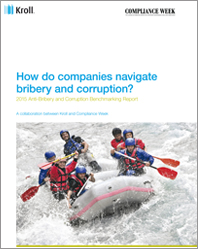
Report: The 2015 Anti-Bribery and Corruption Benchmarking Report – How do companies navigate bribery and corruption?

Forex five fined $5.7bn

BY Richard Summerfield

Five of the world’s largest banking groups have been handed fines totalling $5.7bn for their role in manipulating the foreign exchange market.

For the banks - JPMorgan, Barclays, Citigroup, RBS and UBS - the fines continue to stack up as the latest scandal to hit the banking sector once again makes headlines.

According to regulators, forex traders from the banks met in online chatroom groups, named ‘the Cartel’ and another ‘Mafia’, and colluded to set rates that cheated customers while adding to their own profits. "They acted as partners - rather than competitors - in an effort to push the exchange rate in directions favourable to their banks but detrimental to many others," said US Attorney General Loretta Lynch.

The fines, meted out by the US Department of Justice, and separately by the US Federal Reserve, bring total penalties related to rate rigging of the foreign exchange markets to nearly $9bn, according to the Justice Department. Indeed, in November 2014 a number of the same banks agreed to pay $4.25bn to resolve foreign exchange investigations by a raft of regulators.

Four of the five banks under investigation by the DoJ plead guilty – namely Barclays, RBS, Citigroup and JP Morgan. However UBS was granted immunity for being the first to report the manipulation of the $5 trillion a day forex. A sixth bank - Bank of America - was separately fined $205m by the Fed. Announcing the settlements, Ms Lynch said: “The penalty they will pay is fitting, it’s commensurate with the pervasive harm that was done. It should deter competitors from chasing profits without regard to fairness to law or public welfare."

Barclays has been the hardest hit institution; in total, the bank has been fined $2.4bn – the highest amount any bank has paid for the scandal. US banks JPMorgan Chase and Citigroup will pay $900m and $1.2bn in fines respectively. Citigroup’s fine included a $925m antitrust settlement. The firm called the scandal "an embarrassment to our firm, and stands in stark contrast to Citi's values”. RBS agreed to pay around $660m. UBS agreed to pay more than $500m in fines, some of which was earmarked for Libor crimes and the rest for currency manipulation.

News: Global banks admit guilt in forex probe, fined nearly $6 billion

SEC - companies cannot silence whistleblowers

BY Richard Summerfield

On 1 April, the Securities and Exchange Commission (SEC) announced its first ‘enforcement action’ regarding the use of what it deemed to be restrictive language in a confidentiality agreement.

The decision handed down by the SEC found that technology and engineering firm KBR Inc had violated whistleblower protection rule 21F-17, enacted under the Dodd-Frank Act. “By requiring its employees and former employees to sign confidentiality agreements imposing prenotification requirements before contacting the SEC, KBR potentially discouraged employees from reporting securities violations to us,” said Andrew Ceresney, the SEC’s enforcement director, in a statement announcing the enforcement action.

The confidentiality agreements KBR’s employees were required to sign were discovered as a result of a lawsuit brought against the firm. In the suit, Harry Barko, a former employee of the company, accused KBR and Halliburton of inflating the cost of a military supply contract for US bases in Iraq.

As a result of the enforcement action against it, KBR agreed to pay a fine of around $130,000 to settle the SEC’S investigation and has also agreed to amend its confidentiality agreements, a step which has been welcomed by the SEC. However KBR did not admit any wrongdoing as part of the settlement. Furthermore, the company was not found to have specifically prevented an employee from reporting fraud. Indeed the firm’s use of confidentiality agreements pre-dated the enactment of the SEC’s whistleblower protection rules.

In a statement, KBR’s chief executive officer, Stuart Bradie, noted that the “SEC’s order acknowledges that it is not aware of KBR having ever prevented anyone from reporting to the SEC, nor has the company taken any action to enforce the agreement, and that is because we have never done so.” Mr Bradie added, “We are pleased to have amicably resolved this matter and look forward to putting it behind us.”

Yet with this action, and with a number of other enforcement actions imminent, the SEC has once again reiterated that it is willing to diligently implement the whistleblower protections it has at its disposal.

News: SEC: Companies Cannot Stifle Whistleblowers in Confidentiality Agreements

HSBC in tax dodging scandal

BY Richard Summerfield

British banking group HSBC Bank plc is facing potential legal action in both the US and the UK over claims that the bank conspired with clients of its Swiss subsidiary, helping them avoid paying tax in the run up to the financial crisis.

According to a number of leaked bank account files, HSBC helped over 100,000 clients across 203 countries to hide around $118bn worth of assets. The documentation, which was leaked to a number of global media outlets, has sparked an outpouring of outrage across Europe, the US and elsewhere. Though the relevant tax authorities have had access to the leaked files since 2010, HSBC’s misconduct is only now being made public.

Prosecutors in the US have begun to intensify their investigations into HSBC’s conduct given the revelations, and are now looking into allegations that the bank may also have manipulated currency rates as part of its wider malfeasance. The US Department of Justice may also choose to re-evaluate the $1.9bn deferred prosecution agreement reached with the bank in 2012 as a result of the leak. In the UK, the bank may face possible criminal charges.

In many respects, the HSBC revelations are indicative of a dubious culture permeating the banking sector, and the latest revelations will do little to convince the public that banking and financial institutions can be trusted. With many of the wounds from the financial crisis still raw, HSBC’s alleged collusion with tax dodging clients will undoubtedly provide a significant setback for those attempting to clean up the industry’s image. As the UK’s general election is mere months away, the issues of tax avoidance and corporate misconduct are likely to remain high on the political agenda in the short term.

Given the potentially damaging nature of the revelations, HSBC has moved swiftly to calm the quickening storm. In a statement the bank said, “We acknowledge that the compliance culture and standards of due diligence in HSBC’s Swiss private bank, as well as the industry in general, were significantly lower than they are today. At the same time, HSBC was run in a more federated way than it is today and decisions were frequently taken at a country level.”

News: HSBC could face U.S. legal action over Swiss accounts

S&P agrees $1.5bn settlement

BY Richard Summerfield

After years of legal wrangling, credit rating agency Standard & Poor's has agreed to pay the federal, state and D.C. governments around $1.5bn to resolve several lawsuits covering the firm’s role in the 2008 financial crisis.

While the settlement does not bring an end to the scrutiny placed upon the wider ratings business (indeed, S&P’s competitors Fitch and Moody’s are still embroiled in legal battles), the agreement does bring to a close an embarrassing chapter in S&P’s history. The firm, much like its rival agencies, stood accused of issuing falsely inflated ratings of mortgage-backed securities during the housing boom of 2004 to 2007, which contributed to the onset of the 2008 financial crisis. “As S&P admits under this settlement, company executives complained that the company declined to downgrade underperforming assets because it was worried that doing so would hurt the company’s business,” said Attorney General Eric Holder. “While this strategy may have helped S&P avoid disappointing its clients, it did major harm to the larger economy, contributing to the worst financial crisis since the Great Depression.”

Under the terms of the agreement, S&P’s parent group, McGraw Hill Financial Inc, will pay $687.5m to the US Department of Justice, and $687.5m to 19 states and the District of Columbia, which had all filed similar lawsuits. According to S&P, the firm agreed to the settlement in order “to avoid the delay, uncertainty, inconvenience and expense of further litigation".

S&P has also reached a separate $125m settlement agreement with the California Public Employees’ Retirement System. The pension fund opened legal proceedings against S&P in 2009.

The agreement reached between S&P and the DOJ is a so-called ‘no fault’ deal. Accordingly, the firm has admitted no wrongdoing as part of the settlement. No fault agreements have been particularly unpopular in the past and the S&P agreement has drawn fierce criticism from some circles. Critics of the plan have been particularly vocal in their opposition to the deal as S&P was not found to have violated the law under the terms of the deal. Some commentators had hoped that the firm would be held accountable for its actions, in order to act as a preventative measure in the future.

News: S&P reaches $1.5 billion deal with U.S., states over crisis-era ratings

©2001-2026 Financier Worldwide Ltd. All rights reserved. Any statements expressed on this website are understood to be general opinions and should not be relied upon as legal, financial or any other form of professional advice. Opinions expressed do not necessarily represent the views of the authors’ current or previous employers, or clients. The publisher, authors and authors' firms are not responsible for any loss third parties may suffer in connection with information or materials presented on this website, or use of any such information or materials by any third parties.