Global IPO down in Q1 – EY

BY Richard Summerfield

Global initial public offering activity (IPO) suffered a significant decline during the first quarter of 2016, according to a new report from EY.

The firm’s quarterly report – EY Global IPO Trends: 2016 1Q – noted that 167 deals were completed, raising just $12.1bn. That makes it the poorest first quarter recorded since 2009. By comparison, 1Q 2015 saw 39 percent more volume and 70 percent more capital raised.

In the US, total capital raised declined 88 percent compared to the same period in 2015, falling to $753m. Deal numbers fell by 71 percent, with just 10 IPOs recorded, all of which came from the healthcare sector.

Though EY notes that the first quarter of the year is often the weakest for IPO activity, and there was always likely to be a period of depressed activity following several years of robust dealflow, many companies appear to be approaching the market more carefully than they have in years. The reason for this caution appears to be a number of issues permeating the global economy. Organisations have been spooked by fears of a global economic slowdown, increased volatility, falling oil prices and equity market turbulence. IPO activity has been weak in major markets including the Americas, the Asia Pacific region and EMEA.

The technology space, normally one of the most active sectors for US IPOs, was absent. Companies in Silicon Valley are seemingly content to wait out the market, delaying their IPOs until the market picks up.

Jackie Kelley, EY Americas IPO Leader, says: “With increased volatility in the markets and the uncertainty surrounding oil prices, interest rates and US elections, we expected a stop-start year for IPO activities. Despite a slower than usual start in the first quarter, we’re seeing signs that the IPO window will finally open. The pipeline of offerings ready to price is building up and IPOs are outperforming the S&P 500 this quarter. As the markets recover and confidence steadies, we are optimistic that IPO levels will start to trend closer to historic norms.”

Moving forward EY is confident that the slowdown in IPO activity will be short term. Once the economic slowdown, falling oil prices and equity markets stabilise, there should be a flotilla of companies ready to act on their IPO plans.

Report: EY Global IPO Trends: 2016 1Q

P&U sector rethinks business models to tackle cyber security challenges

BY Fraser Tennant

Understanding the cyber security challenges facing the power and utilities (P&U) sector and improving how businesses respond to them is the overarching theme of a new EY report published this week.

In EY’s ‘Creating trust in the digital world’ global information survey 2015, 1755 respondents from global P&U organisations provide insight into the most important cyber security issues facing the sector today – a sector currently undergoing major transformation due to the introduction of smart meters and data networks across the digital energy value chain.

Moreover, the onset of this digital energy value chain, what EY describes as the “attack surface” of P&U organisations, is expanding considerably, as is the sophistication and persistence of the cyber attacks being launched by cyber criminals.

Highlighting the main concerns of the P&U sector, the EY report reveals that 19 percent of P&U responders admit that they do not have an information security strategy; 46 percent point to a lack of executive awareness or support as a major obstacle to dealing with threats to cyber security; and 55 percent confirm that their organisation does not have a dedicated security operations centre (SOC).

In terms of how P&U organisations should manage a cyber attack, the report recommends that they first identify their key risk management principles and apply them to the cyber risk issue. Fundamentally, this means knowing their critical assets; making cyber risk more tangible; aligning cyber risk with existing risk frameworks; making cyber risk relevant to the business; and embedding risk appetite within investment decisions.   

Furthermore, says EY, organisations should adopt a three-stage improvement process: (i) ‘Activate’ (establishing and improving cyber security foundations); (ii) ‘Adapt’ (adapting cyber security to changing requirements); and (iii) ‘Anticipate’ (predicting what is coming to be better prepared).

“P&U companies are rethinking their business models by being more innovative and offering a richer customer and employee experience through a variety of channels”, states the report. “However, there are significant cyber threats, and organisations need to recognise and understand the current challenges to get ahead of the cyber criminals.”

Although the EY report makes it clear that the P&U organisations are indeed making significant progress as far as tightening up their cyber security, the overriding message is that there remains considerable room for improvement across the sector.

Report: Global information survey 2015: creating trust in the digital world

Global investment in FinTech to top $150bn within 5 years claims new report

BY Fraser Tennant

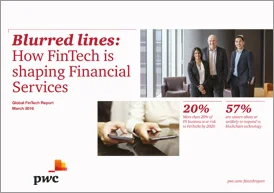
Global investment in FinTech is set to top $150bn over the next five years, putting one in four financial services (FS) companies potentially at risk, according to a report published this week by PwC.

The report, ‘Blurred Lines: How FinTech is shaping Financial Services’, is based on a survey of 544 respondents across 46 countries and examines the development of new financial services sector technologies and their potential impact on the FS market.

Pointedly, 83 percent of survey respondents said they felt at risk of losing some of their business to standalone FinTech firms, with 67 percent citing pressure on margins as being the top threat to business, followed by loss of market share (59 percent).

In terms of the relationship between FS firms and FinTech companies, while the report notes that joint partnerships are “the most common way” in which collaboration takes place, it also makes clear that there are particular challenges to overcome. Chief among these are IT security, regulatory uncertainty and differences in business models.

“Given how fast technology is changing and lines are blurring, no business can afford to rest on its laurels,” said Steve Davies, EMEA FinTech leader at PwC. “As competition hots up, the result will be a reduction in margins and a loss of market share for traditional financial institutions. Those who do not act now are at risk of falling behind as FinTech changes the industry from the outside. Incumbents cannot afford to ignore this trend. Nevertheless, our survey shows that 25 percent of firms currently have no interaction at all with FinTech companies.”

The PwC report also identifies the distributed ledger technology Blockchain as being the next evolution in the FinTech story, with huge cost savings and improvements in transparency being real possibilities – a “once-in-a-lifetime opportunity”, according to Mr Davies. Testament to this belief is PwC’s identification of more than 700 companies that have recently entered this space.

Mr Davies concluded: “In the past, financial services companies have provided invaluable services to clients by acting as intermediaries in the system. Their functions are now increasingly being usurped by technology-driven business models. Before these traditional intermediary roles become obsolete, firms need to wake up to the once in a generation opportunity provided by this changing financial landscape.”

Report: Blurred Lines: How FinTech is shaping Financial Services

People are the problem – report

BY Richard Summerfield

Global M&A activity has been one of the most notable stories of recent years. Dealmaking activity climbed sharply in 2015, rising to $4.7 trillion, up 42 percent on 2014. Companies have engaged in deals in new and complex markets, lured by the promise of reduced costs and value creation opportunities.

However, dealmaking today is rife with risk. A new report from Mercer, ‘People Risks in M&A Transactions’, looks at one of the most potent areas of risk: individuals often fail to adapt to organisational transition brought about by M&A, and this can create turmoil. 

If left unchecked, the inability of individuals to manage uncertainty and embrace change brought about by deal making can have a profoundly negative impact on an organisation.

Issues such as employee retention, cultural integration, leadership assessment, compensation, benefit levels and overall talent management are significant. Fifty-five percent of buyers surveyed by Mercer said that employee challenges continue to present significant risks in M&A deals.

Companies are completing deals in a highly competitive and demanding economic landscape. Increased competition and the influence of activist shareholders, for example, are combining to greatly curtail the length of time in which companies can carry out their due diligence procedures. They are under pressure to get deals done quickly.

Forty-one percent of acquiring companies claimed they have less time to complete due diligence compared to three years ago. Furthermore, 33 percent of acquirers believe sellers are providing less information about assets for sale.

“Both buyers and sellers tell us they need rich data, unique insights and practical guidance to maximise transaction value and reduce people-related risks. The goal of our research is to enable business leaders, inside and outside of the HR function, to make more informed people decisions in the current challenging global deal environment," said Jeff Cox, Mercer’s global M&A transaction services leader.

According to Mercer, companies should invest in their employees with the same enthusiasm they have for managing their balance sheet and other investments. By focusing on staff, companies can minimise disruption and increase value in people related areas.

Report: People Risks in M&A Transactions

Internationally immobile

BY Richard Summerfield

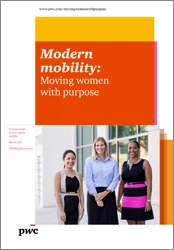
As employers look to develop the business leaders of tomorrow, they are increasingly using mobility to bolster their talent pipeline. However, according to a new report from PwC, companies are greatly neglecting one part of their work force: women.

PwC’s ‘Moving Women with Purpose’ notes that international mobility experiences can be of great benefit to both employees and employers, and by allowing staff to develop their careers overseas companies can create opportunities for staff to develop into future leaders and key talents. However, PwC’s data suggests that the number of women being transitioned into international opportunities is remarkably low, at just 20 percent of international assignees.

PwC interviewed 134 global mobility executives and 3937 professionals from over 40 countries and found a huge disparity in the number of women wanting to experience overseas work in the careers and those being afforded the opportunity to pursue such a position. Indeed, 71 percent of female ‘millennials’ – millennials, for the purposes of PwC’s report, are defined as being born between 1980 and 1995 – want to work outside their home country during the course of their careers, yet only 20 percent of the current internationally mobile population are women.

More and more women wish to be considered for international assignments, yet that demand is not being borne out in reality. More than half of the survey’s respondents said their female employees were being under-represented in their company’s mobility populations.

"This PwC report highlights a number of critical diversity disconnects. CEOs must drive an agenda where women are both aware of, and provided with, the critical experiences required to progress their career, including international assignment opportunities. Global mobility, diversity and talent management strategies must be connected to support the successful realisation of international business and people strategies," said Dennis Nally, chairman of PwC International.

Furthermore, only 49 percent of women surveyed believed that organisations had enough female role models with successful international assignment experiences. This shortcoming has a negative impact on employers’ female talent pools and global mobility programmes.

The report also vanquishes a number of myths around gender stereotypes, namely the suggestion that women with children would be unwilling to work overseas or that women would not seek an international assignment for fear of jeopardising a higher earning partner’s income at risk. Forty-one percent of the female respondents who noted that would want to undertake an international assignment were parents, compared with 40 percent of men.

Given the data contained within the report, the onus is on organisations to take steps to drive higher awareness of the positive experiences of female assignees moving forward.

Report: Moving Women with Purpose

©2001-2025 Financier Worldwide Ltd. All rights reserved. Any statements expressed on this website are understood to be general opinions and should not be relied upon as legal, financial or any other form of professional advice. Opinions expressed do not necessarily represent the views of the authors’ current or previous employers, or clients. The publisher, authors and authors' firms are not responsible for any loss third parties may suffer in connection with information or materials presented on this website, or use of any such information or materials by any third parties.