
How W&I insurance is reshaping deal dynamics
March 2026 | COVER STORY | MERGERS & ACQUISITIONS
Financier Worldwide Magazine
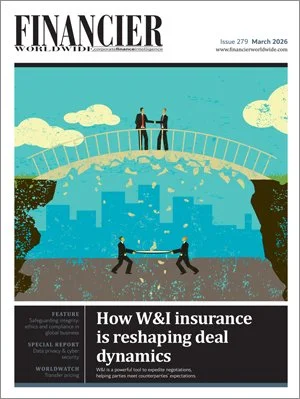
March 2026 Issue
As M&A becomes more complex, warranty and indemnity (W&I) insurance is transforming how transactions are structured and providing much needed protection for acquirers. Over time, W&I has become one of the most innovative solutions used to mitigate risk and maximise returns from M&A.
With record adoption across Europe in 2024, buyers and sellers increasingly rely on W&I to transfer post‑closing risk, including breaches of warranty and unknown off‑balance‑sheet liabilities. W&I’s ability to facilitate clean exits, reduce the need for escrows or price adjustments and provide greater certainty of payout is making deals smoother and more attractive. As underwriting capacity grows and competition intensifies, W&I is becoming a mainstream staple of M&A, reshaping deal dynamics and risk allocation.
W&I’s growing influence in European transactions
Across jurisdictions, the W&I market has experienced significant growth in recent years, reflecting wider recognition of its value in facilitating M&A across industries and sectors.
This growth is driven by the product’s practical benefits and by its evolving sophistication, with policies tailored to changing M&A dynamics amid economic, geopolitical and technological shifts. The number of W&I policies placed in 2023 was roughly four times that of 2016, according to WTW, underscoring rapid market development and the growing ease with which lawyers, advisers, corporates and private capital embrace W&I.
According to Norton Rose Fulbright, deal insurance continues to gain momentum as parties seek to shield themselves from risk in an increasingly unpredictable landscape. Dealmaking confidence has been shaken since early 2025, particularly following US tariff announcements and other geopolitical challenges. Norton Rose’s Global M&A Trends and Risks report found that 65 percent of respondents expected the use of W&I and representations and warranties (R&W) insurance to rise in 2025, a trend seen across every major market, including Europe.
Amid this uncertainty, W&I provides confidence. A policy enables the parties to transfer the risk of liabilities arising from breaches of representations and warranties to a third party – the insurer – within a reasonable timeframe and at a reasonable premium. Users are attracted by the clean exits it offers, together with benefits such as buyer recourse that does not damage relationships with retained management, the added scrutiny insurers bring that validates diligence quality and the ability to make more competitive offers in auction processes.
Buy‑side and sell‑side structures
There are two main types of W&I policy.
A buy‑side policy insures the buyer. The buyer makes a claim directly against the insurer and the insurer indemnifies the buyer for losses arising from breaches of the representations and warranties, with limited or no recourse against the seller. For buyers, W&I offers recourse to an insurer with the financial capacity to meet claims, delivering greater post‑completion certainty than reliance on a selling entity that may have distributed proceeds or exited the asset. In competitive auctions, W&I can provide a decisive edge by allowing buyers to present a cleaner, seller‑friendly offer without compromising protection.
A sell‑side policy insures the seller. The insurer indemnifies the seller for losses paid to the buyer arising from breaches of the representations and warranties. For sellers, W&I enables a near‑total cash exit at completion, significantly reducing or eliminating ongoing post‑closing liabilities and the need for escrows, holdbacks or complex indemnity structures. Negotiations are often streamlined, avoiding prolonged debates over liability caps and survival periods, allowing parties to focus on value rather than risk allocation.
“The market remains in an exploratory phase, balancing innovation against uncertainty. Organisations that can demonstrate robust AI governance frameworks, clear accountability, effective oversight and proactive risk mitigation are likely to be better positioned when engaging with insurers.”
Accordingly, W&I is a powerful tool to expedite negotiations, helping parties meet counterparties’ expectations. Although W&I was long used mainly by financial buyers such as private equity (PE) funds, recent years have seen a significant increase in strategic and corporate insureds. The market is evolving. Initially viewed as expensive and inflexible, W&I is now solution‑driven and increasingly popular, breaking out of its traditional markets – the UK, US and Australia – and finding broader global adoption, including across Europe.
W&I’s growing influence in European transactions
From a European perspective, W&I is reshaping the regional M&A landscape, evolving from a niche product into a mainstream deal tool that enhances certainty, efficiency and competitiveness.
From a broader market perspective, W&I has become a key facilitator of dealmaking across Europe, supporting transaction flow in increasingly competitive environments. Adoption has expanded beyond established jurisdictions such as the UK, gaining traction in France, Belgium and other European markets, and is now common even in the mid‑market. As insurer appetite widens, coverage has broadened to include more complex structures, emerging sectors such as technology and healthcare and, in some cases, previously excluded or known risks, reinforcing W&I’s role in driving deal certainty and market efficiency.
“In the Dutch market, W&I is highly prevalent and there is plenty of appetite from W&I market insurers,” says Lennart Crain, a partner at AKD. “For example, we have seen a number of insurers willing to offer coverage on the basis of limited or no specific due diligence for non-material jurisdictions. These are typically jurisdictions which represent less than 5-10 percent of group turnover and with limited employees.
“The reduced requirements can vary significantly and may involve a focused review of only the key highlighted topics by local advisers, a high‑level ‘common sense’ review of major risk areas by lead advisers from another jurisdiction, or no formal due diligence at all, provided that information is disclosed through a virtual data room (VDR). In some cases, insurers even offer ‘blind spot’ coverage where neither specific due diligence nor VDR disclosure is required. Notably, insurers still apply the de‑minimis threshold for any claims arising in these blind‑spot jurisdictions,” he adds.
Balancing exclusions with enhanced deal protection
While W&I offers significant benefits, parties must remain cognisant of challenges such as coverage limitations, claims processes, costs and transactional complexities.
As with any insurance product, close attention must be paid to the drafting of the policy, particularly its exclusions, limitations and conditions. While W&I is intended to mirror the warranty protections in a sale and purchase agreement (SPA) as closely as possible, insurers inevitably exclude certain warranties or categories of risk that fall outside underwriting appetite. These exclusions vary between insurers and policies, reflecting differing risk tolerances and sector experience.
Buyers should look beyond headline pricing and carefully assess the scope of cover, ensuring that material risks are adequately protected. A competitively priced policy may offer limited value if key exposures are carved out. Thorough review and comparison of exclusions is therefore essential, and buyers should satisfy themselves that the insurer has not excluded risks that are central to the deal or could materially affect value.
Additionally, W&I is not a guarantee against all losses. Policies provide defined protection within agreed parameters, so understanding limitations is essential to avoid misplaced reliance on cover. Claims‑related costs are also a consideration. Buyers must demonstrate that any claim falls squarely within scope, and the initial time, investigation and advisory costs involved in establishing coverage are typically uninsured. Policies also commonly include de-minimis thresholds aligned with the SPA, meaning smaller claims will not trigger recovery.
W&I responds once an agreed attachment point has been exceeded. This deductible – often negotiated but typically around 1 percent of transaction value – is a tranche of risk borne by the parties before the insurer becomes liable. In many deals this initial exposure is reflected in a seller escrow, ensuring alignment with the diligence process. Buyers may need to fund losses upfront until the threshold is reached, recovering only once the policy responds. Finally, W&I is subject to the same disclosure obligations as any commercial insurance. Full and accurate disclosure of all material facts is critical, as failure to do so may jeopardise enforceability. Taken together, these features underline the importance of viewing W&I as a sophisticated risk management tool rather than a blanket solution, requiring careful structuring and informed expectations to deliver value.
In Europe, availability and scope are influenced by practical and legal considerations. Deal size is significant. While insurers have expanded into the mid-market, many apply minimum thresholds, often requiring transaction values in the region of €10m-25m to justify underwriting and premium economics. Below this level, obtaining cover may prove challenging.
Deal structure and counterparty profile also affect appetite. Transactions involving state‑owned or state‑operated entities may attract closer scrutiny, reflecting concerns around moral hazard and enforcement. Jurisdictional nuances matter. In some countries, local frameworks shape how policies are structured; for example, the use of ‘synthetic warranties’ has historically raised questions in certain markets, though these challenges are commonly addressed through careful structuring and local expertise.
W&I is designed to protect against unknown risks. Matters known to the buyer at inception or clearly disclosed through the data room or due diligence are generally excluded, as are categories considered uninsurable by law or market practice, such as fines and penalties, forward‑looking statements, pre‑closing tax exposures, pension deficits and existing pollution liabilities.
Notwithstanding these limitations, W&I has become largely sector‑agnostic. It is particularly prevalent in real estate and energy and infrastructure transactions, where asset stability and limited management recourse favour insured solutions, and in PE deals, where clean seller exits are a priority. Uptake is also strong in technology and media, albeit with heightened diligence around intellectual property and data protection.
For those taking out a W&I policy in Europe, there are a number of issues to consider. “The W&I insurance market in the Netherlands is competitive, with several insurers entering the country to capture part of the region’s robust W&I activity,” explains Mr Crain. “As a result, buyers can often negotiate broader coverage and fewer exclusions, particularly when the due diligence process addresses the relevant risk areas. Standard exclusions still apply, however, and most W&I policy terms begin with baseline carve-outs such as transfer pricing and secondary tax liabilities, environmental risks involving hazardous substances, cyber incidents, and pension funding matters.
“Adequate due diligence on, for example, transfer pricing or a clean desktop environmental due diligence can typically lift these exclusions,” he continues. “An existing cyber policy where W&I provides excess cover can also be a solution to the cyber exclusion. Insureds – usually the buyer – should also challenge exclusions on the basis of the target business characteristics – for example, hazardous substance exclusion may not apply where the target does not own real estate or can be narrowed to only apply to asbestos, polychlorinated biphenyls or legionella on a leased site. Due diligence advisers should be instructed to address typical exclusions areas, as even a red flag review of these areas can remove a standard exclusion.”
Despite these challenges and exclusions, a range of enhancements is still available. Mr Crain explains that these can include applying a synthetic disclosure definition, providing both top‑up and ground‑up fundamental warranty coverage, and allowing for non‑disclosure of the VDR through a synthetic carve‑out from the disclosed information definition. In some cases, the due diligence reports may also be excluded from the disclosed information definition, and, in certain circumstances, both the VDR and the due diligence reports may be carved out together but this will come at a significant additional premium.
He adds that additional enhancements may involve new breach cover for issues that arise and are identified between signing and closing, as well as knowledge and materiality scrapes, and extensions of the general warranty period to three years and the employment and environmental warranty period to five years. Affirmative tax cover for certain known risks may also be available.
AI and the next phase of W&I market evolution
The growth of the W&I market over the last decade mirrors an insurance industry that continues to evolve and adapt – a trend that will continue as technological advancements, including artificial intelligence (AI), accelerate. AI is becoming ubiquitous, rapidly transforming workflows, driving innovation and reshaping industries, and the insurance space is no different.
As AI becomes more deeply embedded across operations, organisations that take a proactive approach to managing AI risk may play an important role in shaping how insurers respond to emerging liability exposures.
There are early indications that insurers are beginning to assess a company’s AI governance, controls and deployment practices when determining coverage and pricing, although the breadth and versatility of AI make standardised underwriting approaches difficult to establish. Unlike more mature technology risks, AI is not confined to a single function or system, but spans customer engagement, decision making, content generation and security, complicating traditional risk assessment models.
The market therefore remains in an exploratory phase, balancing innovation against uncertainty. Organisations that can demonstrate robust AI governance frameworks, clear accountability, effective oversight and proactive risk mitigation are likely to be better positioned when engaging with insurers. Over time, these practices may help to inform more consistent standards, influencing how AI-related liabilities are understood, priced and insured as the technology evolves.
AI powered due diligence is also becoming increasingly popular. It is more consistent than traditional procedures, more comprehensive and it speeds up underwriting. As the scope and quality of diligence is almost always the most important factor in obtaining a best in class W&I policy – one that provides broad coverage and a limited list of exclusions – companies would be wise to embrace AI.
In addition, the growing integration of AI across corporate functions means that insurers are beginning to examine not only how AI is used but how it is governed, documented and monitored throughout an organisation. This shift is encouraging deal teams to incorporate AI specific risk assessments into their transaction planning and due diligence processes, ensuring that potential exposures linked to algorithmic decision making, data provenance and model governance are properly identified and mitigated.
As businesses become increasingly digitised, the ability to demonstrate operational resilience and transparent AI oversight is likely to influence both the availability and the pricing of W&I cover. These developments signal that AI will shape not only underwriting practices but also how buyers and sellers prepare for transactions in an environment where technology driven risk is becoming more prominent.
As M&A volumes improve throughout 2026, W&I insurance will continue to play an important role in the dealmaking process in Europe and beyond. It is no longer the niche solution for dealmaking that it once was; today, W&I is a mainstream tool for enhancing deal certainty.
© Financier Worldwide
BY
Richard Summerfield