

Managing sanctions exposure across global supply chains
May 2026 | COVER STORY | GLOBAL TRADE
Financier Worldwide Magazine
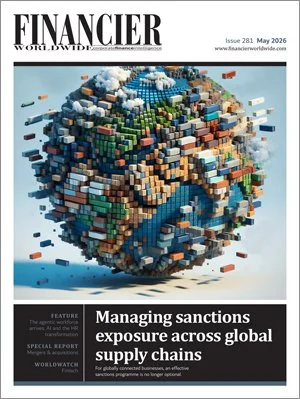
May 2026 Issue
Sanctions have rapidly become one of the most powerful foreign‑policy tools of the modern era – deployed to pressure states, regimes, companies and individuals without firing a shot. Their rise has been dramatic: LSEG’s Global Sanctions Index hit 446 in March 2025, a staggering 446 percent increase since 2017, reflecting the sheer speed at which sanctions volume and complexity have exploded. As a result, compliance is no longer a matter of simple list checks; it now demands constant vigilance, forensic evidence gathering and rapid decision making.
For globally connected businesses – especially those dependent on sprawling supply chains – an effective sanctions programme is no longer optional. Obligations are multiplying, expectations are rising and compliance teams are being pushed to deliver more assurance with fewer resources. To survive, organisations must adopt dynamic, risk‑based frameworks capable of detecting and preventing breaches across borders and business units, proving at every step that they understand their risks and are actively controlling them.
Uncovering vulnerabilities deeper in the supply chain
Many companies face challenges when establishing their compliance programmes, especially within multi-tier global supply chains. According to Kartikey Mahajan, a partner at Khaitan & Co., boards often concentrate on tier one suppliers and underestimate exposure deeper within the chain. “Sanctioned parties may sit invisibly within sub-tier sourcing, beneficial ownership, intermediaries and logistics touchpoints like freight forwarders, insurers and banks,” he explains. “Another blind spot is ‘services and software’ supply chains, such as cloud, IT support and engineering, beyond physical goods.
“A sanctions programme that genuinely reduces enterprise risk is not defined by the volume of screening or policies, but by governance and execution. It must include risk-based segmentation, credible assurance testing, and escalation routes that translate red flags into timely action. It integrates sanctions controls into all business functions – procurement, operations and logistics, finance, and legal contracting, and creates a defensible audit trail,” he adds.
Boards often underestimate exposure to sanctions evasion and circumvention, which have increased significantly since Russia’s invasion of Ukraine and have become a major regulatory priority. Risk typologies now include complex ownership structures, hidden beneficiaries, facilitators and mislabelled goods, end use or origin. As scrutiny intensifies – particularly regarding the provenance of raw materials such as Russian crude processed in third countries such as India – companies must look beyond direct counterparties and assess the entire supply chain, including transport routes, intermediaries and financial backers. Effective sanctions programmes embed this analysis across operations, supported by tools and processes that extend far beyond basic screening.
Sharper sight in an increasingly opaque landscape
In a period of escalating geopolitical tensions and rapidly changing trade restrictions, supply chain visibility has become far more than an operational efficiency tool. Visibility should be a frontline defence against sanctions risk. For companies operating across complex, multi-tier global networks, understanding who their suppliers are, where goods originate and how transactions move is essential for maintaining compliance and protecting both reputation and revenue.
According to Adam M. Smith, a partner at Gibson, Dunn & Crutcher LLP, one problem is that there is no universal standard for visibility, nor a clear test of what constitutes ‘enough’ from a sanctions risk perspective. “In many jurisdictions, such as the US, sanctions can be enforced on a strict liability basis,” he explains. “Despite this, the Office of Foreign Assets Control (OFAC) and other regulators emphasise a risk-based approach tailored to an organisation’s size, sector, geographic exposure, product mix and other factors.
“In practice, this means that in order to develop a programme that is most defensible to OFAC and other regulators requires a company to have visibility into supply chain vulnerabilities, at least to suppliers’ direct suppliers,” he continues. “This is all the more the case when operating in high-risk industries and high-risk geographies, and where trade diversion is present. Consequently, investing in, among other elements, multi-tier supply chain mapping tools, due diligence on suppliers, and periodic auditing and testing will help close gaps and develop programmes in line with regulator expectations.”
As Mathilde Gerritsma, outreach and China associate at Sanctions SOS, points out, visibility not only means full end-to-end mapping of every link in a supply chain – it also requires deep insight into high-risk jurisdictions, routing structures, intermediaries and suppliers with heightened geopolitical exposure. “Senior leaders should prioritise investment in ownership intelligence, strong open-source intelligence and investigative practices, trade flow analytics, and enhanced-due diligence, including on counterparties and logistics partners,” she says.
“It is essential that effective sanctions compliance and linked controls sit across commercial, finance, and operational decision making – while ensuring that compliance functions have ultimate responsibility to deliver effective compliance. This is also key when considering entering new markets,” she adds.
Where technology meets effective risk control
As sanctions regimes grow more complex and enforcement more assertive, managing exposure across global supply chains has become a board-level priority. Harnessing advanced technology and data analytics can help executives move beyond reactive compliance toward real-time visibility, risk-based monitoring and proactive oversight that strengthens resilience across global operations.
“As sanctions regimes grow more complex and enforcement more assertive, managing exposure across global supply chains has become a board-level priority.”
Though technology and analytics represent significant opportunities to enhance sanctions compliance and oversight, Ian Bolton, founder and chief executive of Sanctions SOS, warns against overreliance. “When used correctly, technology and analytics which are embedded in operational and enterprise systems can significantly strengthen sanctions oversight and risk management,” he says. “It is important to remember that over-automation can cause false confidence without review by experts and contextual analysis.
“In addition, such tools and analytics can make it easier to manage sanctions divergence, which can be supported with a structured jurisdictional risk framework that should align with the company’s jurisdictional nexus and enforcement exposure,” he adds.
Daniel Martin, a partner at Holman Fenwick Willan LLP, sees the volume of information as one of the central challenges in sanctions compliance. “Successful organisations harness the information they already have, to avoid duplication and inefficiency, and use their experience, for example of deceptive practices or inadequate information, to avoid problems before they arise,” he observes. “They are also mindful that sanctions analysts are confronted with huge amounts of data every day and need to avoid ‘information blindness’.
“Organisations need to carry out a careful risk analysis if they are dealing with conflicting or overlapping sanctions regimes, and consider whether the business can be structured to minimise conflict,” he adds.
Technology and data analytics now uncover what traditional processes often miss – subtle variations in entity names, concealed ownership layers and fast‑shifting networks of intermediaries. To keep pace, organisations must move beyond periodic checks and adopt continuous, event‑driven monitoring that reacts to real‑world triggers.
Strong governance is essential: clear escalation routes, targeted case sampling and rigorous model testing prevent overreliance on automated tools and reduce false positives. Where multiple sanctions regimes overlap, boards should maintain a conflicts playbook that sets risk appetite, jurisdictional priorities, blocking‑law guidance, licensing strategy and practical mitigations such as ringfencing. Thorough documentation remains a critical safeguard against regulatory challenge.
Effective governance depends on clearly defined roles, decision rights and oversight mechanisms that embed accountability across regions, business units and third‑party relationships. Sanctions compliance must be woven into enterprise‑wide risk management, not treated as a siloed control.
The longstanding ‘three lines of defence’ model still forms the backbone of strong programmes: operational teams identify day to day risks, compliance and legal functions set and monitor policy, and internal audit independently tests effectiveness. Regulators consistently assess the quality of a firm’s risk assessment, leadership oversight, culture and resourcing. Ultimately, proactive risk assessment, disciplined escalation, and well‑trained staff underpin a resilient and credible sanctions‑compliance framework.
Managing the fallout from suspected sanctions violations
Even the strongest compliance frameworks cannot entirely eliminate sanctions risk, which makes preparedness for potential breaches essential. A well-designed response strategy that combines rapid internal escalation, disciplined investigation, transparent engagement with regulators and timely remediation can significantly mitigate legal, financial and reputational consequences while reinforcing a culture of accountability and continuous improvement.
Mr Mahajan emphasises that senior leaders should prioritise containment and credibility during any suspected breach. They must pause any potentially prohibited transaction, preserve data and documents through a legal hold, and engage counsel to begin a privileged investigation with escalation to senior management or the board. “This would help determine the scope of applicable sanctions regimes, counterparties and owners, products or services involved, routing and payment paths, and whether the conduct amounts to facilitation or re-export,” he says.
“Simultaneously, they need to manage contractual and operational consequences, including inventory in transit and termination rights, and align crisis communications to avoid inconsistent statements. It is also important to evaluate licensing and self-disclosure options early and initiate regulator engagement, if necessary,” he adds.
Transparency and timely analysis are key. “Should a company find itself potentially breaching sanctions, it is vital that senior leadership is informed and that an incident management process is completed to understand how the potential breach occurred, ensure it cannot happen again and understand the reporting requirements and potential reputational risk,” stresses Mr Bolton. “In particular, it is our experience that early engagement with regulators is important, and providing a full accounting of the issue wherever possible.”
Senior leaders must assess whether a potential breach is isolated or symptomatic of wider control weaknesses. Immediate action is necessary to halt the breach, which may include blocking payments or freezing shipments. Next steps include reviewing contract terms to assess liability, identifying remediation measures to prevent recurrence and planning engagement with regulators, stakeholders and affected counterparties.
“Preparation for a sanctions breach should be planned well in advance,” suggests Cari Stinebower, a partner at Winston & Strawn LLP. “The key to managing it is to have a formal plan in writing, available to relevant personnel, and tested periodically through tabletop exercises so when it occurs, personnel are well-versed and act efficiently. It should include notification of relevant personnel, implementation of a document hold, and a freeze on transactions involving the sanctioned element.
“Next, a tailored internal investigation plan should be drafted and should address other relevant regulatory teams,” she continues. “Finally, senior leadership should consider whether representations and warranties with counterparties were breached, such as banks, insurers, customers and so on.”
Emerging fault lines in the sanctions landscape
The sanctions landscape is likely to become more fragmented, politicised and technologically sophisticated, reshaping risk across global supply chains. Escalating geopolitical rivalries, the expansion of secondary sanctions, and the growing use of export controls and investment restrictions as strategic tools will continue to test supply chain resilience.
“Companies should expect continuing and increasing supply chain friction and operational challenges as a result of ongoing conflicts and tensions, including in the Ukraine and Middle East, and economic and strategic competition between the US and traditional allies and China,” says Mr Smith. “Existing complexities will only grow as regulators focus on supply chain management and cross-border investment flows, particular when involving AI, semiconductors, quantum computing, biotechnology, rare earths, avionics and other sensitive, high-tech or defence-related industries and dual-use goods and services.
“We expect to continue to see the full panoply of trade-related tools being brought to bear – including sanctions, import and export controls, foreign direct investment controls, and tariffs. We also expect a continued proliferation of various ‘anti-sanctions’ measures by countries such as China, further exacerbating supply chain complexities,” he adds.
The sanctions landscape will grow more challenging over the next three to five years, with faster policy changes, wider jurisdictional divergence and increased extraterritorial measures such as secondary sanctions. High-risk sectors include technology, dual-use goods and critical minerals, alongside ongoing Russia-related restrictions and emerging Middle East and Indo-Pacific pressures.
Regulators are expected to intensify scrutiny of circumvention tactics, including transhipment hubs, free trade zones, unusual routing and questionable ownership or end-use claims, and to increase enforcement across enabling sectors. This will require stronger data traceability and closer oversight of third parties.
“We are seeing a convergence in enforcement approaches among export controls and sanctions regulators,” says Ms Stinebower. “This is evident in the Affiliates’ Rule, set to begin in November 2026, as it adopts the OFAC 50 percent rule. Due diligence implications for the global supply chain are significant as export controls programmes are not designed to look at the 50 percent ownership when screening against Bureau of Industry and Security lists.
“Geopolitically, movement of supply chain away from China can be expected to remain a priority. Given China’s comprehensive role in manufacturing, it will be difficult in the short term to avoid components and parts of Chinese origin,” she adds.
As Mr Martin points out, tensions between the US and China will continue to create risks for global supply chains, as will increasing concerns about collaboration between sanctioned countries. “Likewise any divergence between the US, EU and UK over sanctions measures will create additional challenges for global organisations and global supply chains,” he notes. “We can expect to see increased sanctions enforcement by the UK and the EU, potentially with increased penalties and regulators using powers to enforce on a strict liability basis, and that may trigger more concerns about circumvention and sanctions evasion. There will be plenty to keep people busy.”
Looking ahead, companies and their leadership teams must maintain a clear view of where sanctions risk is heading and recognise that the landscape will only grow more dynamic and complex. This means treating sanctions as a strategic, forward‑looking risk that demands continual reassessment.
Scenario planning should become a routine discipline, helping organisations anticipate how geopolitical shifts, regulatory divergence or emerging circumvention patterns could affect their operations. Data‑driven monitoring – capable of detecting subtle changes in behaviour, ownership or supply chain activity – needs to be embedded directly into day to day workflows rather than applied as an occasional check. Equally important is agile governance: decision‑making structures that can respond quickly to new measures, escalate concerns effectively and adapt controls without delay.
Organisations that integrate these capabilities into their operating models will be far better placed to navigate sanctions risk with confidence and resilience.
© Financier Worldwide
BY
Richard Summerfield