

Orphans of the storm: the rise of ‘mega bankruptcies’
February 2026 | COVER STORY | BANKRUPTCY & RESTRUCTURING
Financier Worldwide Magazine
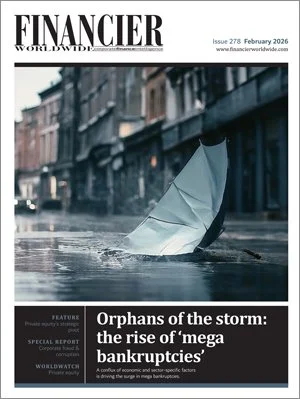
February 2026 Issue
Buffeted by major interlocking economic and geopolitical headwinds, the corporate world has faced a challenging environment. Companies across the globe have struggled to operate and grow, with some forced into bankruptcy filings as a means of survival.
The pressure has not been evenly distributed. Cash‑generative companies with modest leverage have largely absorbed higher funding costs, whereas firms reliant on continuous refinancing have faced a harsher reckoning. Working capital cycles have lengthened in sectors exposed to tariff friction or supply chain rerouting, and this has left more businesses vulnerable to covenant breaches and liquidity scrapes. In practice, the tide has gone out on easy money, revealing fragile balance sheets that survived the pandemic only because extraordinary support masked underlying weaknesses.
Over the past 18 months, bankruptcies have climbed in most countries. According to Allianz’s ‘Global Insolvency Outlook 2026-27: Don’t look down!’ report, the first half of 2025 saw its Global Insolvency Index rise by 5 percent year on year (YOY), maintaining similar momentum across Q1 and Q2.
While this represents a softer increase compared to previous quarters, it marks the 12th consecutive quarter of rising insolvencies since mid-2022. Consequently, Allianz’s headline indicator has increased by 7 percent when considering the cumulative four quarters.
That persistence matters because sustained elevation in insolvency levels tends to reshape competitive landscapes. When major distributors or component makers fail, second‑order effects ripple through customer networks, often pushing otherwise viable counterparties into distress. Insolvency professionals now warn that portfolio exposure to vulnerable counterparties must be monitored with the same intensity as credit metrics on the primary borrower – a shift that is forcing boards to invest in more granular supplier risk analytics and tighter trade credit controls.
“Financial distress is on the rise globally,” says Simon Heath, a partner at the Heligan Group. “Economic headwinds, punitive tax rises for business, declining consumer sentiment and generally higher interest rates means bankruptcies are at their highest post-pandemic level. However, this is likely to be the tip of the iceberg with an impending global recession likely in 2026 which will ramp up the prevalence of corporate failure.”
Allianz’s preliminary figures for the coming months indicate that the upward trend in bankruptcies is expected to persist globally, with two-thirds of countries recording YOY increases when looking at cumulative 12-month data, and more than half showing YOY increases in year-to-date (YTD) figures.
These YTD statistics, continues Allianz, reveal significant jumps across all regions, particularly in Asia (39 percent YOY, with Hong Kong and Singapore at 33 percent), Western Europe (38 percent and 26 percent in Italy and Switzerland), as well as the Americas (16 percent).
In the US, between the second half of 2024 and the first half of 2025, there was a 4 percent increase in Chapter 7 and Chapter 11 filings among public and private companies with assets exceeding $100m, according to Cornerstone Research’s ‘Trends in Large Corporate Bankruptcy and Financial Distress – Midyear 2025 Update’. Cornerstone reveals that 117 companies in the $100m-plus assets range filed for bankruptcy between 2H 2024 and 1H 2025, up from 113 in the previous 12 months – a 44 percent increase over the 20-year average and 44 percent above the 2005-24 annual average of 81 bankruptcies.
“The speed at which US bankruptcy filings are coming through is certainly cause for concern, especially given we are now roughly three years on from the pandemic,” observes Yerbol Orynbayev, a financial services consultant. “We can always expect Chapter 7 and 11 bankruptcies to spike in the midst of a crisis, but I would have expected the numbers to have settled down, as they did following the 2008 financial crisis.”
“A conflux of economic and sector-specific factors is driving the surge in mega bankruptcies, including rising interest rates, shifting consumer behaviour and the geopolitical climate – the latter characterised by US administration policy frameworks such as widespread aggressive tariffs.”
Warranting particular attention amid a burgeoning bankruptcy landscape is the surge in ‘mega bankruptcies’ – filings by companies with over $1bn in reported assets – a trend that Cornerstone confirms has grown 33 percent over the past 12 months.
“Companies with business models dependent on discretionary consumer spending are at the highest risk of bankruptcy as consumer spending is under significant pressure from low growth economies and increasing inflation,” notes Mr Heath. “In the UK, high-profile brands such as Claire’s and Pizza Hut have recently rationalised their retail footprints as consumer confidence plunges. In the US, Sunnova Energy International and Nikola Corporation are among the high-profile mega bankruptcies.”
Driving the surge
A conflux of economic and sector-specific factors is driving the surge in mega bankruptcies, including rising interest rates, shifting consumer behaviour and the geopolitical climate – the latter characterised by US administration policy frameworks such as widespread aggressive tariffs.
“Large corporate bankruptcies over $1bn are at an all-time high,” affirms Christopher Ward, a managing partner at Polsinelli. “High interest rates and inflation are increasing borrowing costs while weaker consumer demand is also serving to stress the markets. While interest rates have begun to tick down, the extended government shutdown in October and November 2025 provided further cracks in an otherwise strong economic façade.”
According to Cornerstone, over the past 12 months there were 32 mega bankruptcies in the US, up from 24 in the prior 12 months and well above the 2005-24 historical average of 23. In the first half of 2025, there were 17 mega bankruptcies, the highest number of any half-year period since the pandemic outbreak in 2020.
The manufacturing industry, notes Cornerstone, had the highest share of mega bankruptcy filings across all industries, accounting for 30 percent of the overall total. Moreover, 67 percent of manufacturers filing mega bankruptcies cited the regulatory, legal and policy landscape as a key driver of financial distress.
Another sector experiencing a significant share of mega bankruptcies is the renewables sector, with Sunnova Energy International and Nikola Corporation in the US two of the more high-profile examples.
In many instances, however, mega bankruptcies are the result of a cyclical correction rather than a sign of deeper systemic change in consumer behaviour, capital markets and policy frameworks. “Prior to 2020, companies that experienced operational issues used Paycheck Protection Program loans and other governmental pandemic-related funding to mask operational and systemic issues,” explains Mark S. Indelicato, a managing partner at Thompson Coburn LLP. “These companies were operating in a low interest rate environment in which large amounts of debt were sustainable.
“As a result of rising interest rates and inflationary pressures, these entities could no longer avoid bankruptcy and had to address their overleveraged debt structure and operational issues,” he continues. “In fact, we saw several familiar names file repeat bankruptcies recently, including Rite Aid, Party City and Forever 21.”
In the UK, attests Mr Heath, with consumer spending under significant pressure from a low growth economy and elevated inflation, those companies with business models dependent on discretionary consumer spending are at the highest risk of bankruptcy.
Restructuring options
A range of restructuring options are available to large corporates facing distress – financial, operational, organisational and strategic – with out-of-court restructuring transactions finding particular favour.
“Traditional bankruptcy is still available to large corporates but cost is making it difficult for middle market companies to use it as an avenue to restructure their operations,” says Mr Indelicato. “Restructuring professionals are continuously looking for quick ways in and out of bankruptcy or any restructuring transaction, so that they can return to normal operations and deploy their capital to operations instead of restructuring expenses.”
To achieve a swift optimisation of companies’ balance sheets without recourse to formal bankruptcy proceedings, restructuring professionals are increasingly turning to out-of-court liability management transactions (LMTs) – the use of which, according to Cornerstone, reached a record level in the US in 2024 and 27 in 1H 2025, with 46 completed transactions.
“An LMT gives a company the opportunity to implement operational improvements such that a bankruptcy filing is unnecessary – the perfect out-of-court workout for a large company,” says Mr Indelicato. “Ideally, an LMT will be a quicker, more streamlined bankruptcy proceeding, but on occasion, they can become more complex and contentious because of the different views of competing creditor and equity classes.”
In the UK, large corporates have a range of restructuring options. “The first approach should be to undertake an informal option such as a debt renegotiation or debt-for-equity swap to improve the company’s capital adequacy,” says Mr Heath. “If this is not achievable, a formal restructuring could be undertaken via a company voluntary arrangement or a scheme of arrangement which requires creditor approval. Beyond this, a trading administration can be implemented to find a solvent restructuring solution or ultimately liquidation for the closure of the company.”
Opportunistic M&A
The significant increase in mega bankruptcies is also a primary driver of current opportunistic M&A activity, which sees buyers leveraging market volatility and increasing numbers of financially distressed companies to acquire assets or entire businesses at potentially discounted prices.
“M&A in general, and distressed M&A in particular, paused slightly when the Federal Reserve started increasing interest rates as a result of the instability that such rate increases caused,” points out Mr Indelicato. “Distressed M&A transactions, however, are making a comeback. Highly leveraged companies are looking to divest themselves of certain business lines that either are not as profitable or do not match the long-term strategic plan of the company to generate cash to reduce debt.”
Concurrently, in Europe, distressed M&A is prominent and expected to remain a defining feature of the market. Opportunistic buyers are circling, mobilising capital and expertise to unlock value in struggling but salvageable businesses with slowing growth, elevated input costs and tight financing conditions.
Regulatory relief
While the regulatory, legal and policy landscape was cited by around half of mega bankruptcies in their first-day declarations, according to Cornerstone, a less restrictive environment, while potentially providing some relief for distressed companies, could also be a double-edged sword.
In the view of Mr Orynbayev, the current US administration’s deregulatory agenda could both help distressed companies in the short term and undermine their survival over the longer term. “For now, freeing up banks’ balance sheets by reducing capital requirements and changing disclosure rules, so they no longer have to report troubled loans, could encourage banks to take on more risk, benefitting distressed firms,” he asserts. “But we must be completely honest with ourselves – over the next few years, these could turn out to be a catastrophic set of missteps.”
If, ponders Mr Orynbayev, banks use looser regulation to lend to borrowers unable to service their debt, mega bankruptcies on an even greater scale are likely. “Distressed companies will end up in an even more severe position, and this may threaten the survival of entire financial institutions,” he warns. “We have already seen US regional bank shares fall sharply after it was revealed Western Alliance Bank and Zions Bank were exposed to alleged fraud by borrowers. There is clearly already instability across some banks’ loan books and now is not the time to encourage more risk-taking.”
Stress or stabilisation?
At the outset of 2026, monitoring interest rates, consumer sentiment and credit availability will be key to determining whether the pace of bankruptcy filings will persist or give way to a period of stabilisation.
“On the one hand, interest rates will likely continue to decrease this year, potentially significantly, which could further affect inflation,” opines Mr Ward. “On the other, if tariffs survive the long haul, they may offset any benefit of interest rate reductions and lead to higher inflation.
“Lower interest rates may help with consumer confidence and lead to an increase in weaker consumer demand,” he continues. “This would bolster the economy and potentially lessen the impact of large Chapter 11 filings in the coming year. But unforeseen problems could be the straw that breaks the camel’s back in an uneasy economy.”
Scenario planning now separates resilient companies from the rest. In a benign case – rates easing, energy costs steady, and tariffs contained – consumer‑facing businesses could stabilise as confidence returns. In a tougher case – persistent tariff pass‑through, choppy demand and patchy credit supply – discretionary categories will remain under strain. The prudent chief financial officer will prepare for both by locking in term funding, tightening inventory turns and sequencing efficiency programmes that drop cash to the bottom line within two quarters.
Even so, most indicators suggest that bankruptcy levels are set to remain elevated. According to Allianz, global business insolvencies will rise by 5 percent in 2026 (broadly in line with 2025 levels), before a modest 1 percent decline in 2027.
“A slower than expected reduction in interest rates from the Federal Reserve in 2026, coupled with the uncertainty created by geopolitical forces, will continue to stress marginal companies,” foresees Mr Indelicato. “This will lead to more restructurings and bankruptcies, likely prolonging the use of LMTs to raise much-needed capital.”
Likewise, conditions in the UK are expected to remain subdued. “Further tax increases in the November 2025 budget will likely tighten consumer and business spending, accelerating the number of bankruptcies and administrations,” contends Mr Heath. “The UK economy is at real risk of a doom loop, which will have a devastating impact on the business community.”
Also wary is Mr Orynbayev, noting that excess debt is the common factor in all financial crises, while serving up the 1997 Asian meltdown, 2008 financial crash and 2010-12 European sovereign debt catastrophes as prime examples. “Worryingly, today’s environment bears striking similarities,” he notes. “We face record-high public and private debt levels, tighter financial conditions and eroding investor confidence. If defaults begin to cascade, the resulting debt-deflation spiral could quickly destabilise markets, choke off lending and push the global economy into a prolonged downturn.”
The rise of mega bankruptcies signals a structural stress test for global business models. Elevated leverage, volatile policy frameworks and fragile consumer sentiment have combined to create a harsher operating climate. While LMTs and opportunistic M&A offer lifelines, they demand precision and transparency. For boards and investors, resilience now depends on proactive liquidity planning, disciplined governance and a readiness to pivot strategy before the storm intensifies.
© Financier Worldwide
BY
Fraser Tennant