

Outlook for restructuring and insolvency in the Middle East
January 2026 | TALKINGPOINT | BANKRUPTCY & RESTRUCTURING
Financier Worldwide Magazine

January 2026 Issue
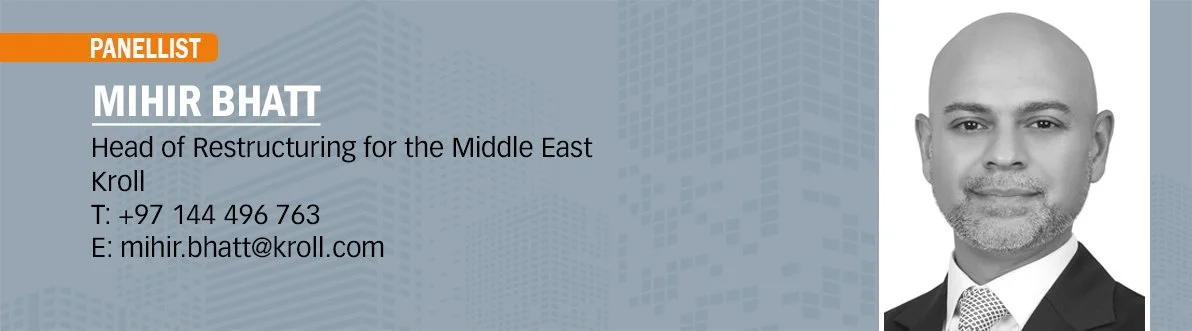
FW discusses the outlook for restructuring and insolvency in the Middle East with Mihir Bhatt at Kroll.
FW: In your experience, which sectors are currently most vulnerable to insolvency in the Middle East? What restructuring strategies are proving most effective?
Bhatt: Small and medium-sized enterprises remain highly exposed due to limited access to capital markets, high leverage and thin liquidity buffers. Extended creditor payment cycles – a persistent regional issue – can quickly turn working capital strain into insolvency. Commodity trading firms and the construction supply chain also face acute stress. While real estate headlines appear strong, downstream contractors and suppliers grapple with project delays, margin compression from global material inflation, and counterparty risk. Restructuring strategies increasingly emphasise early intervention through preventive settlement procedures, liability management exercises and court-supervised negotiations under United Arab Emirates (UAE) and Kingdom of Saudi Arabia (KSA) frameworks. These tools, modelled on Chapter 11 principles, allow businesses to stabilise operations while preserving enterprise value. Proactive engagement with creditors and transparent governance remain critical to success.
FW: How are operational and governance weaknesses – rather than pure liquidity issues – emerging as critical drivers of distress in Middle Eastern businesses? What strategies can mitigate these risks?
Bhatt: In many legacy businesses, particularly family-owned conglomerates, governance structures lack independence and rigour. This often manifests as a failure to appoint independent board directors or implement robust internal controls, leading to suboptimal strategic allocation of capital or unchecked related-party transactions. This governance gap impairs sound decision making long before liquidity becomes an issue. Historically, protected market positions allowed businesses to thrive despite inefficient operating models. As competition intensifies, a lack of investment in supply chain optimisation, advanced planning systems and process automation becomes a critical financial drag, undermining margin performance. One area to focus on as an immediate priority is strengthening the corporate structure by mandating and empowering independent board members and advisory committees, enhancing objectivity and accountability.
FW: To what extent is the stigma around insolvency and restructuring still a barrier in the region? How can cultural perceptions shift to encourage early intervention and value preservation?
Bhatt: Fear of reputational damage, coupled with historical risks of punitive measures such as travel bans or criminal liability for default, incentivised management to conceal financial distress until the company reached a point of no return. The uncertainty of recovery and the perception of a non-flexible legal system historically deterred international distressed debt investors, limiting the sources of capital available for turnaround situations. However, this is slowly changing. Modern bankruptcy laws are crucial because they fundamentally reframe insolvency from a personal failure into a legal and commercial process aimed at economic preservation and allows capital to be recycled. By providing a clear and non-punitive path for good-faith directors, they encourage management to seek assistance at the first sign of financial difficulty. Communicating successful, high-profile corporate turnarounds that utilise the new legal mechanisms serves as powerful social proof. Highlighting cases where value was successfully preserved and jobs were saved helps normalise the process, positioning restructuring as a sophisticated financial solution rather than an admission of defeat.
“Restructuring strategies increasingly emphasise early intervention through preventive settlement procedures, liability management exercises and court-supervised negotiations under United Arab Emirates and Kingdom of Saudi Arabia frameworks.”
FW: How are recent legislative reforms in the Middle East reshaping the restructuring landscape? What practical challenges remain in implementation?
Bhatt: The UAE and KSA have introduced significant reforms to modernise restructuring and insolvency frameworks. In the UAE, Federal Decree-Law No. 51 of 2023 created a dedicated Bankruptcy Court and introduced ‘preventive settlement’ procedures, allowing distressed businesses to continue operations under court supervision while negotiating with creditors. KSA’s Bankruptcy Law, aligned with ‘Vision 2030’, prioritises restructuring over liquidation and includes tools such as cram-down provisions, rescue financing and streamlined processes for SMEs. These measures are strengthening investor confidence across the region. Implementation challenges remain; inconsistent interpretation of new provisions and limited awareness hinder effective application of the laws. To overcome these barriers, authorities in the Middle East must prioritise judicial training, enhance digital case management systems and promote education among all stakeholders to normalise restructuring as a viable business recovery tool.
FW: How are Middle Eastern jurisdictions addressing cross-border insolvency challenges? What role do international best practices – such as Chapter 11-style frameworks – play in these reforms?
Bhatt: Middle Eastern jurisdictions are increasingly adopting international best practices to tackle cross-border insolvency challenges. The KSA has adopted legislation based on the United Nations Commission on International Trade Law (UNCITRAL) on Cross-Border Insolvency, which allows foreign officeholders to seek recognition of overseas proceedings and access judicial assistance, including asset control and enforcement of foreign judgments. Similarly, the UAE’s common law jurisdictions, such as the Dubai International Financial Centre and Abu Dhabi Global Market – have incorporated the UNCITRAL model, providing a predictable framework for multijurisdictional restructurings. These steps align with global norms and enhance creditor confidence. Onshore UAE reforms, such as the 2024 Bankruptcy Law and dedicated bankruptcy courts, mirror Chapter 11-style principles by prioritising business rescue over liquidation. However, practical gaps remain: onshore UAE still lacks a formal mechanism for recognising foreign insolvency orders, relying instead on general civil procedures. Bridging these gaps and harmonising enforcement across jurisdictions will be critical to fully realising the benefits of these reforms.
FW: How do you see the evolution of pre-insolvency tools – such as early warning systems and liability management exercises – changing the way companies approach financial distress?
Bhatt: Pre-insolvency tools are changing the way companies in the Middle East address financial distress. The frameworks under the KSA and UAE bankruptcy laws such as ‘financial restructuring procedures’ have normalised early debtor-creditor engagement, giving management teams a structured path to negotiate before value erosion becomes irreversible. These frameworks are helping to reduce the stigma traditionally associated with raising a hand early and has pushed boards to assess liquidity, governance and performance gaps sooner. At the same time, regional lenders have stepped up. Most major banks in the UAE and KSA now run formal early-warning systems, portfolio-watch committees and credit-risk units that track soft signals – such as covenant drift and margin compression – well before a default. As a result, liability management exercises, amendments, maturity extensions and bilateral negotiations are happening earlier and with clearer data. Together, these shifts are moving the region away from reactive crisis management toward proactive, continuous financial discipline, improving recoveries for lenders and preserving value for companies.
FW: What role is technology, including electronic case management systems and AI-driven tools, playing in streamlining insolvency proceedings and improving transparency across the region?
Bhatt: Technology adoption in insolvency remains nascent but promising. Electronic case management systems, particularly in the KSA, have helped improve transparency and procedural efficiency, but we are far from a fully digitalised landscape. Where we are seeing more tangible progress is in the advisory space. Artificial intelligence (AI)-driven analytics are helping process complex data faster, conduct research more efficiently and make quicker, better-informed decisions in tight timeframes. That said, AI is not a substitute for human expertise. We have seen instances in the market where unmonitored AI tools produced unreliable or misleading results.
Mihir Bhatt is a managing director with Kroll, and the head of restructuring for the Middle East. With 20 years of experience – 15 in the Middle East – he specialises in capital restructuring, turnaround strategies and operational improvement. He has extensive experience with public and private clients across Saudi Arabia, the UAE and Qatar, and is known for this collaborative and effective approach in solving complex problems. He can be contacted on +97 144 496 763 or by email: mihir.bhatt@kroll.com.
© Financier Worldwide