


Hostile M&A and shareholder activism
May 2026 | TALKINGPOINT | BOARDROOM INTELLIGENCE
Financier Worldwide Magazine

May 2026 Issue
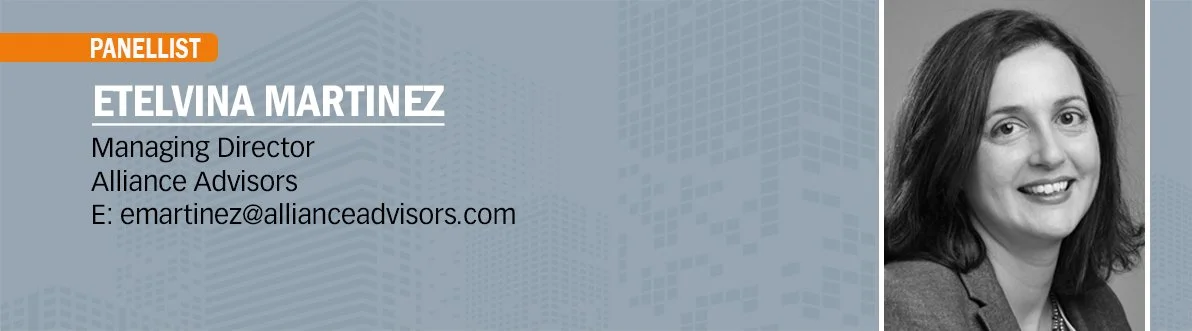
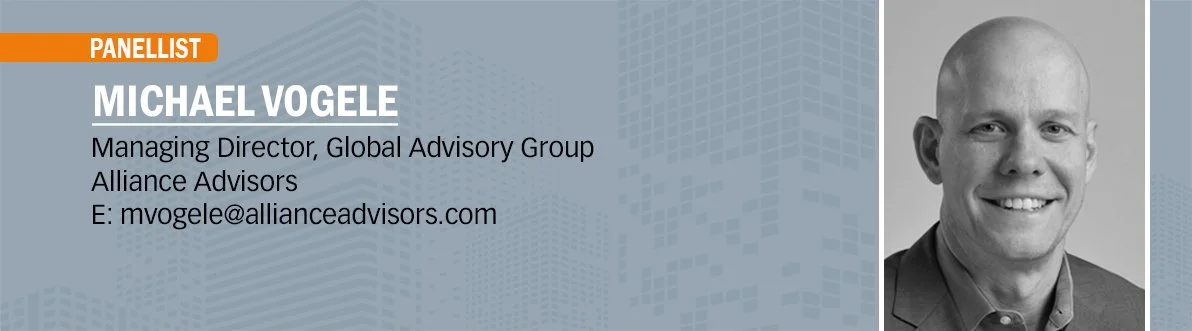
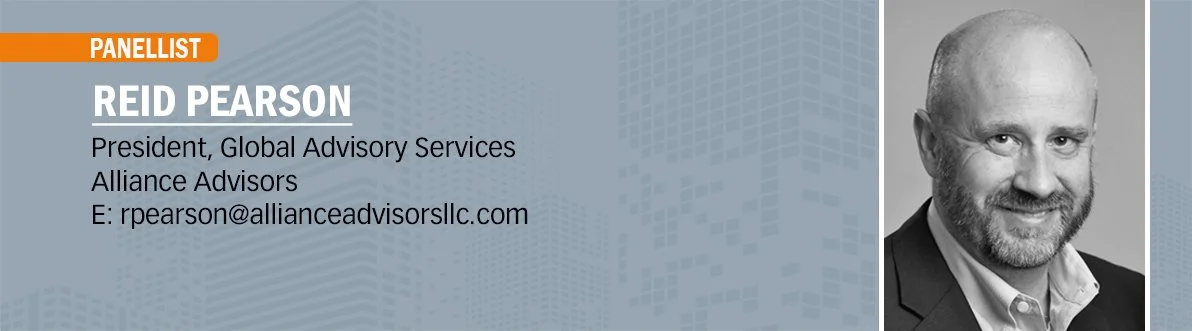
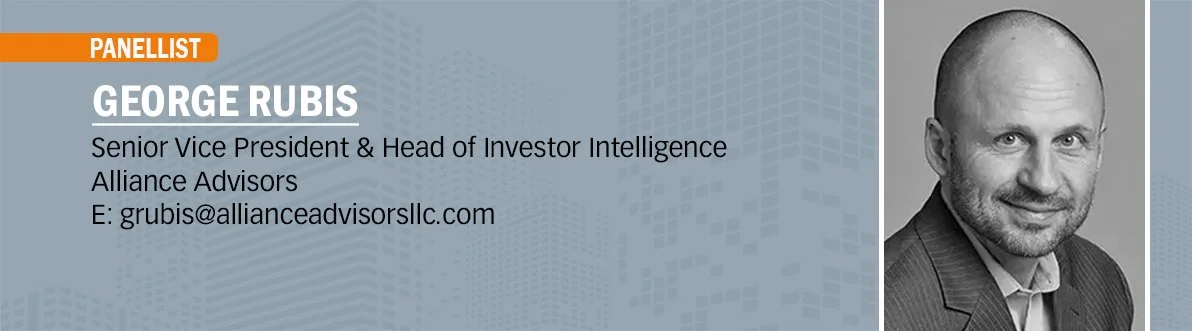
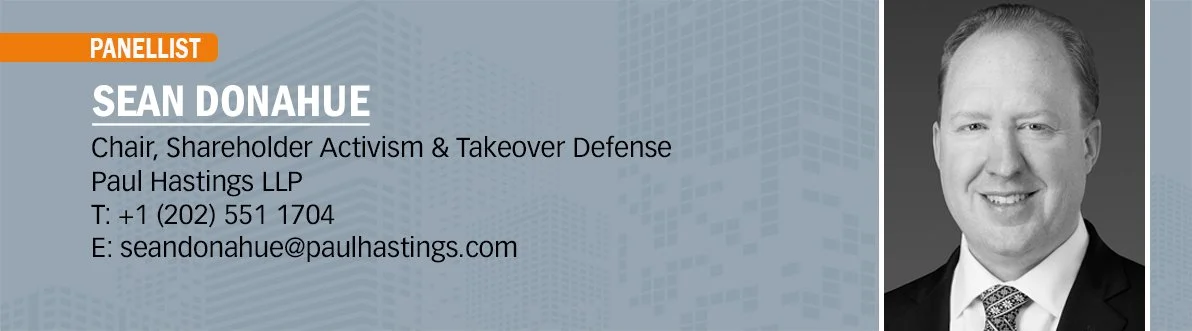
FW discusses hostile M&A and shareholder activism with Etelvina Martinez, Michael Vogele, Reid Pearson and George Rubis at Alliance Advisors, and Sean Donahue at Paul Hastings LLP.
FW: How do you see shareholder activists balancing traditional value‑creation demands – such as M&A, capital allocation and governance reforms – with emerging themes like operational efficiency in the current market environment?
Donahue: Shareholder activists have recently been balancing traditional value‑creation levers with operational themes by becoming more targeted and thesis‑driven. With M&A markets still uneven and financing conditions tighter, activists continue to emphasise capital allocation discipline, board accountability and strategic portfolio moves – but they now pair these demands with sharper operational critiques. Campaigns in 2025 showed activists using operational efficiency as evidence of management credibility: benchmarking margins, scrutinising cost structures and tying governance reforms to execution risk. At the same time, evolving regulatory expectations and increasingly polarised shareholder proposals have pushed investors back toward fundamentals. Companies that articulate a coherent strategy linking capital deployment, governance and measurable operational progress tend to blunt activist narratives early, while those that drift invite focused, high‑conviction campaigns.
“Universal proxy mechanisms in the 2025 season continued to reshape leverage in proxy contests, but the balance of power has become more nuanced.”
FW: How are activists adapting their tactics – such as campaign messaging, coalition building or use of media channels – to increase pressure on target companies?
Martinez: Activists are increasingly more sophisticated and targeted in how they apply pressure to companies. In recent years, messaging has expanded beyond purely financial and stock price performance, to encompass themes including governance practices, executive compensation, sustainability commitments and other themes that resonate with a wider range of stakeholders. This broader framing helps activists build credibility with audiences beyond just investors. Media strategies have also evolved. It has become more common to see these blend traditional financial press with other channels like social media or campaign-specific websites. Coalition building has always been a cornerstone of activism, but is becoming more critical in the current environment where proxy adviser influence may be eroding and institutional voting grows more fragmented.
“Activists have been known to borrow shares before the record date to temporarily increase their voting block.”
FW: How have universal proxy mechanisms and evolving voting dynamics shifted the balance of power in proxy contests and settlement negotiations?
Donahue: Universal proxy mechanisms in the 2025 season continued to reshape leverage in proxy contests, but the balance of power has become more nuanced. Activism volumes remain high, with US campaigns up roughly 11 percent year over year and boards settling faster and earlier as universal proxy modelling improves. While activists still benefit from the ability to target individual directors, 2025 dynamics showed that universal proxy has not unleashed a wave of full contests; instead, it has encouraged partial refreshes, withhold campaigns and data-driven negotiations. At the same time, large passive investors – particularly the ‘big three’, BlackRock, Vanguard and State Street Global Advisors – retain significant influence over director elections, reinforcing the premium on director level credibility, transparent governance processes and defensible advance notice bylaws. Well-prepared issuers now counterbalance activist leverage through targeted engagement and clearer articulation of board skills and strategy.
“Changes are becoming clear as investors rely more on artificial intelligence to assist with voting decisions.”
FW: How has the current movement by a number of major institutional investors to more AI-driven voting policies and methods impacted contested solicitations?
Pierson: Changes are becoming clear as investors rely more on artificial intelligence (AI) to assist with voting decisions. Certainly, the influence of proxy advisory firms Institutional Shareholder Services and Glass Lewis will continue to wane. Investors will focus more on their own internal models to evaluate key drivers in a proxy contest, such as financial performance, governance and board, and activist proposals. Not only will AI-driven voting policies drive specific voting outcomes at the institutional level, but we will see different voting among specific funds at the same institution, particularly at actively managed funds. This will make projecting vote outcomes more difficult during a contested solicitation. Both activists and companies will need to evolve the way they engage with shareholders. Historically, both parties have relied on a similar message, usually conveyed in a lengthy deck as well as filings. With the influence of AI, the message from the activist and company will need to be very tailored to not only the investor but the underlying fund manager. It is critical that companies and activists have a clear understanding of the shareholder base, particularly in a high stakes contested solicitation.
FW: Could you explain how stock loan and shorting impact activism?
Rubis: Shares on loan and shorted stock can have a meaningful impact on shareholder activism, mainly because they affect voting power and who controls the vote at the record date. The borrower of the shares receives the voting rights. As a result, the original owner of the shares – the lender – loses the ability to vote. Activists have been known to borrow shares before the record date to temporarily increase their voting block. The slight difference between shares on loan and stock that is shorted is that the latter has been sold into the market and now the new buyer of the stock holds the voting rights.
“Repeated weak director votes may indicate governance concerns or gaps in risk oversight.”
FW: What indicators or early warning signs should boards monitor to assess their vulnerability to unsolicited bids or activist driven strategic demands? What preparedness programmes are available so that a board can proactively stay ahead of, or be better prepared for, a possible activist event?
Vogele: Boards should closely monitor shareholder voting outcomes. Particularly when recurring over multiple years, support well below 85 percent for director elections or advisory votes on executive compensation signals meaningful shareholder dissent. Repeated weak director votes may indicate governance concerns or gaps in risk oversight, while persistently low support on compensation proposals often reflects a perceived disconnect between pay and performance and potential misalignment with long-term strategy. An underperforming three- or five-year total shareholder return relative to peers can further heighten these vulnerabilities and attract activist attention. Proactive engagement is critical. Boards should use their proxy solicitor to help them reach out to the stewardship teams of major institutional investors to understand concerns and address them early – whether related to pay design, director qualifications or risk management. Institutional investors typically favour constructive dialogue and demonstrable improvement over adversarial campaigns. Companies can use proxy solicitors to design a year-round shareholder engagement strategy that utilises Form N-PX filings to analyse vote returns. In addition, boards can utilise solicitors and legal teams to conduct an activist preparedness audit, which should include a governance benchmarking analysis to helps spot weaknesses in a company’s governance framework.
“Coalition building has always been a cornerstone of activism, but is becoming more critical in the current environment.”
FW: In your experience, what distinguishes successful defensive strategies from those that ultimately strengthen an activist’s case during a contested situation?
Donahue: Successful defensive strategies over the past few years share a consistent pattern: they confront the activist’s thesis directly with credible, data-driven analysis and demonstrate that the board is acting decisively. In 2025, for example, uncertainty, tariff-related developments and select Securities and Exchange Commission proposals drove some activist investors to reassess engagement practices, increasing scrutiny on whether boards were genuinely responsive. Companies relying on procedural manoeuvres or generic messaging often reinforced activists’ claims. Meanwhile, activism levels remained near long-term averages but grew more chaotic in tone, making disciplined sequencing and clear operational milestones even more important. The defences that failed appeared reactive or insular, while the ones that succeeded articulated a forward path more compelling than the activist’s alternative.
FW: Looking ahead, what structural or market conditions do you expect will most influence the next wave of M&A-related activism, including hostile or contested approaches?
Pierson: The next wave of M&A-related activism – especially hostile or contested approaches – will be driven by stronger equity markets, changing regulations, distressed opportunities and more advanced activist tactics. Activists will lean harder into M&A situations, as they are emboldened by improved dealmaking conditions, a universal proxy card and heightened sponsor appetite. Rising equity markets have historically inspired activists by increasing their assets under management. The universal proxy card has lowered the costs associated with contested situations, making them more viable. Activists are increasingly aligning with private equity sponsors to gain added leverage in their campaigns, and companies facing operational underperformance will continue to be prime targets of activism. In addition, activists are now employing more sophisticated digital strategies, such as multimedia campaigns, causing faster public escalation without the cost or delay associated with private engagement. These factors will collectively contribute to a surge in sponsor-led activity and create conditions in which activists will feel increasingly empowered to push for sales, breakups and contested transactions.
Etelvina Martinez has been in the field of corporate governance since 2003 and has worked with issuers and institutional investors in the US and several international markets. She can be contacted by email: emartinez@allianceadvisors.com.
Michael Vogele is a multilingual professional with 25 years of experience providing consultative services on the design and disclosure of governance and compensation topics within global corporate filings. His expertise lies in analysing executive and director compensation structures, evaluating governance practices and modelling proxy voting trends. He can be contacted by email: mvogele@allianceadvisors.com.
Reid Pearson is president of global advisory services at Alliance Advisors and leads its corporate governance practice. He works with clients and partners on a number of proxy issues including solicitation strategy, shareholder engagement, say on pay, equity compensation plans and other corporate governance matters. A respected figure in the field, he is a frequent speaker on corporate governance and equity compensation issues at the National Association of Stock Plan Professionals, National Investor Relations Institute and the Society for Corporate Governance. He can be contacted by email: rpearson@allianceadvisorsllc.com.
George Rubis joined Alliance Advisors as the senior vice president & head of investor intelligence in 2020. He leads the business and product development for ownership insight, market surveillance, investor targeting and perception study programmes. He can be contacted by email: grubis@allianceadvisorsllc.com.
Sean Donahue is chair of the shareholder activism & takeover defence practice of Paul Hastings. Previously an attorney in the SEC’s Division of Corporation Finance, his practice focuses on counselling public companies and their boards of directors on shareholder activism and takeover defence, M&A, capital markets transactions, securities regulation and corporate governance matters. He can be contacted on +1 (202) 551 1704 or by email: seandonahue@paulhastings.com.
© Financier Worldwide
THE PANELLISTS
Alliance Advisors
Paul Hastings LLP