Mergers/Acquisitions

M&A deals drop in oil & gas space

BY Richard Summerfield

Strong headwinds in the oil & gas markets and wider global economic uncertainty have made a significant impact on deal making over the last two years. Indeed, mergers and acquisitions activity in the US oil & gas industry plummeted to its lowest fourth quarter period in five years, according to a new report from PwC.

PwC’s Q4 Oil & Gas Deals Analysis noted that Q4 2015 saw 42 deals in the oil & gas space with values of $50m and above. Those deals recorded in the final quarter of last year were worth $31.6bn. The previous year saw 70 deals worth $103.4bn during the same period. 2015 saw a 69 percent decline in total deal value year on year.

Doug Meier, PwC’s US Oil & Gas Sector Deals Leader, said, “Accelerating declines in oil and gas prices coupled with the closing of the capital markets for oil and gas companies during the second half of 2015 drove management teams to focus on cash preservation. As oil prices stay lower for longer, cash flow will stay constrained resulting in companies operating in survival mode with a focus on realigning their strategies and business models. This internal focus resulted in a steady decline in oil and gas deal activity leading to the lowest fourth quarter in five years, a period that is typically strong for oil and gas deals.

"While the headlines appear depressing, deal-making opportunities exist for companies with dry powder and who are willing to use their equity as currency for doing deals. Looking at the subsectors, midstream companies, including MLPs, were hit with a devastating left-right combination of dramatically lower stock (unit) prices and closed capital markets, resulting in a precipitous decline in the fourth quarter midstream deal activity," he added.

The difficulties seen in deal making in the US in Q4 were experienced the world over last year, according to PwC’s data. In 2015, worldwide power and renewables deal value reached $199bn, a decline of 16 percent from the $236.2bn recorded in 2014. However, in spite of this decline, renewable activity boomed in 2015, nearly doubling year on year from $28.3bn in 2014 to $55.3bn in 2015. Renewables’ share of deal value rose from12 percent in 2014 to 28 percent in 2015.

Europe and the Asia-Pacific region were the most popular locations in terms of number, by both bidder and target in 2015, with 313 and 318 deals in each region respectively. The US led the field on total deal value.

Looking ahead, PwC expects Europe to be a strong focus of activity in 2016 as the region continues to provide the highest volume of global power and renewable deal activity, although deal numbers and value dipped in 2015.

Report: PwC’s Q4 Oil & Gas Deals Analysis

Biopharma M&A expansion to continue in 2016 claims new report

BY Fraser Tennant

Following a record-breaking 2015 which saw deals total $300bn, mergers and acquisitions (M&A) activity within the biopharmaceutical industry is set to continue at a “brisk” pace in 2016, according to the new EY ‘Firepower Index and Growth Gap Report’ published this week.

The EY Index, which measures the ability of biopharma companies to fund M&A transactions based on the strength of their balance sheets and their market capitalisation, reveals that the drivers of biopharma M&A last year included payer consolidation, rising healthcare costs and the intensification of companies’ growth imperatives throughout the industry.  

Among the key findings highlighted in the Index are that: (i) deal activity in early 2015 was driven by specialty pharma companies with a majority of deals by total valuation in the specialty or generics sector (big pharma grabbed the limelight later in 2015 while biotech experienced more modest deals); (ii) big pharma’s aggregate growth gap – the revenue shortfall below global biopharmaceutical sales growth – remained stuck at near $100bn due in part to foreign exchange headwinds; and (iii) specialty pharma’s firepower, has decreased by nearly 50 percent following a recent series of debt-fuelled acquisitions and falling equity valuations.

“While we can’t predict more large transformational deals over $100bn in 2016, we do expect a continued brisk pace for acquisitions and a continuation of the robust divestiture environment, as companies seek to focus on and gain scale in their chosen therapeutic areas,” said Glen Giovannetti, EY’s Global Life Sciences leader. “Three times as many companies now possess at least $3bn in firepower than a year ago, meaning more competition for targets as well as a longer list of potential acquirers for divestitures.”

However, while the Index makes it very clear that biopharma companies continue to benefit from an era of increased drug approvals and healthy pipelines, there are a number of challenges and considerations likely to drive M&A in 2016. These include a renewed focus on value-based drug pricing, staunch competition across key therapeutic battlegrounds and consolidated payer clout, which may exacerbate existing growth gaps and result in a continued feverish deal environment.

“These pressures may make the lofty heights of $200bn in annual M&A the new normal for the foreseeable future,” concluded Jeffrey Greene, EY’s Global Life Sciences Transaction Advisory Services leader.

Report: EY’s Firepower Index and Growth Gap Report 2016


Telecoms giants Orange and Bouygues in $10bn merger talks

BY Fraser Tennant

Following months of speculation, France-based telecommunications giants Orange and Bouygues Telecom have confirmed discussions surrounding a potential merger – a combination that, if it goes ahead, would account for approximately 50 percent of the French mobile and fixed telecoms market.

Although there has been no official statement made as to what a deal may be worth, according reports by MarketWatch earlier this week, Orange has made an offer totalling €10bn ($10.9bn), a submission comprising €8bn in shares and €2bn in cash.

A confidentiality agreement between Orange and Bouygues means that detailed comment from either party has thus far been thin on the ground, but in a statement an Orange spokesperson said that “discussions are not limited by any particular calendar and hold no commitment to any particular predefined outcome".

Furthermore, Orange indicated that it was “exploring the opportunities available within the French telecoms market, while keeping in mind that its investments and its solid position afford it a total independence in its approach".

In an equally sparse statement, Bouygues related that it was “interested in opportunities that would enable it to bolster its long-term presence in the telecoms sector” and would “invest momentum” within a sector which it believes must remain strong to serve the best interests of the consumer.

Much of the merger talk is believed to be due to the disruptive effects of a price war sparked by the entry of a fourth mobile operator – Free Mobile (owned by Iliad SA) – into the French market in 2012. Orange, by way of acquiring Bouygues, hopes to reduce competition, allowing it to invest in high-speed mobile and cable networks and compete with their counterparts in the US and Japan.

However, within a highly fragmented European cellphone market, any attempt at a merger by Orange (the biggest operator in France with 28 million customers) and Bouygues (the third biggest operator with 14 million customers) will require the approval of antitrust authorities and involve the disposal of significant assets.

Should the move by Orange to acquire Bouygues come to pass, analysts believe that the combined company’s market capitalisation could reach €50bn – around 20 percent more than the current value of Orange.

Keeping its cards close to its chest, Orange also stated that it will act solely in the interests of its shareholders, its employees and its customers and be particularly vigilant with regards to the value created through any resulting project.

News: Orange in Talks to Acquire Bouygues Telecom

Mega deals dominate in 2015

BY Richard Summerfield

2015 was the year of the mega deal. Last year there were more than 67 announced deals valued at $10bn and above for a combined total in excess of $1.86 trillion, according to Dealogic.

2015’s mega deal volume more than doubled 2014's $803.4bn total. Furthermore, the number of such deals surpassed the previous record of 48 set in 2006. Transactions valued at $50bn or more in 2015 totalled around $730bn.

Many of the mega deals completed last year were the largest ever deals in their particular sector, including the tie up between Dow Chemical and DuPont. Pfizer's $160bn merger with Allergan is the largest healthcare deal in history, and the second-largest deal of any type on record.

The revival of the mega deal was part of a larger resurgence in general M&A activity over the last 12 months. Indeed, 2015 was a bumper year for deal making, with more than $4 trillion worth of announced deals.

The Americas was the most fertile region for mega deal activity, with around 50 deals announced in the region for a total value of $1.40 trillion. This is even more remarkable considering the region's previous record, set in 2014, of 19 mega deals for a total value of $512.1bn. Elsewhere EMEA and the Asia Pacific regions saw nine and eight deals respectively, for combined totals of $301.2bn and $171.8bn.

Global M&A volume has been on an upward trajectory since 2012, however the increase seen between 2014 and 2015 was remarkable.

It is not just the firms involved that have benefitted from the resurgence in mega deals; investment banks also enjoyed a bumper 2015. Fees from completed M&A advisory increased globally. According to Dealogic, Goldman Sachs led the global M&A advisor ranking in 2015 with $1.76 trillion. Morgan Stanley and JPMorgan also enjoyed a successful year with $1.50 trillion and $1.49 trillion respectively.

Report: Dealogic – M&A Statshot

Record breaking year for M&A

BY Richard Summerfield

2015 was a momentous year for M&A activity, with mega-deals once again a key feature of the corporate landscape.

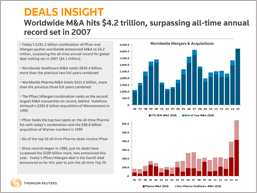
New data from Thomson Reuters suggests that M&A activity totalled $4.2 trillion in 2015, breaking the all time annual record thanks to a 42 percent increase over 2014’s record. Mega deals were undoubtedly the driving force behind the impressive figures recorded this year.

"It's the most prolific year that we've ever seen since we began tracking M&A in 1980," said Matthew Toole, Thomson Reuters’ Director of Deals Intelligence. "Companies are looking for revenue growth, they're also looking to streamline and get rid of businesses that are non-core.

"And as companies consolidate at the top, it filters down to other companies looking to see what do we need to do to compete in this landscape," he added.

According to Thomson Reuters, the $191.5bn merger of Pfizer and Allergan was the deal which pushed 2015 past 2007’s record of $4.1 trillion. The healthcare and pharmaceutical sectors were two of the most prolific for deal activity, seeing $649.4bn and $415.6bn worth of deal activity respectively.

In the context of recent years, 2015 was a show stopping year for both industries. The $649.4bn worth of deals recorded in the healthcare space equates to more than the previous two full years worth of deals combined. For the pharma sector, 2015 exceeded the combination of the last three full years combined.

Financial engineering played a significant role in the success of some of the bigger deals in the pharma and healthcare spaces. Inversion deals, which have angered politicians on both sides of the aisle in the US, have continued to be a major factor in US deal making. Pfizer took advantage of an inversion to relocate to Ireland, and substantially reduce its tax bill.

Away from the pharma and healthcare industries, there were a number of other impressive deal making hauls. Though the number of announced deals globally declined from 2014 by 2.1 percent to 39,687, there was record M&A activity in five sectors: healthcare, consumer products, retail, technology and industrials.

Furthermore, for the first time ever, there were three consecutive trillion-dollar-plus quarters in 2015, thanks to large deals including the Pfizer/Allergan tie up and Anheuser-Busch InBev's planned $120.8bn merger with SABMiller.

However, 2016 is likely to be a more challenging year. With political uncertainty likely and further interest rate increases expected, we may see a drop in deal making.

Report: Thomson Reuters Deals Insight M&A 2015

©2001-2026 Financier Worldwide Ltd. All rights reserved. Any statements expressed on this website are understood to be general opinions and should not be relied upon as legal, financial or any other form of professional advice. Opinions expressed do not necessarily represent the views of the authors’ current or previous employers, or clients. The publisher, authors and authors' firms are not responsible for any loss third parties may suffer in connection with information or materials presented on this website, or use of any such information or materials by any third parties.