Icahn faces insider trading claims

BY Matt Atkins

Renowned activist investor Carl Icahn has come under investigation for insider trading along with two others. According to reports, the investigation began three years ago and is the latest to emerge from an ongoing crackdown on insider trading by US authorities.

The investigation reportedly centres on suspicious trades in consumer products company Clorox Co by golfer Phil Mickelson and high-profile sports better William Walters. The trades came shortly before Mr Icahn made a bid to take over the company in 2011. Mr Icahn had accumulated a 9.1 percent stake in Clorox in February 2011. In July, he made an offer which valued the company at above $10bn and did wonders for its stock price.

Federal prosecutors in Manhattan are handling the inquiry in conjunction with the FBI and the SEC. The investigation appears to be looking at whether Icahn leaked details of his failed takeover bid to Mr Walters – who Mr Icahn knows – which were subsequently passed on to Mr Mickelson.

Investigators are also looking into trades made by Mr Mickelson and Mr Walters in relation to Dean Foods Co, just before the company announced quarterly results in 2012. These trades appear unconnected to Mr Icahn.

Even supposing Mr Icahn had leaked information about his plans regarding Clorox, there is confusion to whether he would have violated the law. Insider trading regulations prohibit trading based on material, non-public information obtained from someone who breached a fiduciary or confidentiality duty by disclosing it. Since he was not a board member at Clorox, Mr Icahn owed no duty to its shareholders. It is possible that Mr Icahn owed a confidentiality duty to his own investors, though this legal argument may be a stretch, given he owned more that 90 percent of Icahn Enterprises at the time.

Mr Icahn denies all allegations against him. He told Reuters that he was unaware of any investigation and said that his firm always followed the law. He acknowledged a business relationship with Walters but said that he did not know Mickelson personally. "I am very proud of my 50-year unblemished record and have never given out insider information," he said.

News: Icahn, Mickelson are investigated in US insider trading probe

Regulatory costs rocket 60 percent

BY Richard Summerfield

Expenditure for regulatory bodies in the US, UK and Hong Kong has increased exponentially in recent years, according to a new report from Kinetic Partners.

Since the end of the 2006-2007 financial year, regulatory expenditure across all three regions has increased 59.4 percent, at an average of 8.075 percent each year, says Kinetic's ‘Global Enforcement Review 2014’ report. This increase may be a result of the pressure placed on regulatory agencies to enhance scrutiny of the financial services sector following the financial crisis of 2008.

Kinetic’s research found that for the 2012-2013 financial year, the US Securities and Exchange Commission (SEC), the UK Financial Conduct Authority (FCA) and the Securities and Futures Commission of Hong Kong (SFC) had a combined expenditure of approximately $2.4bn.  This was over $900m more than the nearly $1.5bn total expenditure of the organisations before the onset of the financial crisis in 2006/07. In the report Julian Korek, Kinetic Partners’ chief executive officer, noted that the “disparity between expenditure and headcount could be indicative of a focus by the regulators to improve market surveillance by developing innovative technologies and hiring more experienced, specialised staff. For our clients across the banking, asset management and insurance sectors, we are seeing a mirroring of this investment in systems to monitor and report on transactions”.

According to Kinetic’s research the biggest increase in growth in expenditure between the SEC, the FCA and the SFC came in Hong Kong, where the SFC’s spending has increased by 120.2 percent in the last seven years. SFC spending rose from $69.25m during the 2006-2007 fiscal year to $152.50m by the end of the 2012-2013 fiscal year. Despite making smaller increases in spending than Hong Kong's regulatory body, the SEC and the FCA have both still made sizeable increases in spending since the onset of the financial crisis. The last seven years have borne witness to a 61.9 percent spending increase at the SEC and a 48.4 percent increase at the FCA.

Report: Global Enforcement Review 2014

Pfizer abandons AstraZeneca effort

BY Matt Atkins

US pharmaceutical firm Pfizer has walked away from its efforts to woo British drugmaker AstraZeneca. The American giant threw in the towel shortly before 5pm on Monday 26 May, conceding that its attempts to create the world's largest pharmaceutical firm had failed. 

AstraZeneca has fiercely resisted Pfizer's campaign, which began in November last year. Backed by UK scientists and politicians, the firm's boardroom has knocked back a string of multi-billion pound offers. The UK firm rejected a final offer of £69bn, or £55 per share, saying the proposal undervalued the company and its prospects for growth.

Pfizer's campaign faced many hurdles, being mired in controversy from the off. The bid had stirred public anger on both sides of the Atlantic, after it was revealed tax savings were a key driver of Pfizer's approach. A successful takeover would have given Pfizer the chance to relocate its tax base to the UK, escaping the high rate of US corporation tax.

The US firm had come under intense pressure from the UK government, as well as unions, to spell out Pfizer's commitment to British research and jobs. The firm’ chief executive, Ian Read, spent two days of questioning from MPs on the Commons Business Select Committee and the Science Committee, giving a five-year pledge on UK jobs and facilities. In light of the tax storm surrounding the deal, these guarantees were dismissed as inadequate.

While AstraZeneca’s board can breathe a sigh of relief, the news will come as a disappointment to a number of shareholders who had wanted the firm to engage with Pfizer. Investors including BlackRock, Legal & General, Axa and Schroders made it clear they wanted the company to consider the bid, though other leading investment groups were against it. Many viewed the price per share offered as a few pounds too low. It has been widely reported that a figure above £58 may have swayed the board.

Under UK takeover rules, Pfizer cannot approach AstraZeneca for six months, although the UK firm can choose to initiate talks in three month's time. Mr Read has said the US firm does not rule out future discussions with AstraZeneca, but that it will now focus on "lots of great opportunities" including growth within the company and other potential deals.

News: Pfizer drops AstraZeneca takeover bid

LatAm PE down but optimism high

BY Matt Atkins

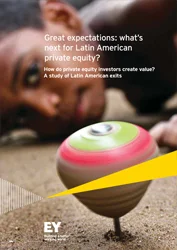
Latin America focused private equity (PE) invested and raised a lower amount in 2013 than in previous years, according to a new EY Report. However, amounts remained well above 2009 levels.

PE faces a much more challenging environment in Latin America than in previous years, says the ‘Great expectations: what’s next for Latin American private equity?’ report. GDP growth forecasts have been lowered for many of the region’s biggest economies, and high inflation remains an issue. However, the region’s continued development means PE activity is significantly higher than a decade ago.

The biggest story of 2013 was the strength of Latin American IPO markets. Exits via IPO in EY’s study sample doubled, and 38 percent of IPOs in the region were PE-backed – the highest level ever recorded. The trend looks set to continue through 2014. Exit by IPO is by far the most common route to realisation for Latin America’s larger PE portfolio companies, with trade sales predominant in sub-$100m deals. However, as the barriers to going public are coming down, particularly in Brazil, this longstanding divergence is narrowing.

While secondary buyouts were expected to increase, they have remained relatively rare. In EY’s study, only a tenth of deals exited from the sub-$100m category were sold to other PE houses. The report predicts this proportion will grow as smaller houses work more closely with portfolio companies.

EY reports that PE is exploiting opportunities in a diverse range of sectors. The consumer goods and services sector accounted for nearly a third of realisations in 2013, followed by financials and technology. These three sectors benefited from growing consumer demand and overall economic development in the region.

Regarding triggers for exit, in 2013, strong business performance accounted for nearly 50 percent of exits. Favourable market conditions were a timing trigger in just over a third of exits. Overall, says EY, this suggests that PE owners in Latin America have an eye on exit. Their preparation is paying off, with exits via sales to trade buyers and IPOs both showing strong multiple returns.

Report: Great expectations: what’s next for Latin American private equity?

Security concerns restrain mobile banking

BY Matt Atkins

Consumer fears surrounding security have dampened interest in the mobile technology services of financial institutions worldwide. These are the findings of Deloitte's new report, Mobile Financial Services: Raising the Bar on Customer Engagement, based on survey data from Andrews Research Associates.

Though financial services companies are largely eager to enter the mobile transaction market, the industry still has work to do before it captures the full potential of today's technology, finds the report.

Of those respondents who do not regularly use mobile devices for financial services, sixty-one percent cited security issues as the prime reason. Over one-third of those surveyed were most insecure about using financial services on mobile devices due to lack of trust in the security of the Wi-Fi and mobile networks transmitting their data. Twenty-eight percent were worried about their mobile device being lost or stolen. One in five respondents believed that the risk of identity theft was greater with mobile transactions.

To address security concerns, respondents supported measures to create more secure Wi-Fi or mobile networks, systems that automatically disable stolen mobile devices, and the adoption of more secure mobile identification methods such as biometric technology.

The survey did indicate that mobile products have been more widely adopted in the banking sector than in other financial service sectors, such as insurance. However, it still finds that banks "are at a decided disadvantage compared to other sectors" when it comes to security.

“The financial services industry is entering a new phase in its digital evolution, with mobile technology reshaping customer engagement in a dramatic manner, and increasingly becoming the primary method of a consumer's interaction with their financial services providers," said Jim Eckenrode, executive director of the Deloitte Center for Financial Services. "To boost adoption and set the stage for more ambitious applications, companies will likely have to take tangible steps to reassure consumers about the security of their mobile financial transactions."

Report: Mobile Financial Services: Raising the Bar on Customer Engagement

©2001-2025 Financier Worldwide Ltd. All rights reserved. Any statements expressed on this website are understood to be general opinions and should not be relied upon as legal, financial or any other form of professional advice. Opinions expressed do not necessarily represent the views of the authors’ current or previous employers, or clients. The publisher, authors and authors' firms are not responsible for any loss third parties may suffer in connection with information or materials presented on this website, or use of any such information or materials by any third parties.