
Embrace the cloud to stay competitive, says PwC

BY Matt Atkins

According to a new PwC report, modern day financial institutions face increasing demands on two fronts: the need to consolidate their data centres and increase business agility.

After the burst of M&A activity which followed the 2008 financial collapse, organisations have been left with an overlapping mix of data centre assets which must now be consolidated into a more cohesive whole. In addition, in a continually changing business environment, institutions are feeling the pressure to innovate and embrace new technology.

In light of these challenges, says the report, CIOs are increasingly turning to cloud technology to transform their technology infrastructure and deliver consistent service to their global customers. Of the respondents to PwC's survey, 71 percent said they would invest more in cloud technology – up 18 percent on the previous year. The adoption of private clouds offers institutions a chance to address their data consolidation needs, in turn boosting IT agility, according to PwC.

Embracing cloud technology offers numerous rewards. Using the cloud, leading institutions are able to: adapt more rapidly when entering new markets; improve IT services to business units, enabling units to better serve their customers; and improve the consistency of service to customers worldwide, resulting in greater customer satisfaction and loyalty. The cloud also allows institutions to cope with the changing demands of software development lifecycles and technology change programs.

Security concerns remain a major consideration in cloud adoption. By its very nature, the cloud forces IT services to pay closer attention to potential risks in the strategic planning and implementation of data centres. However, while 46 percent of respondents reported their organisation uses cloud services, only 18 percent of financial organisations included provisions for the cloud in their security profile.

Moving to the cloud is a complex process, says PwC, and cloud strategy should be developed with the input of top management across the company. But when an institution strategically implements a private cloud solution, it can help the overall objectives of the organisation, as well as its IT goals.
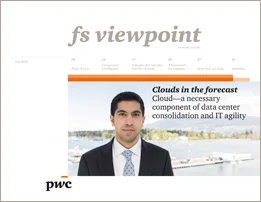
Report: FS viewpoint: Clouds in the Forecast

Tech M&A on the rise

The technology deal market has displayed tremendous performance over recent years. In terms of total transaction size, the M&A market as a whole increased 4.1 percent in 2012-213 – but the technology M&A sub-sector increased 30.5 percent during the same period. Technology deals overtook the energy, mining and utilities sector for the first time since 2006 and accounted for 23 percent of global M&A activity in 2013. Increasingly, technology firms are using M&A to move into new areas and transactions are being driven by growing demands for reliable and secure mobile infrastructure.

FW spoke to Susan Blanco at Houlihan Lokey, Nick Abrahams, at Norton Rose Fulbright Australia and James Klein at Penningtons Manches LLP about M&A in the tech sector.

TalkingPoint: M&A in the tech sector: outlook for 2014

PE hungry for energy assets

The energy sector is a key target for private equity (PE) , which has proved a major source of investment since the economic downturn. Almost half of executives expect to invest in energy during the next year, with a particular interest in oil and gas assets. North America remains a key region, although other geographies are expected to benefit from private investment. East and West Africa, and Latin America have befitted as the emerging markets have developed, and unconventional exploration is boosting opportunities in Europe and Asia.

FW spoke to Stefanie Fleischmann at Beowulf Energy LLC, Andy Brogan at EY and Douglas Nordlinger at Skadden, Arps, Slate, Meagher & Flom LLP about opportunities for PE presented by the energy sector.

TalkingPoint: Private equity in the energy sector

Icahn faces insider trading claims

BY Matt Atkins

Renowned activist investor Carl Icahn has come under investigation for insider trading along with two others. According to reports, the investigation began three years ago and is the latest to emerge from an ongoing crackdown on insider trading by US authorities.

The investigation reportedly centres on suspicious trades in consumer products company Clorox Co by golfer Phil Mickelson and high-profile sports better William Walters. The trades came shortly before Mr Icahn made a bid to take over the company in 2011. Mr Icahn had accumulated a 9.1 percent stake in Clorox in February 2011. In July, he made an offer which valued the company at above $10bn and did wonders for its stock price.

Federal prosecutors in Manhattan are handling the inquiry in conjunction with the FBI and the SEC. The investigation appears to be looking at whether Icahn leaked details of his failed takeover bid to Mr Walters – who Mr Icahn knows – which were subsequently passed on to Mr Mickelson.

Investigators are also looking into trades made by Mr Mickelson and Mr Walters in relation to Dean Foods Co, just before the company announced quarterly results in 2012. These trades appear unconnected to Mr Icahn.

Even supposing Mr Icahn had leaked information about his plans regarding Clorox, there is confusion to whether he would have violated the law. Insider trading regulations prohibit trading based on material, non-public information obtained from someone who breached a fiduciary or confidentiality duty by disclosing it. Since he was not a board member at Clorox, Mr Icahn owed no duty to its shareholders. It is possible that Mr Icahn owed a confidentiality duty to his own investors, though this legal argument may be a stretch, given he owned more that 90 percent of Icahn Enterprises at the time.

Mr Icahn denies all allegations against him. He told Reuters that he was unaware of any investigation and said that his firm always followed the law. He acknowledged a business relationship with Walters but said that he did not know Mickelson personally. "I am very proud of my 50-year unblemished record and have never given out insider information," he said.

News: Icahn, Mickelson are investigated in US insider trading probe

Regulatory costs rocket 60 percent

BY Richard Summerfield

Expenditure for regulatory bodies in the US, UK and Hong Kong has increased exponentially in recent years, according to a new report from Kinetic Partners.

Since the end of the 2006-2007 financial year, regulatory expenditure across all three regions has increased 59.4 percent, at an average of 8.075 percent each year, says Kinetic's ‘Global Enforcement Review 2014’ report. This increase may be a result of the pressure placed on regulatory agencies to enhance scrutiny of the financial services sector following the financial crisis of 2008.

Kinetic’s research found that for the 2012-2013 financial year, the US Securities and Exchange Commission (SEC), the UK Financial Conduct Authority (FCA) and the Securities and Futures Commission of Hong Kong (SFC) had a combined expenditure of approximately $2.4bn.  This was over $900m more than the nearly $1.5bn total expenditure of the organisations before the onset of the financial crisis in 2006/07. In the report Julian Korek, Kinetic Partners’ chief executive officer, noted that the “disparity between expenditure and headcount could be indicative of a focus by the regulators to improve market surveillance by developing innovative technologies and hiring more experienced, specialised staff. For our clients across the banking, asset management and insurance sectors, we are seeing a mirroring of this investment in systems to monitor and report on transactions”.

According to Kinetic’s research the biggest increase in growth in expenditure between the SEC, the FCA and the SFC came in Hong Kong, where the SFC’s spending has increased by 120.2 percent in the last seven years. SFC spending rose from $69.25m during the 2006-2007 fiscal year to $152.50m by the end of the 2012-2013 fiscal year. Despite making smaller increases in spending than Hong Kong's regulatory body, the SEC and the FCA have both still made sizeable increases in spending since the onset of the financial crisis. The last seven years have borne witness to a 61.9 percent spending increase at the SEC and a 48.4 percent increase at the FCA.

Report: Global Enforcement Review 2014

©2001-2026 Financier Worldwide Ltd. All rights reserved. Any statements expressed on this website are understood to be general opinions and should not be relied upon as legal, financial or any other form of professional advice. Opinions expressed do not necessarily represent the views of the authors’ current or previous employers, or clients. The publisher, authors and authors' firms are not responsible for any loss third parties may suffer in connection with information or materials presented on this website, or use of any such information or materials by any third parties.