EU proposes harmonised trade secret protection

Only two-thirds of EU member states have specific legislation protecting trade secrets, and trade secret protection varies widely. This acts as a significant barrier to legal and commercial certainty across Europe, and restricts innovation and exploitation of trade secrets across the European market. The EU's proposed Directive on the protection of trade secrets is a positive step towards effective harmonisation across EU member states and, for the first time, will establish a recognised framework of minimum protections regarding abuse of trade secrets.

FW spoke to Warren Wayne, Robert Williams and Simon Shooter at Bird & Bird, about protecting trade secrets in the European Union.

TalkingPoint: Protecting trade secrets in the European Union

Asset management set for change

BY Matt Atkins

The asset management industry will be radically altered in the next 15 years, says KPMG.

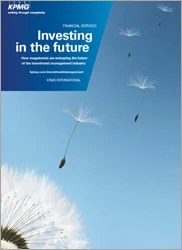
A new report, Investing in the Future, makes a number predictions including that, by 2030, client bases will be fundamentally different as Generation X approaches retirement; the number of players in the global market will halve in the next five years; and big tech firms will make headway into the sector. The report also stresses that asset managers are currently behind the curve on embracing new technology.

Current business models will prove woefully insufficient, according to Tom Brown, global head of investment at KPMG international. "We are on the verge of the biggest shake-up the industry has experienced; and the message to asset managers is clear – adapt to change or your business won't survive. The two biggest issues that need to be addressed are the changing client base and technology, and asset managers need to get to work on these areas now."

Technological investment will be critically import in the coming years says the report. The future needs of clients will be fundamentally different from today, with a growing demand for personalised information, education and advice. However, businesses are currently focusing on the wrong areas.

"Asset managers still have a long way to go to recognise and exploit big data and data analytics," says Ian Smith, financial services strategy partner with KPMG in the UK. "While IT is already attracting a significant amount of investment, it is not being channelled into the right areas. Many businesses are putting their efforts into trying to unpick the complex legacy of disparate systems and technologies while trying to make sure they provide the right level of control to meet increasingly stringent compliance. There is too little focus on building the architecture to meet the business needs of tomorrow."

The report also predicts a shift in the way customers buy investment products. Online purchases are expected to increase, while 'Trip Advisor type' websites will provide buyers with greater opportunities to conduct their own research.

Report: Investing in the Future

Mt. Gox granted Chapter 15 protection

BY Matt Atkins

Mt. Gox, the infamous Tokyo-based bitcoin exchange, has gained court approval to start Chapter 15 bankruptcy proceedings in the US. The development should prove a boost to a Japanese investigation into the loss of 650,000 units of the digital currency, and pave the way for the company to complete the sale of its business.

Once the leading bitcoin exchange, Mt. Gox was forced to cease trading and close down its website in February 2014 when the company lost 700,00 of its customers' bitcoins, along with 100,000 of its own, worth an estimated $473m. Mt. Gox blamed a prolonged hacking attack for the loss, though it subsequently found 200,000 bitcoins in an old-format digital wallet.

Mt. Gox sought court protection in Japan in February. The Japanese court put the company into liquidation in April and appointed a trustee to investigate the disappearance of the bitcoins. The exchange applied for Chapter 15 protection in the US on 19 March to prevent US customers who had filed a class action lawsuit from seizing its US assets and demanding evidence from executives. US Bankruptcy Judge Stacey G. Jernigan said, on 17 June, that she has “ample legal authority” to accept the US filing and recognise Mt. Gox’s Japanese bankruptcy as the foreign main proceeding. US and Canadian customers will split the 200,000 bitcoins held by Mt. Gox and share in a 16.5 percent stake after Mt. Gox is sold.

Mt Gox began life as a website for users of Magic: The Gathering Online, allowing them to trade cards like stocks. In July 2010, the site was re-launched as an exchange for trading bitcoin and regular currencies. Its short life was chequered with security breaches, trading suspensions and lawsuits before its eventual collapse.

News: Failed bitcoin exchange Mt Gox gets US bankruptcy protection

Tax concerns secondary in medical mega-deal

BY Matt Atkins

The latest in a string of healthcare mega-deals has been driven by potential synergies rather than tax considerations, according to executives behind the transaction.

On 15 June, US medical device maker Medtronic Inc announced it had agreed to acquire Ireland’s Covidien Plc for $42.9bn in cash and stock. The purchase will see Medtronic move its executive base to Ireland, reducing its overall tax burden. However, a complimentary strategy with Covidien on medical technology has motivated the deal, rather than tax savings, says Medronic CEO, Omar Ishrak. “This acquisition will allow Medtronic to reach more patients, in more ways and in more places. Our expertise and portfolio of services will allow us to serve our customers more efficiently and better address the demands of the current healthcare marketplace.”

The acquisition of Covidien will significantly advance Medtronic’s position as a leader in medical technology and services. The combined company will have a comprehensive product portfolio, a diversified growth profile and broad geographic reach, with 87,000 employees in more than 150 countries. The deal will create a close competitor in size to the medical device business of industry leader Johnson & Johnson Co.

The deal has raised concerns surrounding the number of US firms striking deals that slash their tax bills. While historically quite rare, the acquisition of companies aimed at lowering corporate tax rates is becoming increasingly common. Pfizer’s recently failed bid for AstraZeneca, for instance, has served to refocus attention on so called ‘inversions’. Currently, two Congress bills, along with a White House proposal, are aiming to make the practice more difficult, though neither has gained much traction. This could change if further US firms try to exploit the loophole.

While the deal has sparked debate for all the wrong reasons, it has been welcomed by the Irish firm. “Covidien and Medtronic, when combined, will provide patients, physicians and hospitals with a compelling portfolio of offerings that will help improve care and surgical performance,” said José E. Almeida, Covidien's chairman, president and chief executive. “This transaction provides our shareholders with immediate value and the opportunity to participate in the significant upside potential of the combined organisation.”

The transaction has been approved by the boards of both companies.

Press release: Medtronic to Acquire Covidien for $42.9 billion in Cash and Stock

EU unveils merger simplification package

On 1 January 2014 the EC introduced key reforms to EC merger control rules, with the aim of reducing the information burden on companies, particularly for notification of non-complex mergers, and to streamline the pre-notification process. However, while the new rules will facilitate dealmaking in Europe, they will not in themselves increase the number of deals, and the EU Merger Regulation process will remain more complex and costly for simple transactions than other regimes.

FW spoke to Catriona Hatton at Baker Botts L.L.P., Davina Garrod at Bingham McCutcheon LLP and Ian Giles at Norton Rose Fulbright LLP, about European merger notification and control.

TalkingPoint: Changes to European merger notification and control

©2001-2025 Financier Worldwide Ltd. All rights reserved. Any statements expressed on this website are understood to be general opinions and should not be relied upon as legal, financial or any other form of professional advice. Opinions expressed do not necessarily represent the views of the authors’ current or previous employers, or clients. The publisher, authors and authors' firms are not responsible for any loss third parties may suffer in connection with information or materials presented on this website, or use of any such information or materials by any third parties.