
CFO risk appetite at seven year high

BY Richard Summerfield

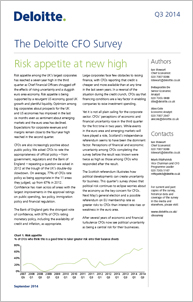
Despite ever increasing uncertainty surrounding the economy of the eurozone and emerging markets, risk appetite among the chief financial officers (CFOs) of the UK’s largest firms is at a seven year high, according to a new report from Deloitte.

Deloitte surveyed 118 CFOs of FTSE 350 and other large private UK companies for its ‘The Deloitte CFO Survey Q3 2014’ and found that British companies are feeling more confident about taking on business risk than at any other point since 2007. The growth in CFO risk appetite has been predicated on a rebound in the US economy, improving UK growth and the current ease of access to finance. Seventy-two percent of CFOs surveyed said now was an opportune time to take risk onto their balance sheets, up from 65 percent of respondents in Q2 2014.

"With a resurgent US economy, good growth in the UK and plentiful liquidity, CFOs have shrugged off the effects of rising uncertainty and weakness in Europe, sending corporate risk appetite to a seven year high,” said Deloitte chief economist Ian Stewart. “Expectations for corporate revenues and margins remain close to the four year high seen in Q2.”

Yet despite the uptick in risk appetite, perceptions of financial and economic uncertainty also rose in the third quarter for the first time in two years. Fifty-six percent of CFO’s surveyed noted that the level of financial and economic uncertainty that their firms were facing was above normal, high or very high. In Q2 that figure was just 49 percent.

Sentiment about the eurozone has deteriorated significantly in 2014, with a net percentage of -39 percent of CFOs seeing improving prospects for the region going forward, down from +54 percent in Q1 2014. Confidence in emerging markets also continued to decline, with a net balance of -13 percent seeing an improvement. Despite those concerns, CFOs are considerably more optimistic about UK prospects, with a net balance of +85 percent reporting improved growth prospects over the last six months.

In many respects, political upheaval was more of a concern for CFOs than any economic issues during Q3. The potential secession of Scotland from the United Kingdom was a contributing factor to rising uncertainty, along with the impending general election and possible referendum on EU membership. CFOs perceived these scenarios as a greater risks to their firm’s prosperity than an increase in interest rates or weaknesses in the eurozone.

Source: The Deloitte CFO Survey
Alibaba IPO hits record level

BY Richard Summerfield

Alibaba Group Holding Limited has completed not only the largest ever US-listed IPO but also the world’s largest-ever stock market flotation.

Shares in the e-commerce giant were initially priced at $68 each. Due to overwhelming demand, the firm’s underwriters were required to take up the option to purchase an additional 48 million shares. Accordingly, the total raised from Alibaba’s offering rose from an initial $21.8bn to $25bn. Once trading began, the company’s share price soon reached $99 before finally closing at $93.89, a jump of 38 percent from the offering price.

Based on the company’s closing price on the first day of trading, Alibaba has a market capitalisation of around $230bn. This makes it more valuable than a host of other notable internet firms, including Facebook Inc and Amazon Inc. Indeed, Alibaba has become the world’s second largest internet company behind Google Inc.

A group of Alibaba's existing shareholders, including chairman Jack Ma, vice chairman Joseph Tsai and internet giant Yahoo Inc, provided the extra shares for the overallotment. Mr Ma sold an additional 2.7 million shares, taking his tolal shares sold in the IPO to around 15.5 million. Including the 900,000 shares he sold during the overallotment, Mr Tsai sold a total of 5.2 million shares. However, Yahoo gave up the most shares during the IPO, divesting around 140 million shares in total, including 18.26 million in the greenshoe. Yahoo is believed to have generated around $9.5bn in pre-tax cash from the sale, and earmarked around $6bn of the after-tax proceeds to be returned to shareholders. It is likely to undertake a number of stock buy-backs in order to facilitate the return. Some observers expect Yahoo to use the remaining cash to carry out a number of acquisitions.

The success of Alibaba’s IPO came despite lingering concerns about the company’s corporate structure. Under the firm’s variable interest entity (VIE) structure, buyers of Alibaba’s stock do not actually own the underlying business, because Chinese government regulations restrict foreign ownership in the sector. The VIE structure was established as a means of circumnavigating those regulations, and although Chinese authorities may take a dim view of the company’s use of the tactic, Alibaba’s strong level of influence may protect it from scrutiny.

News: Alibaba IPO ranks as world's biggest after additional shares sold

Indian infrastructure boom predicted

BY Richard Summerfield

Indian infrastructure development is set to enter a golden era over the next decade, according to PwC.

In its report 'Developing Infrastructure in Asia Pacific: Outlook, Challenges and Solutions', PwC expects the wider Asia pacific infrastructure market to grow by 8 percent per year over the coming decade, reaching $5.36 trillion by 2025, a figure which would represent 60 percent of the world’s investment total. Growth in the region is due to be driven by favourable conditions in the most dominant economies, India and China, as well as a number of South East Asian nations. The size of the consumer base, abundance of natural resources and low cost workforce will all help to drive investment in the region in the coming decade.

The marked increase in infrastructure spending in India over the next decade is expected to be influenced by improvements and investment in a number of industries, including housing, telecoms, healthcare, education and transportation, among others. Some of the most significant growth is expected in the transportation and utilities sectors, where investment is due to treble as income and travel demand rises and the rapid urbanisation of the Indian population continues apace. The population of India's towns and cities is likely to expand to around 600 million by 2031, according to the UN.

A second PwC report, 'Capital project and infrastructure spending: Outlook to 2025', has also highlighted the investment needs that will be propagated by India’s burgeoning urban population. “The ongoing development of technology services sector, as well as demand from households, is likely to drive investment in telecommunications infrastructure. The population is expected to grow much faster than other countries in the region, which will further boost demand for infrastructure sectors serving households," the report said. The telecoms sector alone will see infrastructure rise increase to $130bn by 2025, up from $27bn in 2013.

On 16 September private equity giant KKR announced that it had agreed to invest $164.2m of structured long-term financing, with a number of co-investors, in leading Indian infrastructure development company GMR Holdings, the holding company for GMR Infrastructure.

Report: Developing Infrastructure in Asia Pacific: Outlook, Challenges and Solutions

Big banks cut lending

BY Richard Summerfield

Consumer and business lending by the UK’s largest banks has fallen by $595bn over the last five years, according to a new report from KPMG.

Total lending at Barclays, Royal Bank of Scotland, HSBC, Lloyds and Standard Chartered dropped 14 percent to £2.33 trillion in the first half of 2014, compared with five years earlier. The dramatic decline in lending is the result of the enormous fines and compensation packages which banks have had to accept in order to make amends for their recent chequered past. Since 2011, remediation payments made by the big six British banks have totalled £31bn, although the year on year remediation figure in H1 2014 was down 44 percent to £2.4bn.

The overall reduction in lending since 2009 is also a result of a new risk-averse mentality permeating the big UK banks. KPMG believes that major banking groups in the UK have lost sight of the risk-taking required in the sector. That said, it appears that a number of banks are beginning to take steps which will help the sector return to sustainable growth. Profits have begun to recover , thanks to a new tone at the top. The big six banks reported a combined profit of £15.2bn in H1 2014, continuing the return to profitability first recorded in the second half of 2013.

However, KPMG also notes that the UK’s wider banking sector is approaching “crunch time” due to the rise of pay day lenders and other shadow banking groups. Bill Michael, EMA head of financial services at KPMG, noted that “Shadow banking initiatives are increasingly penetrating under-served areas of the market. These initiatives are creating a challenging environment that traditional banks are unfamiliar with. Equally, if banks get to grip with technology quickly, there is a unique opportunity for banks to capitalise upon. While competitors entering the market do not have the same legacy-based obstacles preventing them from pursing new opportunities, banks can offer the scale, reach and experience many players cannot.”

Report: KPMG’s report analyses the published 2014 half-yearly results of Barclays, HSBC, Lloyds Banking Group, RBS and Standard Chartered

Another twist in HP's Autonomy dispute

Hewlett Packard (HP) has revealed its intention to sue the UK arm of accountancy firm Deloitte over its role in HP’s acquisition of British software company Autonomy Plc nearly three years ago.

HP made the announcement during the latest hearing in its protracted and bitter legal dispute with Autonomy’s former executives. The firm’s decision to pursue a case against Deloitte emerged as US Judge Charles Breyer refused to approve part of a settlement reached between HP and the shareholder group which is suing it over the Autonomy acquisition. According to Judge Breyer, HP’s attempt to pay the investors’ lawyers was a "potentially fatal" clause which meant he was not able to agree to the settlement.

A spokesman for HP noted that the company “will continue to work to hold the former executives of Autonomy as well as Autonomy’s auditor, Deloitte UK, responsible for the wrongdoing that occurred.”

Computing giant HP acquired Autonomy in an $11bn deal in 2011, but less than one year later was forced to make an $8.8bn write down on the transaction. HP alleges that the November 2012 write down came as a direct result of a number of accounting improprieties, misrepresentations and disclosure failures carried out by Autonomy and its executives during the acquisition process.

Following an extensive internal audit, HP dramatically revised Autonomy’s 2010 performance and noted that it had discovered “extensive errors – including misstatements” in Autonomy’s accounts, which were audited by Deloitte.

Deloitte has refuted HP’s claims, saying that any case brought against the firm would be “utterly without merit”. Deloitte has noted that neither HP nor Autonomy enlisted its services to carry out due diligence during the sale of Autonomy and that the firm merely served as an auditor to Autonomy at the time of the transaction.

Former Autonomy executives have claimed that the dramatic decline in the unit’s value was a result of poor integration planning on HP’s part, as well as in-fighting within the company’s wider organisation. Autonomy’s founder, Dr Mike Lynch, has also denied any wrongdoing, claiming that the company’s accounts were legitimate as they had been signed off by Deloitte.

News: http://www.cbronline.com/news/hp-to-sue-deloitte-uk-over-autonomy-deal-4354838

©2001-2026 Financier Worldwide Ltd. All rights reserved. Any statements expressed on this website are understood to be general opinions and should not be relied upon as legal, financial or any other form of professional advice. Opinions expressed do not necessarily represent the views of the authors’ current or previous employers, or clients. The publisher, authors and authors' firms are not responsible for any loss third parties may suffer in connection with information or materials presented on this website, or use of any such information or materials by any third parties.