
North Africa leads the way - PwC

BY Richard Summerfield

Africa is a continent on the rise. Indeed, for many commentators Africa has become an emerging market hotspot, with investment flowing into countries across the continent at an impressive rate. Though the region is still subject to economic and political risks, Africa is undoubtedly on an upward trajectory. According to the World Bank, it is one of the world’s three fastest-growing regions, expected to see economic expansion of around  5.2 percent in 2015-2016, up from 4.6 percent in 2014-2015.

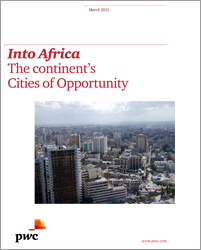
A new report from PwC notes that a number of North African cities demonstrate the greatest potential for economic development in the next few years. The report, ‘Into Africa – the continent’s cities of opportunity’, details the 20 African cities set to become the most dynamic on the continent.

The PwC study was designed to evaluate the strengths and weaknesses of Africa’s major urban hubs, though the firm imposed the stipulation that only one city per country could be assessed. Accordingly, PwC ranked the selected locations in terms of infrastructure, human capital, economics and society, and demographics.

Four of the top five cities listed in the report - Cairo, Tunis, Algiers and Casablanca – are found in North Africa. Johannesburg in South Africa is the only southern city featured in the top five. The relative age of the cities and states in the north are enough to give them an advantage over the majority of those in sub-Saharan Africa.

PwC notes in its report that the infrastructure, regulatory and legal framework, and socio-cultural ecosystems required to establish a successful city, have been present in the northern cities for longer, which has allowed places like Cairo to flourish. Johannesburg’s establishment as a political centre in the mid 1880s allowed the city to develop the requisite infrastructure and services, which have been historically lacking in the south of the continent.

“We believe that these cities demonstrate the relative strengths and weaknesses of Africa’s urban future,” said Kalane Rampai, PwC local government leader for southern Africa.

Despite the dominance of northern cities, a number of sub-Saharan cities scored highest in terms of society and demographics, excelling in diversity and population growth.

Report: Northern African cities lead the way as continent changes: report
Alternative lending to hit the heights across UK and mainland Europe in 2015

BY Fraser Tennant

Alternative (non-bank) lending increased rapidly in 2014 and is expected to continue strongly throughout 2015, according to a new report from Deloitte.

The sixth Alternative Lender Deal Tracker – which covers 36 leading alternative lenders and focuses on primary deal flow in the European mid-market – reveals that non-bank lenders were involved in 195 deals in the UK and across mainland Europe in 2014 – a substantial increase on 2013 figures.

Also highlighted in the deal tracker are predictions for the 2015 private debt market. These include: (i) the increased use of direct lending funds by smaller mid-market private equity and leveraged corporates; (ii) an increasing interest from direct lenders in mainland Europe and increasing numbers of private debt funds opening up local offices; and (iii) a continued imbalance of supply and demand for liquidity will keep pressure on pricing and structures and favour borrowers in the mid-market.

Overall, the alternative lending outlook for 2015 is very strong, says Deloitte, with the deal tracker estimating that European direct lending funds are looking to raise in excess of €15bn over the next 12 months for private debt strategies.

“With strong year on year growth, 2015 could offer a bumper time for alternative lenders, now firmly established alongside mainstream banks," said Fenton Burgin, head of UK debt advisory at Deloitte. “With increased confidence in the markets and wider funding options, we are seeing a pick-up in M&A activity.”

This pickup in activity is substantiated by the deal tracker, which shows that M&A was the primary reason for just over half of all transactions monitored by Deloitte since 2012.

Offering a note of caution amid the confidence, however, is Floris Hovingh, head of alternative lender coverage at Deloitte. “There is increasing activity in France, Germany and Southern Europe. However, mainland Europe may not embrace direct lenders with the same lightning speed as the UK due to the larger share of family or founder owned businesses, who are intrinsically more risk averse than private equity,” she says.

Deloitte’s Alternative Lender Deal Tracker compiles data and information from the final quarter of 2014.

Report: Deloitte Alternative Lender Deal Tracker - Focussed on primary deal flow in the European mid market

Social and economic changes “disrupt” global real estate fund sector and spark clamour for new investment

BY Fraser Tennant

The global real estate fund sector is currently experiencing a period of “disruption” with major social and economic changes sparking a clamour for new investment, according to a new EY report.

EY’s ‘Global market outlook 2015: trends in real estate private equity’ found that M&A deals in particular are continuing to surge, a scenario that is being driven by three main factors: (i) a desire for incremental growth; (ii) the strategic merit of transactions; and (iii) the availability of debt and equity on favourable terms.

As a consequence of this increasing demand for new investments, prices have skyrocketed, leading to the possibility of M&A dealmaking activity in 2015 exceeding the peak levels of 2007.

In the US, the real estate market is currently awash with cross-border capital due to the country’s faster than most economic recovery; however, the immense popularity of this particular asset class has raised the spectre of a bubble similar to the one that enveloped Japanese investment in the US back in the 1980s.

Despite this, analysts such as Mark Grinis, EY’s global real estate fund services leader, are relatively relaxed about the perceived threats.

“If we look at history, market collapses have always been preceded by deteriorating economic fundamentals and stress factors like overdevelopment and rising vacancy rates," said Mr Grinis. “So far, there is little evidence of these precursors. What's more, industry players have moved carefully along the risk spectrum, which is why we have not seen an excessive amount of development or movement in markets that lack significant economic drivers.”

Elsewhere in the report, significant changes to the way private equity funds are administered are highlighted, with outsourced administration platforms shown to be particularly popular. And in terms of regulation, the report flags up the increasing scrutiny being directed toward the global real estate fund sector by the likes of the European Securities and Markets Authority (ESMA) and the Organisation for Economic Co-operation and Development (OECD).

The EY report is based on a series of interviews with more than 20 of EY’s global fund partners in the US, UK, Europe and Asia.

Report: Global market outlook 2015 - Trends in real estate private equity

AbbVie wins Pharmacyclics race

BY Richard Summerfield

Biotech company Pharmacyclics has agreed to be acquired by Chicago based rival AbbVie in a deal worth around $21bn.

Under the terms of the deal, Pharmacyclics shareholders will receive $261.25 per share of the company held. The offer is comprised of a mix of cash and AbbVie equity, and the transaction is expected to close by mid-2015.

AbbVie was a late entrant to the race to acquire Pharmacyclics, beating out competition from Johnson & Johnson and a third, unnamed party to secure the deal. The three way contest for Pharmacylics was driven by interest in the company’s crown jewel – Imbruvica – a cancer drug which could make an important impact on the oncology sector. The company expects US sales of Imbruvica to hit $1bn in 2015, however by 2020 worldwide sales are forecast to reach $5.8bn.

"Team Pharmacyclics is honoured and enthusiastic to join the AbbVie organisation. We share a common purpose. Together and as one, our focus remains to create a remarkable difference for patient betterment around the world," said Bob Duggan, chairman and chief executive of Pharmacyclics, in a statement announcing the deal.

"The acquisition of Pharmacyclics is a strategically compelling opportunity. The addition of Pharmacyclics' talented and innovative team will add enormous value to AbbVie," said Richard Gonzalez, chairman and chief executive of AbbVie. "Its flagship product, Imbruvica, is not only complementary to AbbVie's oncology pipeline, it has demonstrated strong clinical efficacy across a broad range of hematologic malignancies and raised the standard of care for patients."

The deal continues the trend of significant M&A transactions in the pharma and biotech sectors in 2015 to date. With announced deals including Pfizer’s purchase of Hospira for $17bn, Valeant’s acquisition of gastrointestinal drugmaker Salix for $14.5bn, and Shire's $5.2bn deal for NPS Pharma, M&A in the pharma and biotech  reached $70bn by the beginning of March - more than double the level of activity seen in the same period last year.

News: AbbVie to Pay $21 Billion for Pharmacyclics, Maker of a Promising Cancer Drug

Freescale and NXP to form $40bn firm

BY Richard Summerfield       

NXP Semiconductors N.V. and Freescale Semiconductor Ltd this week announced a $16.7bn merger, including the assumption of debt, which will create a firm with a total enterprise value of $40bn.

Under the terms of the deal, NXP will pay $6.25 in cash and 0.3521 shares of NXP stock for each share of Freescale stock. In a statement announcing the transaction, NXP confirmed that the deal will be funded with $1bn in cash and a $1bn debt offering, in addition to around 115 million new NXP shares.

“Today’s announcement is a transformative step in our objective to become the industry leader in high performance mixed signal solutions. The combination of NXP and Freescale creates an industry powerhouse focused on the high growth opportunities in the Smarter World. We fully expect to continue to significantly out-grow the overall market, drive world-class profitability and generate even more cash, which taken together will maximize value for both Freescale and NXP shareholders,” said Richard Clemmer, NXP’s chief executive officer in a statement announcing the deal.

The deal will create an industry heavyweight with about $10bn in annual sales. The largest producer of analogue chips, microcontrollers and other types of semiconductors, Texas Instruments, had sales of around $13.05bn in 2014.

Although the deal has been unanimously approved by the boards of directors of both companies, it is still subject to regulatory approvals in various jurisdictions and customary closing conditions. The deal, expected to close in the second half of 2015, must also be approved by shareholders. Once the merger has been completed, Freescale’s shareholders will own around 32 percent of the new firm. NXP’s stockholders will hold the remaining 68 percent.

The transaction will see a conglomerate of private equity investors, including Permira, Blackstone, Carlyle and TPG Capital, complete a partial exit of Freescale, acquired by the consortium in 2006 for $17.6bn. The group currently owns 64 percent share of Freescale. Once the deal has been finalised, the private equity firms will still hold around 19.1 percent of the merged company.

News: NXP to buy Freescale Semiconductor to create $40 billion co

©2001-2026 Financier Worldwide Ltd. All rights reserved. Any statements expressed on this website are understood to be general opinions and should not be relied upon as legal, financial or any other form of professional advice. Opinions expressed do not necessarily represent the views of the authors’ current or previous employers, or clients. The publisher, authors and authors' firms are not responsible for any loss third parties may suffer in connection with information or materials presented on this website, or use of any such information or materials by any third parties.