
PitchBook unveils 2Q US ‘Private Equity Breakdown Report’

BY Fraser Tennant

A wealth of insight into recent trends in the private equity space is showcased in the 2Q US ‘Private Equity Breakdown Report – newly published by data & technology provider for the global private equity and venture capital markets, PitchBook.

The report, an annual publication produced in partnership with virtual dataroom solution Merrill DataSite, offers data-driven analysis on deal flow, investment trends, exit activity and an overview of the year's fundraising activity.

The 2Q 2015 report includes: (i) deal volume and capital invested by year and quarter; (ii) investments by deal size, industry and region; (iii) buyout multiples and debt percentages; (iv) exits and fundraising overviews; and (v) league tables.

PitchBook’s headline figures show that during the first quarter of 2015, private equity investors completed 634 deals in the US worth $100.7bn – representing a 30 percent decrease in deal count and a 26 percent decrease in capital invested when compared to last year’s corresponding quarter.

In terms of fundraising, the report states that the number of closed funds dropped to 38 in 1Q 2015 - the lowest number since 3Q 2010 and a 55 percent decrease from 3Q 2014. As far as exits are concerned, the pace is reported as having slowed in 1Q 2015 with only 218 exits completed by private equity sellers.

“Private equity and M&A deal-making remains highly competitive across the board, driven by a huge amount of available cash and debt funding,” said Adley Bowden, PitchBook’s senior director of analysis. “This environment has led to a bit of a pullback in private equity deals, an increased focus on the middle-market and more non-traditional private equity transactions. As long as the current environment persists we expect private equity activity to stay in a similar range to the last several quarters as firms hunt for value and focus on the growth of their portfolio companies.”

The PitchBook report also features a Q&A with Jamie Spaman, managing director at Murray Devine, in which he discusses the current valuations environment and increased activity surrounding carve-out transactions.
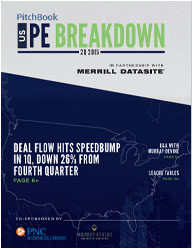
Report: 2Q 2015 US Private Equity Breakdown Report


Shell agrees to buy BG Group in $70bn deal

BY Fraser Tennant

In a major deal likely to be one of the largest undertaken in 2015, Royal Dutch Shell and the BG Group, the UK’s third-largest energy company, have reached an agreement which will see Shell buy the oil and gas exploration giant in a $70bn deal.

Once complete, the deal, a cash and shares offer which will see investors gain a 50 percent premium on BG’s share price, has the potential to create a company worth almost $300bn.

According to Shell’s summary terms and metrics, the deal: (i) represents a value per BG ordinary share of 1350p, a premium of 52 percent; (ii) values BG equity at $70bn; (iii) will see BG shareholders own 19 percent of Shell; (iv) is a transaction underpinned by intrinsic asset value of BG; (v) is mildly accretive to earnings per share in 2017 and strongly accretive from 2018; and (vi) is accretive to cash flow from operations per share from 2016.

“This is an important transaction for Shell, accelerating the delivery of our strategy for shareholders," said Jorma Ollila, chairman of Shell. “The result will be a more competitive, stronger company for both sets of shareholders in today’s volatile oil price world. We believe that the combination is in the interests of both our companies and their shareholders.”

Commenting on the deal, BG chief executive Helge Lund said: “The offer from Shell delivers attractive returns to shareholders and has strong strategic logic. The consolidated business will be strongly placed to develop the growth projects in BG’s portfolio. The transaction will take time to complete, during which my team and I will remain committed to BG and our shareholders, and to safely delivering our 2015 business plan.”

Despite Mr Lund’s commitment, the BG chief, who joined the firm as recently as February 2015 amidst controversy over his $35m-plus pay package, will “probably move along” from his position if the deal goes ahead according to Shell’s chief executive, Ben van Beurden. 

The Shell/BG Group deal is expected to be concluded in early 2016 following regulatory and shareholder approvals, to be followed by a $25bn share buyback program commencing in 2017.

News: Shell offers 50 percent premium to buy BG for 47 billion

SEC - companies cannot silence whistleblowers

BY Richard Summerfield

On 1 April, the Securities and Exchange Commission (SEC) announced its first ‘enforcement action’ regarding the use of what it deemed to be restrictive language in a confidentiality agreement.

The decision handed down by the SEC found that technology and engineering firm KBR Inc had violated whistleblower protection rule 21F-17, enacted under the Dodd-Frank Act. “By requiring its employees and former employees to sign confidentiality agreements imposing prenotification requirements before contacting the SEC, KBR potentially discouraged employees from reporting securities violations to us,” said Andrew Ceresney, the SEC’s enforcement director, in a statement announcing the enforcement action.

The confidentiality agreements KBR’s employees were required to sign were discovered as a result of a lawsuit brought against the firm. In the suit, Harry Barko, a former employee of the company, accused KBR and Halliburton of inflating the cost of a military supply contract for US bases in Iraq.

As a result of the enforcement action against it, KBR agreed to pay a fine of around $130,000 to settle the SEC’S investigation and has also agreed to amend its confidentiality agreements, a step which has been welcomed by the SEC. However KBR did not admit any wrongdoing as part of the settlement. Furthermore, the company was not found to have specifically prevented an employee from reporting fraud. Indeed the firm’s use of confidentiality agreements pre-dated the enactment of the SEC’s whistleblower protection rules.

In a statement, KBR’s chief executive officer, Stuart Bradie, noted that the “SEC’s order acknowledges that it is not aware of KBR having ever prevented anyone from reporting to the SEC, nor has the company taken any action to enforce the agreement, and that is because we have never done so.” Mr Bradie added, “We are pleased to have amicably resolved this matter and look forward to putting it behind us.”

Yet with this action, and with a number of other enforcement actions imminent, the SEC has once again reiterated that it is willing to diligently implement the whistleblower protections it has at its disposal.

News: SEC: Companies Cannot Stifle Whistleblowers in Confidentiality Agreements

M&A booms in Q1 2015

BY Richard Summerfield

2014 was a notable year for global mergers and acquisitions (M&A) activity, with deal volumes and valuations reaching pre-crisis highs in some regions. This  boom continued into the first quarter of the year, according to data released by Dealogic.

In the first three months of 2015, $902.2bn worth of M&A activity was announced - the highest first quarter total since the $1.08 trillion worth of deals announced eight years ago.

The 14 megadeals – each valued in excess of $10bn – accounted for a significant amount of  announced transactions in Q1, worth a combined $267.4bn. It was the busiest Q1 for megadeals since  15 deals were announced in the first quarter of 2006.

Cross-border M&A also performed well, reaching $315.2bn - the highest first quarter volume since 2007 when activity reached $357.9bn.

The healthcare sector was the most targeted industry, with deal value of $126.5bn. The real estate space was the second most targeted industry last year with $113bn worth of announced deals  across 462 transactions, a leap of 38 percent from Q1 last year.

US targeted M&A climbed 28 percent, with a total of $415bn, up from $324.6bn. This was the highest first quarter total since 2007 when $430.7bn worth of deals were announced.

In Europe, seven of the region’s top 10 sectors saw a year on year increases in volume in the first quarter. In the construction sector, activity climbed to $11.7bn - a more than threefold increase on Q1 2014, which saw just $3.2bn worth of deals.

Report: Dealogic Global M&A Review First Quarter 2015

ChemChina to acquire Pirelli in $7.7bn deal

BY Fraser Tennant

China National Chemical Corp (ChemChina) has announced a $7.7bn deal that will see the state-owned company acquire Pirelli, the world's fifth-largest tire maker.

If the proposed deal for the 143-year-old Italian company is successful, it would be the largest overseas deal seen in China for two years, and another major addition to a growing list of high-profile acquisitions which currently include Volvo cars, Club Med and Sunseeker yachts.

A complicated deal, the acquisition would involve ChemChina paying approximately $1.96bn for a 26 percent stake in Pirelli (owned by Camfin, the holding company indirectly controlled by Pirelli chairman and chief executive Marco Tronchetti Provera) and then launching a bid to buy the rest of the tire maker’s stock.

“Pirelli’s excellent technology and management, and its well-known brand and sales channel, are what we hold high expectations on,” said Ren Jianxin, chairman of China National Chemical Corp. “The strength of Pirelli will add value to our tire business.”

Mr Ren, often referred to as China’s ‘merger king’, is keen to uphold what he sees as the Italian tire maker’s autonomy and reputation for quality. “We will not try to change Pirelli. Pirelli is Pirelli,” he said. “They are of two different tastes, and they’re not the same.”

To help facilitate this, Mr Ren has pledged to keep Mr Provera at the helm of Pirelli for at least the next five years.

Pirelli declined to comment on the deal other than to say that no other companies are bidding for the firm.

On this point Mr Ren warned that any counterbid for Pirelli would “hurt the Italian firm's investors and long-term strategy". He went on to say that his company was “worried that due to cheap liquidity there might be blind competition" but confirmed that no higher offer would be forthcoming as ChemChina had reached the limits of its budget.

And when asked if the acquisition meant that redundancies are likely at Pirelli, Mr Ren responded curtly by saying the deal was about “expanding scale and increasing market share". He also pointed out that despite ChemChina employing 120,000 people across all its operations, the company needed “more people to join” and there are plans in place to invite Pirelli's union members to visit China.

News: ChemChina to buy into Italian tire maker Pirelli in $7.7 billion deal

©2001-2025 Financier Worldwide Ltd. All rights reserved. Any statements expressed on this website are understood to be general opinions and should not be relied upon as legal, financial or any other form of professional advice. Opinions expressed do not necessarily represent the views of the authors’ current or previous employers, or clients. The publisher, authors and authors' firms are not responsible for any loss third parties may suffer in connection with information or materials presented on this website, or use of any such information or materials by any third parties.