Global M&A growth on course to hit five-year high

By Fraser Tennant

Growth in the worldwide mergers and acquisitions (M&A) market is set to hit its highest level in five years, according to EY’s 12th Global Capital Confidence Barometer.

The Barometer, a biannual survey of more than 1600 executives in 54 countries, suggests that the appetite for acquisitions in the market is healthy at present, with 56 percent of global companies intending to acquire in the next 12 months.

EY’s Barometer paints a picture of an already potent market poised to expand further with: (i) global deal value already up 13 percent on 2014; (ii) the number of deals currently in the pipeline up 19 percent on 12 months ago; (iii) 84 percent of firms planning deals abroad; (iv) three-quarters of firms (73 percent) seeking ‘innovative M&A’ deals; and (v) almost half of companies (47 percent) stating that they intend  to complete more deals over the next 12 months than they did in the preceding year.

The UK, China, the US, Germany and Australia are likely to be the top five destinations of choice for investors, according to the Barometer and, in terms of buyers, the US, South Korea, UK, France, Germany and Japan will be the most prominent acquirers. Furthermore, the sectors with the highest level of acquisitive intent are expected to be technology, automotive, consumer products, diversified industrials and financial services.

“The appetite for deals is at a five-year high," says Pip McCrostie, EY’s global vice chair for Transaction Advisory Services. “The Barometer reveals three reasons for the sharp increase in deal making intentions. First, economic divergence fuelled by commodity and currency fluctuations is accelerating cross-border M&A. Second, disruptive innovation is driving inorganic growth strategies at every level of enterprise. Finally, we will see the impact of new entrants and companies returning to the deal market after a hiatus.”

The Barometer also suggests that new buyers will be the ones driving dealmaking activity in 2015, following a period of relative inactivity caused by the recent M&A downturn. “M&A turned a corner in 2014 with deals once again being seen as a route to growth," claims Ms McCrostie. “2015 will see a surge of new entrants and companies returning to the M&A market to generate future growth.”

Report: Global Capital Confidence Barometer-Innovation, complexity and disruption define the new M&A market

Charter to acquire Bright House in $10bn deal

BY Richard Summerfield

The consolidation of the pay television sector shows no signs of abating after Charter Communications Inc announced that it had agreed to acquire privately held cable operator Bright House Networks LLC in a deal worth around $10.4bn.

“Bright House Networks provides Charter with important operating, financial and tax benefits, as well as strategic flexibility,” said Charter’s chief executive Tom Rutledge, in a statement announcing the transaction. Once the deal has been completed the acquisition of Bright House will make Charter the second largest cable television provider in the US.

However, deal closure is contingent on a number of factors outside the control of the merging companies. In order for the deal to proceed, Comcast’s proposed $45bn acquisition of Time Warner Cable must win regulatory approval. Under the terms of that deal, Charter has agreed to pay approximately $7.3bn in cash for 1.4 million Time Warner Cable customers and to swap another 1.6 million customers with Comcast. However, if regulators block the Comcast/Time Warner deal, the agreement to sell subscribers to Charter would be in jeopardy, as would the planned Charter takeover of Bright House.

Should Charter’s acquisition of Bright House win regulatory approval, Charter will retain around 73.7 percent of the newly merged company, while Bright House’s owner, Advance Newhouse,  will hold the remaining stock. Advance Newhouse will receive around $2bn in cash and the rest in common and convertible preferred units of the new company.

The deal would revitalise Charter, which has suffered of late from consumers ‘cutting the cord’ and turning away from traditional cable television services and embracing streaming services provided by Netflix and Amazon Prime. Indeed, in 2014 pay television subscriptions in the US declined by around by 129,000.

News: Charter beefs up cable muscle with Bright House deal

No ‘silver bullet’ in battle for board effectiveness

BY Richard Summerfield

Board effectiveness has been a hot topic in recent years, following the catalyst of the financial crisis. However, for companies operating in today’s business environment, there is no catch-all solution to improving board performance, according to a new report from the Investment Association and EY.

The report, entitled 'Board Effectiveness: Continuing the Journey',  attempts to bring the notion of improving board efficacy into sharper focus. It suggests there is no ‘silver bullet’ to board effectiveness, and that companies must do all they can to improve their own boards on an individual basis. One of the key findings concerns the benefits of having regular discussions about the tenure of the company’s chief executive. This, according to the report, should be carried out not only when the firm is experiencing difficulties but also when the company’s outlook is more positive.

According to Andrew Hobbs, a partner at EY in the corporate governance and public policy space, noted that “Uncertainty is a new normal for businesses as they operate in an increasingly global and competitive environment. They are also facing closer shareholder, political and regulatory scrutiny. Given this context it has never been more important to discuss board effectiveness.“ However, making a board more effective is a journey without a destination. Issues such as board succession, CEO tenure and diversity require constant focus and attention, rather than being set tasks with an end date.

Respondents to the report’s questionnaire imparted their belief that companies and their CEOs should establish expectations on a CEO’s length of tenure at the time of appointment. Furthermore, companies should endeavour to develop a strong pipeline of potential boardroom talent further down the organisation. Board readiness is a key feature to future board effectiveness.

Helena Morrissey, chair of the Investment Association, commented that “investors have a pivotal role in working with companies to improve board effectiveness. Effective boards are essential to the long-term success and sustainability of companies and ultimately of the economy as a whole. This report provides practical discussion points to companies and investors to help them enhance their capacity to ensure that boards are effective and always open to improvement.”

Report: Board effectiveness – continuing the journey

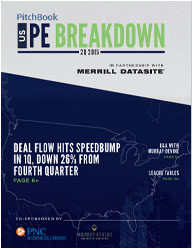
PitchBook unveils 2Q US ‘Private Equity Breakdown Report’

BY Fraser Tennant

A wealth of insight into recent trends in the private equity space is showcased in the 2Q US ‘Private Equity Breakdown Report – newly published by data & technology provider for the global private equity and venture capital markets, PitchBook.

The report, an annual publication produced in partnership with virtual dataroom solution Merrill DataSite, offers data-driven analysis on deal flow, investment trends, exit activity and an overview of the year's fundraising activity.

The 2Q 2015 report includes: (i) deal volume and capital invested by year and quarter; (ii) investments by deal size, industry and region; (iii) buyout multiples and debt percentages; (iv) exits and fundraising overviews; and (v) league tables.

PitchBook’s headline figures show that during the first quarter of 2015, private equity investors completed 634 deals in the US worth $100.7bn – representing a 30 percent decrease in deal count and a 26 percent decrease in capital invested when compared to last year’s corresponding quarter.

In terms of fundraising, the report states that the number of closed funds dropped to 38 in 1Q 2015 - the lowest number since 3Q 2010 and a 55 percent decrease from 3Q 2014. As far as exits are concerned, the pace is reported as having slowed in 1Q 2015 with only 218 exits completed by private equity sellers.

“Private equity and M&A deal-making remains highly competitive across the board, driven by a huge amount of available cash and debt funding,” said Adley Bowden, PitchBook’s senior director of analysis. “This environment has led to a bit of a pullback in private equity deals, an increased focus on the middle-market and more non-traditional private equity transactions. As long as the current environment persists we expect private equity activity to stay in a similar range to the last several quarters as firms hunt for value and focus on the growth of their portfolio companies.”

The PitchBook report also features a Q&A with Jamie Spaman, managing director at Murray Devine, in which he discusses the current valuations environment and increased activity surrounding carve-out transactions.

Report: 2Q 2015 US Private Equity Breakdown Report


Shell agrees to buy BG Group in $70bn deal

BY Fraser Tennant

In a major deal likely to be one of the largest undertaken in 2015, Royal Dutch Shell and the BG Group, the UK’s third-largest energy company, have reached an agreement which will see Shell buy the oil and gas exploration giant in a $70bn deal.

Once complete, the deal, a cash and shares offer which will see investors gain a 50 percent premium on BG’s share price, has the potential to create a company worth almost $300bn.

According to Shell’s summary terms and metrics, the deal: (i) represents a value per BG ordinary share of 1350p, a premium of 52 percent; (ii) values BG equity at $70bn; (iii) will see BG shareholders own 19 percent of Shell; (iv) is a transaction underpinned by intrinsic asset value of BG; (v) is mildly accretive to earnings per share in 2017 and strongly accretive from 2018; and (vi) is accretive to cash flow from operations per share from 2016.

“This is an important transaction for Shell, accelerating the delivery of our strategy for shareholders," said Jorma Ollila, chairman of Shell. “The result will be a more competitive, stronger company for both sets of shareholders in today’s volatile oil price world. We believe that the combination is in the interests of both our companies and their shareholders.”

Commenting on the deal, BG chief executive Helge Lund said: “The offer from Shell delivers attractive returns to shareholders and has strong strategic logic. The consolidated business will be strongly placed to develop the growth projects in BG’s portfolio. The transaction will take time to complete, during which my team and I will remain committed to BG and our shareholders, and to safely delivering our 2015 business plan.”

Despite Mr Lund’s commitment, the BG chief, who joined the firm as recently as February 2015 amidst controversy over his $35m-plus pay package, will “probably move along” from his position if the deal goes ahead according to Shell’s chief executive, Ben van Beurden. 

The Shell/BG Group deal is expected to be concluded in early 2016 following regulatory and shareholder approvals, to be followed by a $25bn share buyback program commencing in 2017.

News: Shell offers 50 percent premium to buy BG for 47 billion

©2001-2026 Financier Worldwide Ltd. All rights reserved. Any statements expressed on this website are understood to be general opinions and should not be relied upon as legal, financial or any other form of professional advice. Opinions expressed do not necessarily represent the views of the authors’ current or previous employers, or clients. The publisher, authors and authors' firms are not responsible for any loss third parties may suffer in connection with information or materials presented on this website, or use of any such information or materials by any third parties.