
Businesses lax on tax transparency – EY

BY Richard Summerfield

In the face of increased regulatory pressure from the OECD, the European Commission and various national governments, tax transparency is becoming an extremely important issue. However, many companies lack the systems and resources to adequately respond to these new global tax disclosure and transparency requirements, according to a report from EY.

The report, ‘A new mountain to climb: tax reputation risk, growing transparency demands and the importance of data readiness’, surveyed 962 tax and finance executives across 27 distinct jurisdictions. It found that more than two-thirds of those surveyed believe that they would require additional resources to gather and provide the information required following the introduction of the OECD's base erosion and profit shifting project, and increasing government clampdowns on tax avoidance.

Though many of those firms surveyed believe that they are unable to meet their tax transparency obligations, interest in tax transparency in the corporate boardroom has never been higher.

According to EY, 83 percent of executives surveyed said they regularly brief the chief executive or chief financial officer on issues of tax reputation risk. Forty-three percent of executives regularly brief their audit committee. And 89 percent said they are somewhat or significantly concerned about media coverage as to how much companies pay in taxes.

“We are at a critical stage as the global tax environment evolves,” said Jay Nibbe, EY’s global vice chair of tax. "Increasing transparency readiness presents an opportunity not only to comply with new disclosure demands but also to proactively work to mitigate reputation risk. Getting prepared will require some additional investment in technology, data extraction capabilities, and new skills in people resources. It also involves increased awareness on how you think about your tax position, and how it could be perceived by a wide range of stakeholders.”

If companies hope to achieve compliance, internal tax professionals may need to change the way they report, track information related to the taxes they pay, and realign their IT systems accordingly.

Report: Businesses must augment tax transparency readiness to mitigate increasing reputation risk

Strong UK/US axis helps drive resurgence in UK deals market in Q1

BY Fraser Tennant

The UK deals market is experiencing a major resurgence, with Q1 deal volumes up 50 percent on Q1 2014 and total deal values increasing by 96 percent, according to a new deals index published by PwC this week.

The PwC Deals Index, a survey of 103 c-suite private equity and corporate respondents, tracks global deals over £25m involving a UK asset or acquirer. Much of the resurgence in UK deal activity, claims PwC, is due to the number of 'mega deals' and the ongoing availability of capital.

Key findings presented by PwC include the disclosure that although corporate activity was the main driver of growth in terms of deal numbers – accounting for 70 percent growth compared to growth of just 2 percent in private equity led deal numbers – private equity has turned its attention to much larger deals, with average deal sizes rapidly increasing from £97m to £235m in Q1 2015.  

As far as average corporate deal values are concerned, the Index finds them remaining steady at £153m in Q1 - up from £142m in the previous quarter.

“Although headline numbers across all deal sizes showed a decline in this quarter, the market for larger deals was significantly more positive driven by the improving macroeconomic environment, increased market confidence, favourable debt markets and a strong UK/US deals axis," commented Stuart McKee, PwC's head of corporate finance in the firm’s UK deals business.

Despite the positive outlook for the UK deals market highlighted by PwC, many survey respondents stated that they believe the rapid increase in UK M&A activity seen in Q1 will begin to slow later in the year, but that the outlook for Q2 remains positive. In terms of Q2 deals, 36 percent of corporate respondents said that they are likely to make an acquisition in Q2 2015, while 85 percent of private equity respondents made a similar claim.

“Embedded in these statistics are a number of transformational deals led by private equity,” explains John Dwyer, PwC’s global head of deal business. “Our latest research indicates that our survey panel expect deal activity to remain strong for the next six months before tailing off towards the end of 2015.”

Report: PwC Deals Index Q1 2015


Compliance professionals foresee increasing risk of bribery and corruption

BY Fraser Tennant

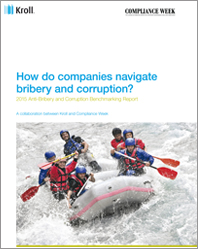
More than 50 percent of compliance professionals are expecting to be faced with an increasing risk of bribery and corruption over the coming year, according to a new report by the corporate investigations and risk consulting firm Kroll and Compliance Week.

The 2015 Anti-Bribery and Corruption Benchmarking Report – ‘How do companies navigate bribery and corruption?’ – is based on a survey of senior-level compliance professionals, 72 percent of whom say they expect to see the risk of bribery and corruption increase due to business expansion into new and unfamiliar markets.

Furthermore, despite 65 percent of compliance professionals stating that their businesses are likely to increase the number of their third-party relationships in future, 48 percent conceded that they never train third parties on anti-bribery and corruption matters – an “alarmingly high” figure, says the report, given the number of enforcement actions taken by regulators that involve third parties.

Recognising the issue with third parties, Kevin Braine, managing director with Kroll’s Compliance practice in EMEA, said: “While there has been phenomenal progress in the extent to which anti-bribery and anti-corruption issues have now made it on the training agenda for most large organisations, that’s still not really the case when it comes to training third parties.” 

Militating against this, only 8 percent of compliance professionals admit to not performing due diligence to hire or retain a third party, with the majority of companies employing risk-based factors to determine how much diligence they actually perform. On this point, the report reveals that 58 percent of compliance professionals rate their due diligence procedures as either “effective” or “very effective".

Further key findings in the report include: (i) more than 50 percent anticipate the bribery and corruption risks to their company will increase; (ii) 66 percent automate their anti-corruption program in some way; (iii) most automated tasks are limited to training; only 26 percent automate the vetting of third parties; and (iv) a majority (52 percent) are not confident in their financial controls to catch potential books-and-records violations of the Foreign Corrupt Practices Act (FCPA).

“Due diligence is really one of the keys to any type of compliance program, whether related to human trafficking, conflict minerals, anti-bribery and corruption, or anti-money laundering,” said Lonnie Keene, managing director with Kroll. “It is one of those elements that cuts across all of those obligations.”

Report: The 2015 Anti-Bribery and Corruption Benchmarking Report – How do companies navigate bribery and corruption?

CVS and Omnicare in $12bn deal

BY Richard Summerfield

CVS Health Corporation has agreed to acquire Omnicare Inc for a total enterprise value of approximately $12.7bn, including $2.3bn in existing debt. The deal will see CVS pay around $10.4bn, or around $98 per share, in cash. The agreed price represented a 4 percent premium over the company’s closing price on 20 May, the day before the deal was announced.

The two companies expect the deal to be completed near the end of 2015, subject to approval by the holders of Omnicare's common stock, as well as other customary closing conditions, including applicable regulatory approvals.

Omnicare has a burgeoning reputation in the pharmaceutical sector and is a rising firm in the business of prescription fulfilment for diseases including cancer and multiple sclerosis. The firm is also the largest provider of prescription medication to nursing, assisted living and other healthcare facilities in the US.

"The acquisition of Omnicare significantly expands our business, providing CVS Health access into a new pharmacy dispensing channel," said CVS Health's president and chief executive Larry Merlo, in a statement announcing the deal. "It also creates new opportunities for us to extend our high-quality, innovative pharmacy programs to a broader population of seniors and chronic care patients as they transition across the care continuum. We have been impressed by the Omnicare team and what they have created for the patients they serve."

CVS intends to complete the transaction by utilising $13bn of fully committed unsecured bridge financing which has been secured from Barclays Bank. The company also expects to put in place permanent financing in the form of senior notes and/or term loans prior to the closing of the transaction.

The rapidly ageing US population has made the long term care segment of the healthcare system an extremely attractive proposition. As such, CVS’ play for Omnicare positions the company nicely for the future, as healthcare for the elderly is likely to be a considerable growth area moving forward.

News: CVS to expand pharmacy business with $10.1 billion Omnicare buy

Forex five fined $5.7bn

BY Richard Summerfield

Five of the world’s largest banking groups have been handed fines totalling $5.7bn for their role in manipulating the foreign exchange market.

For the banks - JPMorgan, Barclays, Citigroup, RBS and UBS - the fines continue to stack up as the latest scandal to hit the banking sector once again makes headlines.

According to regulators, forex traders from the banks met in online chatroom groups, named ‘the Cartel’ and another ‘Mafia’, and colluded to set rates that cheated customers while adding to their own profits. "They acted as partners - rather than competitors - in an effort to push the exchange rate in directions favourable to their banks but detrimental to many others," said US Attorney General Loretta Lynch.

The fines, meted out by the US Department of Justice, and separately by the US Federal Reserve, bring total penalties related to rate rigging of the foreign exchange markets to nearly $9bn, according to the Justice Department. Indeed, in November 2014 a number of the same banks agreed to pay $4.25bn to resolve foreign exchange investigations by a raft of regulators.

Four of the five banks under investigation by the DoJ plead guilty – namely Barclays, RBS, Citigroup and JP Morgan. However UBS was granted immunity for being the first to report the manipulation of the $5 trillion a day forex. A sixth bank - Bank of America - was separately fined $205m by the Fed. Announcing the settlements, Ms Lynch said: “The penalty they will pay is fitting, it’s commensurate with the pervasive harm that was done. It should deter competitors from chasing profits without regard to fairness to law or public welfare."

Barclays has been the hardest hit institution; in total, the bank has been fined $2.4bn – the highest amount any bank has paid for the scandal. US banks JPMorgan Chase and Citigroup will pay $900m and $1.2bn in fines respectively. Citigroup’s fine included a $925m antitrust settlement. The firm called the scandal "an embarrassment to our firm, and stands in stark contrast to Citi's values”. RBS agreed to pay around $660m. UBS agreed to pay more than $500m in fines, some of which was earmarked for Libor crimes and the rest for currency manipulation.

News: Global banks admit guilt in forex probe, fined nearly $6 billion

©2001-2025 Financier Worldwide Ltd. All rights reserved. Any statements expressed on this website are understood to be general opinions and should not be relied upon as legal, financial or any other form of professional advice. Opinions expressed do not necessarily represent the views of the authors’ current or previous employers, or clients. The publisher, authors and authors' firms are not responsible for any loss third parties may suffer in connection with information or materials presented on this website, or use of any such information or materials by any third parties.