
Lockheed to buy Sikorsky for $9bn

BY Richard Summerfield

Lockheed Martin Corp announced this week that it had agreed to acquire military and commercial rotary-wing aircraft manufacturer Sikorsky Aircraft from United Technologies Corporation in a deal worth $9bn. The price of the deal will effectively be reduced to around $7.1bn once the tax benefit resulting from the transaction is taken into account.

The transaction, which is subject to the customary closing conditions including regulatory approval, is expected to be completed in Q4 2015 or Q1 2016. “Sikorsky is a natural fit for Lockheed Martin and complements our broad portfolio of world-class aerospace and defence products and technologies,” said Marillyn Hewson, Lockheed Martin’s chairman, president and chief executive in a statement announcing the deal. “I’m confident this acquisition will help us extend our core business into the growing areas of helicopter production and sustainment. Together, we’ll offer a strong portfolio of helicopter solutions to our global customers and accelerate the pace of innovation and new technology development.”

By completing a deal for Sikorsky, Lockheed - the Pentagon’s largest arms supplier - has secured its position as the world’s largest defence company, overshadowing rivals including the defence business of Boeing Co and Northrop Grumman Corp.

Sikorsky manufactures a range of military helicopters, including the Black Hawk, which is utilised by 25 nations for multi-mission support, and the Seahawk, used in marine operations. The company also makes commercial helicopters and fixed-wing aircraft for surveillance and transport missions.

“Exiting the helicopter business will allow UTC to better focus on providing high-technology systems and services to the aerospace and building industries, and to deliver improved and sustained value to our customers and shareowners,” United Technologies president and chief executive Gregory Hayes said in a separate statement.

In addition to the Sikorsky deal, Lockheed also announced a better than expected 4.5 percent rise in quarterly profit this week. The company also said it could spin off or sell its government IT and technical services businesses going forward.

News: Lockheed to buy Black Hawk maker Sikorsky for $9 billion
Celgene and Receptos agree $7.2bn merger

BY Richard Summerfield

On 14 July, Celgene Corp announced that it had agreed to acquire Receptos Inc in a deal worth approximately $7.2bn. The deal continues the trend of major M&A deals in the healthcare sector which has seen more than $250bn worth of M&A since January.

According to the terms of the deal, Celgene will pay $232 per share to acquire Receptos. The agreed price represents a 12 percent premium to the company’s closing price on the day the deal was announced. The transaction was made public after the markets had closed.

By acquiring Receptos, Celgene has gained access to the company’s valuable pipeline of products, most notably its treatment for multiple sclerosis and ulcerative colitis, ozanimod. The drug is currently in late-stage clinical trials with approval possible in 2018 for multiple sclerosis and the following year for ulcerative colitis. According to data from Celgene, ozanimod could generate peak sales of around $6bn annually.

“The Receptos acquisition provides a transformational opportunity for Celgene to impact multiple therapeutic areas,” said Robert J. Hugin, chief executive of Celgene, in a statement announcing the deal.

Celgene too has an impressive portfolio of products, the most prominent of which is the company’s blockbuster cancer treatment Revlimid.

As a result of deal speculation, Receptos has seen its market value nearly double since the turn of the year. AstraZeneca, Gilead Sciences and Teva were all rumoured to be interested in acquiring the company, although none were able to agree a deal.

For Celgene, the acquisition represents business as usual. The company has developed a reputation for M&A transactions to buy up smaller companies or licence their product lines. In 2014, the firm paid $710m to Irish firm Nogra Pharma to gain access to GED-03010, a treatment for Crohn’s disease. In June, the company invested $1bn in Juno Therapeutics, an organisation which manufactures experimental cancer medication.

According to Celgene’s statement, the deal for Receptos will impact the company’s earnings per share up to and including 2017. It will be neutral to earnings per share the following year and add to earnings from 2019 onwards. Celgene intends to finance the deal via a combination of existing cash on hand and new debt. The company intends to raise around $5bn in a bond offering in August.

The deal is expected to close in the second half of 2015.

News: Celgene to buy Receptos for $7.2bn; gains promising drug

Dissension in the ranks: Greek government in fresh turmoil over €86bn bailout deal

BY Fraser Tennant

Following the intense negotiations required to secure the €86bn conditional bailout deal with eurozone leaders, Greek prime minister Alexis Tsipiras now needs to do more tough talking – this time with his own coalition partners.

The first to highlight dissension within the ranks of the Greek government was Panos Kammenos, defence minister and leader of the Independent Greeks party, who likened the deal to that of a coup by foreign leaders. The junior coalition partner has made it clear that he will not support the measures included in the bailout deal.

Mr Kammenos said: “The agreement speaks of 50bn euros worth of guarantees concerning public property, of changes to the law including the confiscation of homes. We cannot agree to that."

The new bailout agreement has also to be approved by parliaments in a number of eurozone states.

Further examples of the strength of opposition in Greece to the terms of the deal include demonstrations at the Greek parliament and the announcement of a 24-hour strike by civil service workers.

“The Greek government made a 360 degree shift after six months of tenuous negotiations and accepted another devastating deal for Greece," says Dimitris Rapidis, a political analyst and director of the think-tank, Bridging Europe. “The government and its prime minister, Alexis Tsipras, grew public expectations immensely and irrelevantly, motivating 61 percent of the electorate to vote ‘no’ in the recent referendum.”

The financing deal agreed for Greece over the next three years (the third such bailout) is on condition that Greece passes all agreed reforms – which include tax revenue, liberalising the labour market, and pension and VAT reforms – by Wednesday 15 July.

Should the four pieces of legislation required not be passed by the Greek government, the deal will fail – leaving Greece’s banks facing a possible collapse and opening the door to the country's expulsion from the eurozone.

Adding to Greece’s short-term crisis is the International Monetary Fund’s (IMF) announcement that the beleaguered country had this week missed a debt repayment (€456m) for the second consecutive month.

“The social and electoral consequences for the Syriza party, and especially for Mr Tsipras himself, will be assessed mid-term,” asserts Dimitris Rapidis. “It’s important to point out that this bailout has no chance to succeed and improve the current economic conditions in Greece as there is no concrete growth plan, there is no commitment to address unsustainable debt and, above all, there is no plan to protect the most vulnerable parts of the society.

“On the contrary, by accepting such a program, Greece moves closer to a Grexit or, worse, to a continuous political instability and social unrest. This government had every chance to shift course, demonstrating a solid social appeal so far, even with bigger geopolitical risks for the country, but it finally chose to apply the same catastrophic recipe.”

Potential Grexit or otherwise, finance ministers from all 28 EU countries are convening on Tuesday 14 July to hold a scheduled meeting in Brussels to discuss the mounting debt crisis in Greece.

News: Eurozone Leaders Reach Rescue Deal for Greece, With Tough Conditions

$18bn merger sees Willis Group and Towers Watson become one

BY Fraser Tennant

Willis Group Holdings and Tower Watson have announced that they are to merge in an $18bn transaction that will create a major integrated global advisory, broking and solutions provider.

The signing of a definitive merger agreement between the pair - two highly complementary businesses combining in an all-stock merger of equals transaction – will, they say, "create an integrated global platform to drive long-term growth and market share gain in traditional and new businesses".

Upon completion of the merger, Willis shareholders will own approximately 50.1 percent and Towers Watson shareholders will own approximately 49.9 percent of the combined company on a fully diluted basis. The combined company will be named Willis Towers Watson.

The combination is also expected to result in a $100-125m cost saving within three years of closing – due mainly to increased efficiencies and the elimination of duplicate corporate costs and economies.

“These are two companies with world-class brands and shared values," said Dominic Casserley, CEO of Willis. “The rationale for the merger is powerful – at one stroke, the combination fast-tracks each company’s growth strategy and offers a truly compelling value proposition to our clients. Together we will help our clients achieve superior performance through effective risk, people and financial management. We will advise over 80 percent of the world’s top-1000 companies, as well as having a significant presence with mid-market and smaller employers around the world.”

Unanimously approved by both the board of directors of both companies, the combined entity will have approximately 39,000 employees in over 120 countries. 

“Our organisations share a client-first mentality and a focus on providing services and solutions that consistently exceed clients’ expectations," said John Haley, chairman and chief executive of Towers Watson. “As we bring these two companies together, we are confident associates across both organisations will enjoy increased development opportunities as part of a stronger and more global growth company.”

In terms of the leadership structure of Willis Towers Watson, James McCann (previously non-executive chairman of the Willis board) will become chairman; John Haley will be chief executive and Dominic Casserley will be president and deputy CEO. The board will consist of 12 directors in total: six nominated by Willis and six by Towers Watson.

Mr Casserley said: “We look forward to bringing Towers Watson’s innovative solutions to our clients alongside our broking and advisory services. The opportunity to deliver significant savings to our growing middle market client base with Towers Watson’s market-leading private exchange platform is particularly attractive.”

News: Willis Group and Towers Watson merge in $18bn deal


Global alt assets to reach $15.3 trillion

BY Richard Summerfield

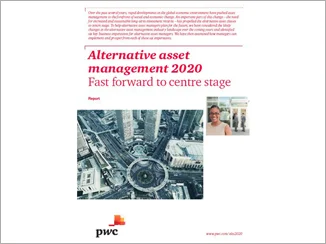
Global alternative assets are set to increase to $15.3 trillion by 2020, according to a new report from PwC.

This growth in alternative assets will likely be driven by a period of transformation in the global alternative asset management industry as parties active in the space recalibrate their business and operations and make technology a top investment priority.

The report, 'Alternative Asset Management in 2020: Fast Forward to Centre Stage', notes that though the predicted level of growth in the alternative assets space is expected to be achieved over the next five years, that growth is dependent on a number of factors. Primarily, it relies on the continued growth of global monetary policy and the stable development of global GDPs. However, the report notes that growth could drop to $13.6 trillion if interest rates in Europe and the US rise and capital markets undergo corrections.

Much of the expected growth in alternative assets is expected to come away from the traditional developed global markets. Indeed, South America, Africa and the Middle East are expected to be hotbeds over the next five years. "The shift in global economic power from developed to developing regions will drive continued focus on sovereign investors, fast-growing institutions and the emerging middle classes in new markets," said Mike Greenstein, global alternative asset management leader at PwC. "These groups of investors will increasingly seek branded multi-capability alternative investment firms. Currently, a number of alternative firms exist in this category and others will aspire to join them."

Growth in emerging markets is likely to be driven by key trends. The first is a government-incentivised shift to individual retirement plans. Generally speaking, the global population is rapidly ageing. With global pension fund assets expected to reached $56.6 trillion by 2020, alternative assets should play a larger role in allocations. Other growth trends include a marked increase in the number of high-net-worth-individuals from emerging populations and the growth of sovereign investors.

Report: Global alternative assets predicted to reach $15.3 trillion in 2020

©2001-2026 Financier Worldwide Ltd. All rights reserved. Any statements expressed on this website are understood to be general opinions and should not be relied upon as legal, financial or any other form of professional advice. Opinions expressed do not necessarily represent the views of the authors’ current or previous employers, or clients. The publisher, authors and authors' firms are not responsible for any loss third parties may suffer in connection with information or materials presented on this website, or use of any such information or materials by any third parties.