
Banks agree $1.9bn antitrust deal

BY Richard Summerfield

A number of the world’s biggest banks have agreed a $1.9bn settlement to resolve the claims of investors who alleged that the banks conspired to fix prices and freeze competitors out of the market for credit default swaps.

Twelve banks and two industry groups stuck a preliminary agreement with the plaintiffs in a civil suit which will see the financial institutions pay $1.87bn to settle the case, which was borne out of a raft of regulatory activity and private lawsuits which alleged that the banks manipulated foreign-exchange and commodity markets, as well as interest-rate benchmarks. Those cases have resulted in a number of banks paying fines worth billions of dollars.

Should the deal win final approval it will see the group of defendant banks - Bank of America Corp, Barclays PLC, BNP Paribas SA, Citigroup Inc, Credit Suisse Group AG, Deutsche Bank AG, Goldman Sachs Group Inc, HSBC Holdings PLC, J.P. Morgan Chase & Co, Morgan Stanley, Royal Bank of Scotland Group PLC and UBS Group AG – agree to pay one of the largest antitrust settlements in US history.

Though a tentative agreement has been reached there are still some issues which must be resolved. The settlement would also need to meet with a judge’s approval, but this is a significant step as it would avert a costly and expensive trial.

The plaintiff group, made up of a number of hedge funds, pension funds, university endowments, small banks and other investors, alleged that the banks "made billions of dollars in supracompetitive profits’ by taking advantage of ‘price opacity in the CDS market".

In an interview with Bloomberg TV Daniel Brockett, a partner at the plaintiffs’ law firm Quinn Emanuel Urquhart & Sullivan LLP, noted that the formal agreement of the deal would take about 10 days to come through. “We are pleased to have reached agreement on many of the important terms, including the amount of the settlement, but there are a few issues that remain to be discussed and negotiated," said Mr Brockett.

Under the terms of the settlement the banks will pay different amounts towards the settlement. The size of each bank’s contribution will be derived from its share of CDS trading.

A spokesman for the International Swaps and Derivatives Association (ISDA) said the group was “pleased the matter is close to resolution". He added: “ISDA remains committed to further developing [swaps] market structure to ensure the market functions safely and efficiently." ISDA had previously noted that the allegations against the banks were without merit.
News: Big banks in $1.865bn swaps price-fixing settlement

CKI to buy Power Assets in $11.6bn deal

BY Richard Summerfield

Cheung Kong Infrastructure Holdings Ltd has announced plans to merge with its power utility affiliate Power Assets Holdings Ltd in an all shares deal worth $11.6bn, creating in the process an infrastructure giant.

The deal will see the infrastructure division of Hong Kong businessman Li Ka-shing, which already owns 38.9 percent of Power Assets; acquire the remaining outstanding share in the company. Following completion of the deal, all shareholders of the newly merged company will receive a special dividend of around $0.65.

In completing the deal, CKI will gain access to Power Assets' considerable cash pile, which CKI will utilise both to shore up its balance sheet and to pursue further expansion. At the end of June, Power Assets had around $7.47bn of net cash available, far outstripping the net cash available to CKI. We will continue to carry out deals in the future and then reinvest money into the company," CKI Chairman Victor Li said at a news conference announcing the deal. "As an infrastructure company, the larger we get, the larger deals we can do."

Once the deal has been completed, the newly merged company will control a number of businesses across a variety of sectors, including energy infrastructure, transportation infrastructure, water infrastructure, waste management and other infrastructure related businesses.

CKI has undergone a period of significant renewal in 2015. In January it restructured itself, creating two listed companies. Cheung Kong Property Holdings focuses on property, while CK Hutchison Holdings focuses on telecoms, retail, aircraft leasing and port assets.

In order to finance the deal, CKI will issue 1.36 billion new shares, according to a joint securities filing announcing the acquisition. Under the terms of the deal, Power Assets will delist from the Hong Kong stock exchange once the transaction has been completed. The two companies expect the deal to close in the first quarter of 2016.

The companies already have a solid history of collaboration; CKI and Power Assets have been involved in 11 infrastructure projects together in recent years. These projects included several high profile projects in Europe and the UK.

News: Li Ka-shing's CKI to buy out Hong Kong utility in $11.6 billion deal

Pay freeze hits FTSE 100 CEOs

BY Fraser Tennant

Pay restraint continues to hit senior executives with over a third of FTSE 100 CEOs experiencing a salary freeze this year, up from a quarter in 2014, according to new analysis by PwC. 

The ‘Taking stock – Review of 2015 AGM season’ report reveals that while almost all CEOs still receive a significant bonus each year, pay rose by a median 3 percent (meaning a CEO median base salary of £891,000 for 2015).

The PwC analysis also shows that organisations are improving their bonus disclosure policies and making pay more of a challenge to earn by requiring senior executives to hold onto shares for longer as well substantially beefing up clawback conditions.

“Remuneration Committees have again exercised pay restraint," says Tom Gosling, executive pay partner at PwC. “This continues the trend of largely static executive pay levels in real terms since the financial crisis. But with the average FTSE 100 CEO earning in a year what several ordinary people might earn in a working lifetime, remuneration committees need to make sure that pay-outs are fully justified by performance to help rebuild trust in business.”

Furthermore, the report states that: (i) bonus outcomes are also largely unchanged from the previous year; (ii) the maximum bonus FTSE 100 CEOs can receive as a percentage of salary has not changed since 2011; (iii) median bonus pay-outs have been unchanged for the past three years at 72 percent of the maximum award available; and (iv) CEOs at four out of five companies were paid more than half the maximum bonus and just 4 percent of companies paid zero bonus. 

Mr Gosling continues: “The consistency in bonus pay-outs is raising questions about how well variable pay is living up to its name. To build trust in the system, remuneration committees must continue to improve the quality of disclosure about how bonus targets are set and whether they are sufficiently stretching. This is likely to be where shareholders’ focus will shift next.

“There’s been growing dissatisfaction with long-term incentives, which are often seen as a lottery and too complicated. In response companies are looking for performance measures that more closely link to company strategy. At the same time they’re satisfying shareholder demands by increasing the length of time that shares must be held.”

The PwC report is based on analysis of FTSE 100 annual reports in the 12 months to 31 May 2015.

Report: Taking stock – Review of 2015 AGM season


M&A appetite in UK outpaces US and Europe

BY Fraser Tennant

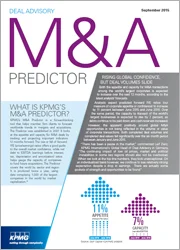
The appetite and capacity for M&A deals among the UK's largest corporates is currently exceeding that seen in the US and Europe, according to the new edition of the KPMG Global M&A Predictor published this week.

The M&A Predictor – a tool that helps member firm clients to forecast worldwide trends in mergers and acquisitions – reveals that, between June 2015 and June 2016, the forward P/E ratios (KPMG’s measure of corporate appetite or confidence) of the UK’s largest corporates are forecast to increase by 13 percent.

In comparison, the P/E ratios for corporates in the US and Europe are forecast to be 6 percent and 8 percent respectively.

 “With the debt markets more accessible than they have been for some time, our view is that the capacity for deals by UK corporates is showing little sign of diminishing," declares Andrew Nicholson, KPMG’s head of M&A in the UK. “Couple this increasing buoyancy with a more stable economy and a greater convergence between vendor and purchaser price expectations, and all the signs are there that UK deal volumes will increase steadily over the coming months.”

However, despite Mr Nicholson’s view that the outlook for M&A in the UK remains bright, the M&A Predictor data also highlights the fact that increasing confidence still does not appear to be reflected in actual transaction levels (completed deal volumes fell in the UK and globally over the six-month period from January to June 2015).

“Globally, it feels like there has been a slight slowdown in the market,” concedes Mr Nicholson. “The continuing impact of low oil prices and political instability in some regions should not be overlooked and, of course, one wonders whether this will be exacerbated by the recent volatility seen in the capital markets. However, we continue to have strong expectations for deal activity in the coming months and there are real pockets of strength to be found.”

In terms of sector expectations, the M&A Predictor confirms the ongoing challenges facing the global energy sector, as evidenced by the 19 percent fall (accompanied by a drop in profits) in market capitalisations of the largest energy companies between June 2014 and June 2015.

Further afield, the M&A Predictor notes that the defensive healthcare sector appears stable (an 18 percent increase in market capitalisation and a 7 percent rise in appetite for M&A) as does telecommunications, with an 8 percent increase in M&A appetite.

Report: M&A Predictor - September 2015

Berkshire Hathaway boosts Phillips stake

BY Richard Summerfield

Fresh on the heels of the firm’s $32bn acquisition of Precisions Castparts, Berkshire Hathaway has announced that is has a taken a $4.48bn stake in oil refiner Phillips 66, making it the company’s biggest shareholder.

According to a filing made with the US Securities and Exchange Commission on Friday evening, Berkshire has amassed a 57.98 million share, or 10.8 percent stake in the company. The move marks a return to the business after divesting two-thirds of its stake last February.

In 2014, Berkshire traded a significant portion of its stake in the Phillips 66 unit for a chemical-business investment which was subsequently absorbed by Berkshire’s Lubrizol division.

However, Berkshire is believed to have begun rebuilding its holding in Phillips 66 in the second quarter of 2015, when it bought $3.09bn worth of equities in the firm. As a result of the conglomerates announcement, Phillips shares closed Friday at $77.23.

Since Berkshire traded away the majority of its holding in Phillips, the firm has continued to blossom. Since the spinoff, Phillips stock has more than doubled in value.

Berkshire’s disclosure underlines its belief that the energy sector is likely to be a growth area. This is Berkshire’s most significant energy investment in around two years, though it only represents a mid range investment by Berkshire’s standards. The conglomerate, which has a diverse portfolio of over 80 firms, typically takes much larger holdings, including $20bn stakes in Wells Fargo & Co. and Kraft Heinz Co. The firm also has a $10bn holding in Coca Cola and IBM.

Berkshire hopes that low oil prices will continue to drive demand for gasoline, diesel and other petroleum products. This demand has been ably demonstrated in the US over the last 12 months; since prices began to tumble last year, gasoline demand in the US has climbed to an eight year high. Following the company’s outlay in Phillips 66, Berkshire will hope this demand continues to grow.

News: Buffett's Berkshire takes $4.48 billion stake in Phillips 66


©2001-2026 Financier Worldwide Ltd. All rights reserved. Any statements expressed on this website are understood to be general opinions and should not be relied upon as legal, financial or any other form of professional advice. Opinions expressed do not necessarily represent the views of the authors’ current or previous employers, or clients. The publisher, authors and authors' firms are not responsible for any loss third parties may suffer in connection with information or materials presented on this website, or use of any such information or materials by any third parties.