CFOs adopting mood of caution in early 2016

BY Fraser Tennant

A cautious mood currently pervades the chief financial officers (CFOs) of the UK’s largest companies, according to Deloitte’s new Q4 2015 CFO Survey - widely accepted as a key barometer of the sentiment and strategies of the UK’s corporate world.

The survey, the 34th focusing on the views of CFOs and group finance directors of major UK companies, features three key findings: (i) risk appetite has shrunk and business confidence has fallen back to 2012 levels; (ii) support among CFOs for UK membership of the EU has narrowed, although a majority still favour UK membership; and (iii) CFOs’ balance sheet strategies are more defensive now than at any time in the last three years.

When quizzed about their company’s prospects for growth in 2016 compared to three months ago, 30 percent of CFOs said they were less optimistic (up from 20 percent in Q2), while 12 percent said they were more optimistic (down from 36 percent six months ago).

“UK corporate sector risk appetite has fallen to a three and a half year low mirroring the loss aversion and caution being seen in financial markets," said Ian Stewart, a chief economist at Deloitte. “With a much sharper focus on cost control and less emphasis on growth through acquisitions and capital spending, CFOs’ strategies are more defensive than at any time in the past three years.

“The surge in business confidence that started in late 2012 went into reverse in 2015. CFOs are reacting to uncertainties abroad by cutting back on risk taking and sharpening their focus on cost reduction. The more defensive stance by CFOs points to a softening in the growth of corporate hiring and capital spending in coming months.”

In terms of whether it is in the interests of UK businesses for the UK to remain a member of the EU, 62 percent of CFOs said they were in favour of the UK remaining in the EU (down from 74 percent in Q2). Furthermore, 28 percent made it clear that their decision will depend on the outcome of the prime minister’s renegotiation of UK membership.

“A clear majority of CFOs continue to favour the UK remaining in the EU, but the proportion of those expressing unqualified support has fallen," said David Sproul, senior partner and chief executive of Deloitte. “This mirrors what we have seen from the broader public in opinion polls in the last six months."

The 2015 Q4 survey involved 137 CFOs, including the CFOs of 24 FTSE 100 and 62 FTSE 250 companies, and took place between 11 November and 2 December 2015.

Report: The Deloitte CFO Survey – the year ahead: A cautious start to 2016

Mega deals dominate in 2015

BY Richard Summerfield

2015 was the year of the mega deal. Last year there were more than 67 announced deals valued at $10bn and above for a combined total in excess of $1.86 trillion, according to Dealogic.

2015’s mega deal volume more than doubled 2014's $803.4bn total. Furthermore, the number of such deals surpassed the previous record of 48 set in 2006. Transactions valued at $50bn or more in 2015 totalled around $730bn.

Many of the mega deals completed last year were the largest ever deals in their particular sector, including the tie up between Dow Chemical and DuPont. Pfizer's $160bn merger with Allergan is the largest healthcare deal in history, and the second-largest deal of any type on record.

The revival of the mega deal was part of a larger resurgence in general M&A activity over the last 12 months. Indeed, 2015 was a bumper year for deal making, with more than $4 trillion worth of announced deals.

The Americas was the most fertile region for mega deal activity, with around 50 deals announced in the region for a total value of $1.40 trillion. This is even more remarkable considering the region's previous record, set in 2014, of 19 mega deals for a total value of $512.1bn. Elsewhere EMEA and the Asia Pacific regions saw nine and eight deals respectively, for combined totals of $301.2bn and $171.8bn.

Global M&A volume has been on an upward trajectory since 2012, however the increase seen between 2014 and 2015 was remarkable.

It is not just the firms involved that have benefitted from the resurgence in mega deals; investment banks also enjoyed a bumper 2015. Fees from completed M&A advisory increased globally. According to Dealogic, Goldman Sachs led the global M&A advisor ranking in 2015 with $1.76 trillion. Morgan Stanley and JPMorgan also enjoyed a successful year with $1.50 trillion and $1.49 trillion respectively.

Report: Dealogic – M&A Statshot

Record breaking year for M&A

BY Richard Summerfield

2015 was a momentous year for M&A activity, with mega-deals once again a key feature of the corporate landscape.

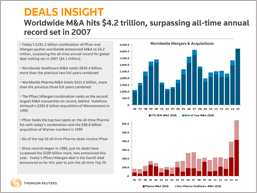
New data from Thomson Reuters suggests that M&A activity totalled $4.2 trillion in 2015, breaking the all time annual record thanks to a 42 percent increase over 2014’s record. Mega deals were undoubtedly the driving force behind the impressive figures recorded this year.

"It's the most prolific year that we've ever seen since we began tracking M&A in 1980," said Matthew Toole, Thomson Reuters’ Director of Deals Intelligence. "Companies are looking for revenue growth, they're also looking to streamline and get rid of businesses that are non-core.

"And as companies consolidate at the top, it filters down to other companies looking to see what do we need to do to compete in this landscape," he added.

According to Thomson Reuters, the $191.5bn merger of Pfizer and Allergan was the deal which pushed 2015 past 2007’s record of $4.1 trillion. The healthcare and pharmaceutical sectors were two of the most prolific for deal activity, seeing $649.4bn and $415.6bn worth of deal activity respectively.

In the context of recent years, 2015 was a show stopping year for both industries. The $649.4bn worth of deals recorded in the healthcare space equates to more than the previous two full years worth of deals combined. For the pharma sector, 2015 exceeded the combination of the last three full years combined.

Financial engineering played a significant role in the success of some of the bigger deals in the pharma and healthcare spaces. Inversion deals, which have angered politicians on both sides of the aisle in the US, have continued to be a major factor in US deal making. Pfizer took advantage of an inversion to relocate to Ireland, and substantially reduce its tax bill.

Away from the pharma and healthcare industries, there were a number of other impressive deal making hauls. Though the number of announced deals globally declined from 2014 by 2.1 percent to 39,687, there was record M&A activity in five sectors: healthcare, consumer products, retail, technology and industrials.

Furthermore, for the first time ever, there were three consecutive trillion-dollar-plus quarters in 2015, thanks to large deals including the Pfizer/Allergan tie up and Anheuser-Busch InBev's planned $120.8bn merger with SABMiller.

However, 2016 is likely to be a more challenging year. With political uncertainty likely and further interest rate increases expected, we may see a drop in deal making.

Report: Thomson Reuters Deals Insight M&A 2015

Britain’s tech sector boom

BY Richard Summerfield               

The tech sector has enjoyed a meteoric rise in recent years. Developments such as the Internet of Things, Big Data and the Cloud have become key features of the modern corporate landscape.

In the UK, the tech sector is booming. Over the last five years 45,000 new technology firms have been created in the UK, equivalent to one new firm ever hour, according to a new report from KPMG. Though London and the South East have remained the most popular locations for tech sector development, surprisingly a large portion of the growth has been spread throughout the UK. Sixty-three local authorities achieved double digit growth in the number of tech enterprises over the last 12 months. Fifteen of the fastest growing local authorities were found within the capital, including Hackney, Newham, Islington, Camden, Bexley, Havering, Waltham Forest, and Barking and Dagenham.

The past six years have seen steady growth in job creation within the UK’s technology space. That said, 2015 saw a slowdown, hitting the lowest level in two and a half years in Q3 2015, with profitability falling for the first time since Q1 2013. Nevertheless, the long-term trend is positive.

 “We can therefore be justly proud of the Tech scene and be optimistic for the future of what must be a key sector for the UK,” said Tudor Aw, KPMG’s Technology Sector Head. “It is important however, that more be done to help ensure the continued growth of the sector, particularly around STEM subject education, regulatory and fiscal conditions, and last but not least, profile within the media to highlight the importance and success of the sector."

The UK’s primary tech cluster remains in Reading. More than one-in-five enterprises (22 percent) based there are tech sector firms, which is almost three times the national average of 8 percent. Throughout the last 12 months, Warwick has seen the fastest increase at 28 percent, followed by Hackney at 25 percent increase and Rotherham at 21 percent.

Clusters of tech sector specialisation seem to be forming around the country. The South Cambridgeshire cluster, for example, is notable for biotech ; while Nuneaton & Bedworth is renowned for automotive-related tech. The City of London is, unsurprisingly, the focal point for FinTech development.

Optimism surrounding the industry remains high. Fifty-four percent of respondents to KPMG’s survey anticipate a rise in business activity over the next 12 months, while only 7 percent predict a decline.

Report: KPMG Tech Monitor UK

EBA confirms “no exemption” approach to banker bonuses

BY Fraser Tennant

Every bank is to be subject to the same staff bonus cap according to new guidelines published by the European Banking Authority (EBA) this week.

The regulator’s guidelines, its final statement on remuneration policy, are designed to ensure that financial institutions correctly and consistently calculate the bonus cap by mapping remuneration components into either fixed or variable pay, as well as detailing allowances, sign-on bonuses, retention bonuses and severance pay.

The EBA does, however, recommend exemptions from certain aspects of the EU's latest Capital Requirements Directive (CRD IV) remuneration rules for smaller banks and operators, such as asset management firms.

To this end, the EBA is of the opinion that legislative action is required in order to clarify and ensure that the CRD remuneration requirements are applied consistently across the EU. At present there are a number of national rules regarding the application of proportionality, including the waiving of requirements, which has led to an uneven playing field between institutions across the EU.

“While smaller asset managers and banks will be relieved that the EBA believes the deferral rule should not apply to them, for larger asset managers the situation is particularly concerning," asserts Jon Terry, a reward partner at PwC. “The EBA appears to be suggesting that they should no longer be able to avoid remuneration requirements on deferral and payment in instruments.”

However, the EBA’s attitude does not constitute a legal basis and the guidelines are essentially “neutral” on this particular aspect. For the moment, the CRD general principle of proportionality determines how waivers are applied – a scenario very much subject to change.

"Many assets managers and smaller banks will be very concerned that the EBA is proposing changes to the Directive that would require that all firms, regardless of size, will be subject to the bonus cap. It appears current practices will apply for 2016, and the guidelines have simply provided a stay of execution until 2017. Although the situation is not yet certain - changes will need to go through the European legislative process, which can be lengthy.”

The EBA Guidelines, based on the so-called ‘comply or explain’ principle meaning that Competent Authorities have two months to state whether or not they will comply with them, are due to come into force across the EU on 1 January 2017.

Report: EBA guidelines on sound remuneration policies

©2001-2026 Financier Worldwide Ltd. All rights reserved. Any statements expressed on this website are understood to be general opinions and should not be relied upon as legal, financial or any other form of professional advice. Opinions expressed do not necessarily represent the views of the authors’ current or previous employers, or clients. The publisher, authors and authors' firms are not responsible for any loss third parties may suffer in connection with information or materials presented on this website, or use of any such information or materials by any third parties.