Trans-Pacific Partnership: critics warn of “toxic” deal that rewards only the elites

BY Fraser Tennant

Since its signing in Auckland, New Zealand just a few days ago, the Trans-Pacific Partnership (TPP) agreement – a free trade agreement designed to liberalise trade and investment – has been the recipient of much fanfare as well as ferocious criticism.

As the largest regional trade accord in history (40 percent of global GDP ($107.5 trillion) and a market of 800 million people), the TPP has been styled as an ambitious, comprehensive, high standard and balanced agreement’ that will lower trade barriers, establish a common IP framework and introduce an investor-state dispute settlement mechanism.   

Upon signing the agreement, the 12 Pacific Rim signatories (Australia, Brunei Darussalam, Canada, Chile, Japan, Malaysia, Mexico, New Zealand, Peru, Singapore, the US and Vietnam) reiterated that the goal of the TPP was “to enhance shared prosperity, create jobs and promote sustainable economic development for all of our nations". 

However, critics of the TPP have never been far away and many have criticised the lack of transparency surrounding how the negotiations were conducted as well as the imbalance in the influence of the nations involved – the US and Japan having much greater trading power than the other TPP nations.

A campaign organised by the Citizens Trade Campaign has urged Congress to oppose the trade agreement. In a letter sent to supporters following the signing of the TPP, Arthur Stamoulis, executive director of Citizens Trade Campaign, said: “As you would expect from a deal negotiated behind closed doors with hundreds of corporate advisors, while the public and the press were shut out, the TPP would reward a handful of well-connected elites at the expense of our economy, environment and public health.

“The TPP would roll back environmental enforcement provisions found in all US trade agreements since the George W. Bush administration, requiring enforcement of only one out of the seven environmental treaties covered by Bush-era trade agreements. The TPP would also provide corporations with new tools for attacking environmental and consumer protections, while simultaneously increasing the export of climate-disrupting fossil fuels.

“We can’t afford a trade deal that threatens the air we breathe, the water we drink and the future we leave for our children and grandchildren.”

Further criticism came from the US-based global climate campaign 350.org which called the TPP “a toxic deal that would give dangerous new powers and pose a serious harm to the climate".

The next stage of the TPP is for the 12 countries involved to complete the domestic processes that are required to ratify the agreement.

News: Trans-Pacific Partnership trade deal signed, but years of negotiations still to come
European IPO activity: slight 2016 decline expected following “bumper” 2015

BY Fraser Tennant

Mega deals with a total value of more than €1bn made the European IPO landscape a hive of activity in 2015, according to a newly-published analysis of last year’s market.

Yet, despite the high levels of activity witnessed over the past 12 months, 2016 is expected to be somewhat more subdued, with market conditions serving to hinder IPO activity in the first half of the year especially.

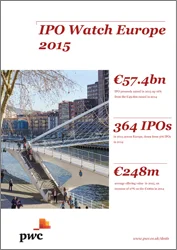
A key finding of PwC’s latest IPO Watch was that European IPOs finished 2015 on a high with total annual proceeds up 16 percent, totalling €57.4bn, and average offering value (excluding IPOs raising less than $5m) up 27 percent year on year, totalling €248m. In addition, London IPO proceeds decreased by 16 percent as the London market was impacted by general election fears, Chinese contagion and tumbling oil prices. PwC’s outlook for the London IPO pipeline, although still containing attractive investment opportunities, remains cautious and less optimistic than this time last year, with overall proceeds expected to fall in 2016.

Furthermore, the IPO Watch forecasts an increase in the number of postponed or cancelled deals in 2016, with many companies battling against the twin forces of market volatility and challenging market conditions. In fact, 61 IPOs were postponed or withdrawn in 2015 (2014 saw 49), 44 due to market conditions.

“As we start 2016, a cold chill has descended across pretty much every market globally – this is certainly a more complex climate to that of 2015,” said Vivienne Maclachlan, PwC’s Capital Markets director. “We rounded off last year with six bumper IPOs, which really saved the day from an annual IPO proceeds standpoint. But that stat really does mask the fact that overall it was not a particularly memorable year for London IPOs.

"This year, I would expect to see the number of companies coming to market to marginally decline, as investors continue to scrutinise investment opportunities and those that can wait, will wait. Having said that, I think 2016 proceeds will be bolstered by the continuing trend of mega deals - the too-big-to-miss-out sentiment - and that we will see a recovery towards the middle of the year.”

PwC’s IPO Watch surveys all new primary market equity IPOs on Europe’s principal stock markets and market segments (including exchanges in Austria, Belgium, Croatia, Denmark, France, Germany, Greece, the Netherlands, Ireland, Italy, Luxembourg, Norway, Poland, Portugal, Romania, Spain, Sweden, Switzerland, Turkey and the UK) on a quarterly basis. Movements between markets on the same exchange are excluded.

The survey was conducted between 1 January and 31 December 2015 and captures IPOs based on their first trading date.

Report: IPO Watch Europe 2015

M&A deals drop in oil & gas space

BY Richard Summerfield

Strong headwinds in the oil & gas markets and wider global economic uncertainty have made a significant impact on deal making over the last two years. Indeed, mergers and acquisitions activity in the US oil & gas industry plummeted to its lowest fourth quarter period in five years, according to a new report from PwC.

PwC’s Q4 Oil & Gas Deals Analysis noted that Q4 2015 saw 42 deals in the oil & gas space with values of $50m and above. Those deals recorded in the final quarter of last year were worth $31.6bn. The previous year saw 70 deals worth $103.4bn during the same period. 2015 saw a 69 percent decline in total deal value year on year.

Doug Meier, PwC’s US Oil & Gas Sector Deals Leader, said, “Accelerating declines in oil and gas prices coupled with the closing of the capital markets for oil and gas companies during the second half of 2015 drove management teams to focus on cash preservation. As oil prices stay lower for longer, cash flow will stay constrained resulting in companies operating in survival mode with a focus on realigning their strategies and business models. This internal focus resulted in a steady decline in oil and gas deal activity leading to the lowest fourth quarter in five years, a period that is typically strong for oil and gas deals.

"While the headlines appear depressing, deal-making opportunities exist for companies with dry powder and who are willing to use their equity as currency for doing deals. Looking at the subsectors, midstream companies, including MLPs, were hit with a devastating left-right combination of dramatically lower stock (unit) prices and closed capital markets, resulting in a precipitous decline in the fourth quarter midstream deal activity," he added.

The difficulties seen in deal making in the US in Q4 were experienced the world over last year, according to PwC’s data. In 2015, worldwide power and renewables deal value reached $199bn, a decline of 16 percent from the $236.2bn recorded in 2014. However, in spite of this decline, renewable activity boomed in 2015, nearly doubling year on year from $28.3bn in 2014 to $55.3bn in 2015. Renewables’ share of deal value rose from12 percent in 2014 to 28 percent in 2015.

Europe and the Asia-Pacific region were the most popular locations in terms of number, by both bidder and target in 2015, with 313 and 318 deals in each region respectively. The US led the field on total deal value.

Looking ahead, PwC expects Europe to be a strong focus of activity in 2016 as the region continues to provide the highest volume of global power and renewable deal activity, although deal numbers and value dipped in 2015.

Report: PwC’s Q4 Oil & Gas Deals Analysis

Fifth column risks rise - EY

BY Richard Summerfield

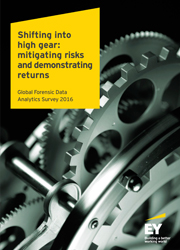
Cyber breaches and the threat posed by malicious insiders are two of the biggest risks driving investment in global forensic data analytics (FDA), according a new report from EY.

EY's 2016 global forensic data analytics survey, ‘Shifting into high gear: mitigating risks and demonstrating returns’, notes that insider threats  in particular offer the biggest risk to organisations becoming a victim of fraud, corruption or data loss. The most prominent forms of inside threat, according to respondents, include malicious insiders stealing, manipulating or destroying data.

The survey questioned 665 executives globally across a wide range of industries including the financial services, life sciences, manufacturing and power and utilities sectors. From the available data, it is clear that concerns around cyber security are helping to crystalise opinions across industry boundaries; indeed, companies are turning to FDA to try to counteract cyber threats.

Companies have been spurred into action by increasing activity among cyber criminals as well as aggressive regulatory pressure. Rising demands from both governmental bodies and the general public is driving much of the investment in FDA, notes EY. Forty-three percent of respondents claimed regulatory pressure was one of the main driving forces behind their FDA investment, second only to the burgeoning threat posed by cyber crime.

Of those executives surveyed, 44 percent reported an increasing level of concern over “bribery and corruption risk” while 62 percent noted an increasing concern over  “cyber breach or insider threat”.

Given the recent spate of major, headline grabbing cyber attacks, it is little surprise that breaches are weighing heavily on executive minds the world over. As companies take steps to protect their physical and digital assets from internal and external threats, the FDA will continue to play an important role in helping them navigate such risks. Given the size of the fines and sanctions imposed on companies and individuals in recent years, c-suites are understandably concerned about regulatory enforcement around cyber risk.

With the c-suite increasingly worried about the threat of cyber risk and malicious internal actors

Many companies have been pouring considerable resources into bolstering their FDA efforts in recent years. Spend is expected to continue throughout 2016. In 2014, 64 percent of those surveyed believed that their investment in FDA was adequate, while in the latest survey only 55 percent felt the same. Furthermore, three out of five respondents said they intend to increase their FDA spend over the next two years.

Report: Shifting into high gear: mitigating risks and demonstrating returns

Bankruptcy snapshot reveals US filings up 46 percent in 2015

BY Fraser Tennant

The US business bankruptcy landscape saw bankruptcy filings increase by 46 percent in 2015 — due primarily to a challenging energy sector environment — according to a report released this week by BankruptcyData.com, a leading provider of information on companies in bankruptcy.

In the ‘Q4 2015 Business Bankruptcy Filings Report’, which breaks down business bankruptcy filings into factors such as industry, sales volume, company size, liability and asset ranges and public and private filings, a total of 79 publicly traded companies (with $81bn in combined pre-petition assets) are revealed to have filed for Chapter 7 or Chapter 11 protection in 2015.

Furthermore, eight of the 10 largest Chapter 11 filings were initiated by companies operating in the oil and gas, mining and related sectors — a substantial 51 percent of the total public bankruptcies seen in 2015. Overall, 40 of the 79 filings involved oil and gas and mining companies.

However, despite this significant uptick, the total assets entering Chapter 11 in 2015 increased only marginally in comparison with 2014; due, in the main, to the $40bn bankruptcy of Energy Future Holdings.

The analysis also shows that six of the publicly traded filings have assets above $3bn (compared to two filings the previous year) while there were 19 bankruptcies with assets over $1bn (compared to 11 the year before).

Looking forward to what 2016 has in store for the business bankruptcy landscape, many analysts, including distressed securities investor George Putnam, expect to see a further increase in activity in US bankruptcy courts.

"There could be a number of additional companies getting ready to file in 2016," said Mr Putnam. “The face amount of bonds that have not yet defaulted but are trading below 50 cents on the dollar jumped to about $80bn in December, a more than five-fold increase during 2015 and the highest level since the 2008-09 financial crisis."

In terms of overall US Bankruptcy Court trends, the BankruptcyData.com report notes that the 2015 figures represent approximately 33 percent of the business bankruptcy activity seen in 2009.

BankruptcyData.com said: “Low interest rates, a robust capital market with easy access to financing, out-of-court settlement alternatives, a slightly improving economy, the perceived cost of filing for bankruptcy and tighter bank lending decisions have driven the number of bankruptcy filings down over the last six years.

“Additionally, the recession eliminated many of the troubled companies, so the remaining relatively healthy businesses are able to borrow with little fear of raising rates keeping the filing rates down.”

Report: Quarterly Report of Business Bankruptcy Filings - Period Ending December 31, 2015

©2001-2026 Financier Worldwide Ltd. All rights reserved. Any statements expressed on this website are understood to be general opinions and should not be relied upon as legal, financial or any other form of professional advice. Opinions expressed do not necessarily represent the views of the authors’ current or previous employers, or clients. The publisher, authors and authors' firms are not responsible for any loss third parties may suffer in connection with information or materials presented on this website, or use of any such information or materials by any third parties.