Energy faces uncertain future as megatrends transform oil & gas sector

BY Fraser Tennant

Industry megatrends, such as historically low commodity prices, are transforming the oil & gas sector with a challenging future the likely outcome, according to PwC’s New Energy Futures report published this week.

Recognising the uncertainty clouding the sector’s future, the report proposes a framework which evaluates four potential future scenarios that could help companies successfully navigate an increasingly complex and volatile global market over the next 5 to 15 years.

The four are: (i)  the oil and gas sector evolves along current lines with limited government intervention; (ii) demand from energy consumers (retail & commercial) for cleaner energy drives the transition towards a low carbon; (iii) governments drive increased energy efficiency, expansion of renewable energy demand and accelerated development of disruptive technologies; and (iv) supply constraints are triggered through direct government action, such as implementing carbon legislation or withholding licences (e.g,. Shale, Arctic) or geopolitical disruption.

“Global demand for affordable, reliable energy will continue to grow for the foreseeable future, but there is a new longer-term backdrop, as the world transitions to a low carbon system,” said Viren Doshi, PwC’s Strategy& oil and gas leader. “Momentum to replace fossil fuels with cleaner energy sources is building, and oil and gas companies need to consider their futures in this context."

The report also recommends that companies across the oil & gas chain: (i) have a clear strategy and alignment with portfolio, decision making processes and capabilities; (ii) have an ability to be agile and resilient in uncertain times; (iii) have an innovative response to disruptive change using existing assets as well as technology, knowledge and capabilities; (iv) have a readiness to form alliances and collaborate across the supply chain; and (v) safeguard the social licence to operate by sustaining the trust and support of investors and wider stakeholders through increased transparency.

Jan-Willem Velthuijsen, PwC’s chief economist in Europe, believes that the recommendations will allow companies to “reassess their current strategy and plans, with implications for the operating model, partnering strategy, resourcing and technical capabilities and other areas".

Despite all the uncertainty and prediction of a challenging future, Mr Doshi is in no doubt as to oil and gas sector’s ability to innovate and adapt to a rapidly changing world: “Time and again, successful operators have demonstrated the ability to respond to challenges by taking a long term view, innovating, adapting and gauging major trends as they define medium-long term investment plans.

“We are convinced that they can do so again."

Mylan’s long deal wait over – shares plummet

BY Richard Summerfield               

Generic and speciality drug company Mylan N.V. has been in an acquiring mood for some time. In November the firm attempted a hostile takeover of rival drug manufacturer Perrigo, offering $26bn but being rebuffed.

However, last week Mylanannounced a deal for Swedish drug maker Meda for $9.9bn, including $2.7bn worth of existing debt. The agreed price for Meda’s shares – SKr165 per share – was more than double the company’s closing price of SKr86.05 on the day before the deal was announced.

Once completed, the transaction will see the combined company boast more than 2000 products including brand-name drugs, generics and over-the-counter medicines. The firm will have a presence in more than 165 countries.

“This transaction builds on everything we have put in place around the world, including our recent acquisition of the Abbott non-US developed markets specialty and branded generics business. Meda brings us greater scale, breadth and diversity across products, geographies and sales channels, and together we will have an even stronger global commercial infrastructure,” said Mylan’s chief executive, Heather Bresch.

But the acquisition has met with dismay among Mylan’s shareholders, partly because Mylan has offered more than 12 times Meda’s EBITDA. Analysts have suggested that the company may have been better off using the cash for other means, such as buybacks.

Following the announcement of the deal, shares of Mylan traded in the US plummeted, eventually closing down 18 percent at $41.42. The company also posted fourth quarter earnings last week, which were sluggish and lagged behind market expectations.

Meda’s shareholders, however, expressed their satisfaction at the transaction. Shares in the company, which are traded in Stockholm, rose 70 percent to $17.41. The company’s largest shareholders, Stena Sessan Rederi AB and Fidim S.r.l., which collectively own 30 percent of Meda, have already accepted the deal.

Despite the concerns of Mylan’s shareholders, and the high transaction value, the acquisition could make strategic sense in the long term, according to a number of analysts and industry observers. Mylan will significantly enhance its position in a number of key markets, including China, Russia and Southeast Asia.

Ms Bresch moved quickly to dismiss fears that the company had overpaid for Meda, “It will take a little time for everyone to catch up with the opportunity,” she said. “I think over the next days and months the value will be realised."

News: Mylan to Acquire Meda

Confidence in 2016 revenue growth is high, say global asset management CEOs

BY Richard Summerfield

Confidence among global asset management CEOs that revenue will grow in 2016 is currently at a high level (90 percent), according to PwC’s 19th Annual Global CEO Survey published this week.

The survey, which quizzed 189 asset management CEOs in 39 countries, also found that over the next three years this boom in confidence will rise to 95 percent.

However, a mere 30 percent of the CEOs said that they expected the global economy to improve over the next 12 months, a view that does not impact on the confidence they have in the ability of their company to achieve strong revenue growth this year and beyond.  

Additionally, the survey reveals that most asset management CEOs believe ‘responsibility’ will play an important part in their success in five years’ time. Furthermore, 86 percent stated that they will prioritise long-term over short-term profitability. Sixty-nine percent also said that they will report on both financial and non-financial matters, while 68 percent anticipate corporate responsibility being a core venture.

“Asset management is going through a time of fundamental change," said Barry Benjamin, global asset and wealth management leader at PwC. “This is a time of great opportunity for growth, yet asset managers need to become more innovative, leverage technology, manage a wider range of risks and use digital communication intelligently if they are to remain competitive. In ten years’ time the sector is likely to be far bigger, but asset management companies will look very different from today.”

As well as concerns over the global economy, global asset management CEOs see over-regulation, geopolitical uncertainty, volatile exchange rates and interest rate rises as major threats to growth. In addition to these, the survey also reveals that 61 percent of asset management CEOs believe that shifting customer behaviours are a threat to growth; 60 percent view cyber security as an escalating issue; and 61 percent consider stock market volatility to be a constant concern.

Yet, despite the threats identified by CEOs, Mark Pugh, UK asset and wealth management leader at PwC, believes that asset managers are on the right side of a number of powerful trends. He said: “Retirement patterns across the globe, especially in the UK with recent Pension Freedom reforms, are leading to opportunities as well as creating a wider set of stakeholders.”

News: Asset management CEOs positive as they innovate to take centre ground - PwC’s 19th Annual Global CEO Survey

Report: PwC’s 19th Annual Global CEO Survey

Trans-Pacific Partnership: critics warn of “toxic” deal that rewards only the elites

BY Fraser Tennant

Since its signing in Auckland, New Zealand just a few days ago, the Trans-Pacific Partnership (TPP) agreement – a free trade agreement designed to liberalise trade and investment – has been the recipient of much fanfare as well as ferocious criticism.

As the largest regional trade accord in history (40 percent of global GDP ($107.5 trillion) and a market of 800 million people), the TPP has been styled as an ambitious, comprehensive, high standard and balanced agreement’ that will lower trade barriers, establish a common IP framework and introduce an investor-state dispute settlement mechanism.   

Upon signing the agreement, the 12 Pacific Rim signatories (Australia, Brunei Darussalam, Canada, Chile, Japan, Malaysia, Mexico, New Zealand, Peru, Singapore, the US and Vietnam) reiterated that the goal of the TPP was “to enhance shared prosperity, create jobs and promote sustainable economic development for all of our nations". 

However, critics of the TPP have never been far away and many have criticised the lack of transparency surrounding how the negotiations were conducted as well as the imbalance in the influence of the nations involved – the US and Japan having much greater trading power than the other TPP nations.

A campaign organised by the Citizens Trade Campaign has urged Congress to oppose the trade agreement. In a letter sent to supporters following the signing of the TPP, Arthur Stamoulis, executive director of Citizens Trade Campaign, said: “As you would expect from a deal negotiated behind closed doors with hundreds of corporate advisors, while the public and the press were shut out, the TPP would reward a handful of well-connected elites at the expense of our economy, environment and public health.

“The TPP would roll back environmental enforcement provisions found in all US trade agreements since the George W. Bush administration, requiring enforcement of only one out of the seven environmental treaties covered by Bush-era trade agreements. The TPP would also provide corporations with new tools for attacking environmental and consumer protections, while simultaneously increasing the export of climate-disrupting fossil fuels.

“We can’t afford a trade deal that threatens the air we breathe, the water we drink and the future we leave for our children and grandchildren.”

Further criticism came from the US-based global climate campaign 350.org which called the TPP “a toxic deal that would give dangerous new powers and pose a serious harm to the climate".

The next stage of the TPP is for the 12 countries involved to complete the domestic processes that are required to ratify the agreement.

News: Trans-Pacific Partnership trade deal signed, but years of negotiations still to come

European IPO activity: slight 2016 decline expected following “bumper” 2015

BY Fraser Tennant

Mega deals with a total value of more than €1bn made the European IPO landscape a hive of activity in 2015, according to a newly-published analysis of last year’s market.

Yet, despite the high levels of activity witnessed over the past 12 months, 2016 is expected to be somewhat more subdued, with market conditions serving to hinder IPO activity in the first half of the year especially.

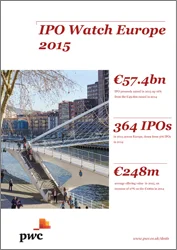
A key finding of PwC’s latest IPO Watch was that European IPOs finished 2015 on a high with total annual proceeds up 16 percent, totalling €57.4bn, and average offering value (excluding IPOs raising less than $5m) up 27 percent year on year, totalling €248m. In addition, London IPO proceeds decreased by 16 percent as the London market was impacted by general election fears, Chinese contagion and tumbling oil prices. PwC’s outlook for the London IPO pipeline, although still containing attractive investment opportunities, remains cautious and less optimistic than this time last year, with overall proceeds expected to fall in 2016.

Furthermore, the IPO Watch forecasts an increase in the number of postponed or cancelled deals in 2016, with many companies battling against the twin forces of market volatility and challenging market conditions. In fact, 61 IPOs were postponed or withdrawn in 2015 (2014 saw 49), 44 due to market conditions.

“As we start 2016, a cold chill has descended across pretty much every market globally – this is certainly a more complex climate to that of 2015,” said Vivienne Maclachlan, PwC’s Capital Markets director. “We rounded off last year with six bumper IPOs, which really saved the day from an annual IPO proceeds standpoint. But that stat really does mask the fact that overall it was not a particularly memorable year for London IPOs.

"This year, I would expect to see the number of companies coming to market to marginally decline, as investors continue to scrutinise investment opportunities and those that can wait, will wait. Having said that, I think 2016 proceeds will be bolstered by the continuing trend of mega deals - the too-big-to-miss-out sentiment - and that we will see a recovery towards the middle of the year.”

PwC’s IPO Watch surveys all new primary market equity IPOs on Europe’s principal stock markets and market segments (including exchanges in Austria, Belgium, Croatia, Denmark, France, Germany, Greece, the Netherlands, Ireland, Italy, Luxembourg, Norway, Poland, Portugal, Romania, Spain, Sweden, Switzerland, Turkey and the UK) on a quarterly basis. Movements between markets on the same exchange are excluded.

The survey was conducted between 1 January and 31 December 2015 and captures IPOs based on their first trading date.

Report: IPO Watch Europe 2015

©2001-2025 Financier Worldwide Ltd. All rights reserved. Any statements expressed on this website are understood to be general opinions and should not be relied upon as legal, financial or any other form of professional advice. Opinions expressed do not necessarily represent the views of the authors’ current or previous employers, or clients. The publisher, authors and authors' firms are not responsible for any loss third parties may suffer in connection with information or materials presented on this website, or use of any such information or materials by any third parties.