Global ETF AUM to top $7 trillion by 2021

BY Fraser Tennant

Exchange Traded Funds (ETFs) are expected to grow exponentially over the next five years, with global assets under management (AUM) set to top $7 trillion, according to a report released this week by PwC.

In ‘ETFs: A roadmap to growth’, PwC predicts that the ETF market will achieve further significant growth through entering new markets, expanding distribution channels and asset classes.

The report’s main findings show that: (i) the North American ETF market is expected to grow to $5.9 trillion by 2021 (a 23 percent cumulative annual growth); (ii) the European market is expected to grow 27 percent annually (reaching $1.6 trillion AUM by 2021); and (iii) Asian firms expect ETF AUM to reach $560bn by 2021 (an 18 percent annual growth rate over five years).

Furthermore, the top three segments that are driving this growth globally are financial advisoes, online platforms and retail investors (online platforms having overtaken wealth management platforms to take its place within the top three).

Also found to be a factor in the growth of ETF markets is the advances seen in technology and data analytics, which have encouraged new product creation and driven an evolution in distribution channels. In addition, says the PwC report, digital technology and Big Data will continue to enable successful firms to improve decision making processes, streamline costs and transform investor relationships.

“The global ETF market has a bright future ahead but the next few years will not be without their challenges," said Nigel Brashaw, global ETF leader at PwC. “The ETF market continues to be increasingly crowded, particularly in North America and Europe, where both maturity and momentum continues to dominate.

“Many firms are looking to expand their global footprint which presents challenges as well as opportunities with respect to local and global regulations, tax laws and establishing working relationships with distribution partners.”

Another key challenge and one cited as a major obstacle to growth by 47 percent of survey respondents is that of increased regulation.

Mr Brashaw continued: “Firms across the globe that wish to take advantage of the booming ETF industry will need to invest in investor education, differentiated products and strong distribution channels. There is plenty of competition in the sector and we expect the industry to grow at a healthy and accelerated rate.”

The PwC report surveyed executives (more than 70 percent of the participants were ETF managers or sponsors from approximately 60 firms around the world) during 2015 using a combination of structured questionnaires and in-depth interviews.

Report: ETFs: A roadmap to growth

Fighting a losing battle on cyber crime

BY Richard Summerfield

The war on cyber crime in the UK is going badly, according to a new report from the National Crime Agency. In its 'Cyber Crime Assessment 2016', released in collaboration with a number of industry partners, the The NCA acknowledges that it is falling behind cyber-criminals in many respects.

Cyber criminality is not only becoming more prevalent, but also increasingly sophisticated. The capabilities of cyber criminals are rapidly outstripping both law enforcement agencies and companies operating in the private sector. Techniques including DDoS attacks and ransomware increased significantly in 2015, and the majority of these attacks can be traced back to a few hundred international cyber criminals. The NCA tracked 2.46 million ‘cyber incidents’ in 2015, including 700,000 cases of fraud.

The report highlights that cyber criminals of all kinds, from "international serious organised crime groups" to hacktivists, have been targeting both UK businesses and individuals, emboldened by "the growing online criminal marketplace, which provides easy access to sophisticated and bespoke tools and expertise, allowing these less skilled cyber criminals to exploit a wide range of vulnerabilities".

In light of the heightened security risk posed by cyber criminals, the NCA has called on organisations to step up their defences and to work more closely with law enforcement agencies, the government, industry regulators and business leaders to fight back against attackers. If cyber criminals are to be defeated,  it will require companies to overcome the stigma attached with reporting cyber attacks. The UK government has pledged £1.9bn to help develop and deliver a national defence response and strategy over the next five years.

However, these efforts may be hindered by the chronic under-reporting of cyber breaches by UK firms. According to the NCA, under-reporting is a major issue, particularly given that companies are not required to notify regulators if they have been subject to a data breach or a cyber attack.

Under reporting has, according to the report, obscured the full impact of cyber crime in the UK, and impaired the efforts of law enforcement agencies that have been struggling to understand the operating methods of cyber criminals and are attempting to respond to the threats they pose. Only by working together will the public and private sectors in the UK be able to turn the tide.

Report: http://www.nationalcrimeagency.gov.uk/publications/709-cyber-crime-assessment-2016/file

Global IPOs on the up but rocky road ahead

BY Richard Summerfield

For the global IPO industry, the first quarter of 2016 was disappointing period, recording the weakest activity since the first quarter of 2009, according to EY's Global IPO Trends 2016 report. Although the second quarter of the year saw the IPO space enjoy a marked recovery, at the mid-year point activity remains significantly below the first half of 2015.

The second quarter of 2016 saw a 120 percent jump in capital raised, climbing to $29.6bn from 246 deals – up almost 29 percent on the first three months of the year. US capital raised was up 755 percent, Asia-Pacific was up 20 percent, and Europe, the Middle East and Africa saw an uptick of 187 percent. The UK and Greater China were the only major IPO destinations that failed to see an increase in capital raised. The most significant gains were made by Australia and New Zealand, which saw proceeds increase by 820 percent.

The report suggests that though things improved significantly in the second quarter, there is more to be done if 2016 is to match IPO activity seen in recent years. Worryingly, the market will remain at the mercy of a febrile global economy which looks set to remain in a period of uncertainty.

Given this  economic and political volatility, the IPO industry will experience an uncertain second half of the year. Speaking of the report, Jackie Kelley, EY Americas IPO leader, said: "Despite the substantial uplift in global IPO activity in the second quarter, there are still a large number of IPO-ready companies sheltering from continued volatility and waiting for much needed clarity on the global economic and political landscape. In the meantime, activity is slow but improving."

If the outlook improves, a number of IPO-ready companies are waiting to enter the market. However, concerns surrounding the UK’s EU referendum result, the impending US presidential election and persistent worries about the direction of interest rates are all likely to impact on IPO activity moving forward. There is, however, an impressive pipeline of technology IPOs developing in the US, which may encourage activity after the November election.

Report: EY Global IPO Trends 2016 2Q

Global M&A value in 1H 2016 hits $1.71 trillion

BY Fraser Tennant

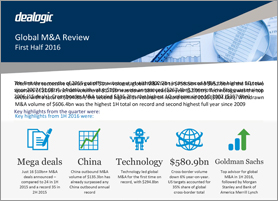
In its ‘Global M&A Review: First Half 2016’, Dealogic reveals that the total M&A value seen in the first half (1H) of 2016 was $1.71 trillion – an impressive figure in itself, although it represents an 18 percent year-on-year drop, from $2.09 trillion.

In terms of the key regional headline data, US targeted M&A volume was $748.5bn – down 18 percent year-on-year. Looking to Europe, the Middle East and Africa (EMEA), targeted M&A volume was $428.4bn, down 14 percent year-on-year and the lowest 1H total since 2011 ($67.1bn).

As far as global cross-border M&A volume is concerned, the review found that cross-border activity in 1H 2016 is valued at $580.9bn, down 6.6 percent year-on-year from $616.4bn. Furthermore, the US was the leading target accounting for 35 percent of volume ($205.8bn), up 39 percent year-on-year ($148.4bn) and the highest 1H volume on record.

In terms of Asia Pacific M&A, China accounted for 54 percent of targeted volume with $243.9bn – its highest 1H share on record and a record 21 percent share as an acquiring nation.

Leading the M&A adviser rankings is Goldman Sachs with transactions totalling $438.7bn, followed by Morgan Stanley on $330.0bn and Bank of America Merrill Lynch on $299.1bn.

Technology was the top sector with a total of $294.8bn, which was the second highest 1H volume on record (trailing the $304.6bn 1H volume seen in 2000). Conversely, the Telecom sector saw the biggest year-on-year drop among the top 10 sectors in 1H M&A deal volume – down some 70 percent from the $200.5bn seen in 1H 2015 to $60.7bn.

The Dealogic review also showcases the ‘Top 10 Announced M&A Transactions 1H 2016’ with Bayer’s $62.0bn bid for Monsanto in May 2016 top of the list.

Second on the list is the $48bn acquisition of Syngenta by China National Chemical Corp (ChemChina) in February 2016, the largest ever cross-border transaction by a Chinese acquirer. In third place is the April 2016 deal which saw Abbot Laboratories acquire St Jude Medical for $30.6bn.

Finally, the Dealogic data confirms that the total value of withdrawn M&A in 1H 2016, at $606.4bn, was more than double the same period in 2015 at $233.3bn. These withdrawn deals include the aborted transactions involving Energy Transfer Equity/Williams Companies in June 2016 and Pfizer/Allergan in April 2016.

US diesel emissions scandal results in Volkswagen making $15.3bn settlement

BY Fraser Tennant

In a settlement which it undoubtedly hopes will draw a substantial line under the matter, German carmaker Volkswagen AG has agreed to pay $15.3bn to settle the charge that it cheated on its diesel emissions tests in the US – a scandal which has rocked the automotive industry to its very core.

Volkswagen’s settlement agreement – reached this week in conjunction with the United States Department of Justice (DOJ), the State of California and the US Federal Trade Commission (FTC) – also resolves the civil claims regarding Volkswagen and Audi 2.0L TDI diesel engine vehicles in the US made by private plaintiffs (represented by the Plaintiffs’ Steering Committee (PSC)).

The diesel emissions scandal first became public in September 2015 when Volkswagen acknowledged that it had deliberately misled officials by installing secret software (the so-called ‘defeat device’) to circumvent US emissions tests (thus allowing US vehicles to emit up to 40 times the legal limit for safe levels of pollution).

Also part of the Volkswagen settlement is an agreement by the carmaker to buy back vehicles from affected consumers, as well as to provide funding that could profoundly benefit the creators of cleaner technologies (this includes a $2.7bn environmental remediation fund and the investment of $2bn to promote the use of zero emissions).

Furthermore, Volkswagen has also agreed with the attorneys general of 44 US states, the District of Columbia and Puerto Rico to resolve existing and potential state consumer protection claims in a settlement valued at approximately $603m.

“We take our commitment to make things right very seriously and believe these agreements are a significant step forward,” said Matthias Müller, chief executive officer of Volkswagen AG. “We appreciate the constructive engagement of all the parties, and are very grateful to our customers for their continued patience as the settlement approval process moves ahead.

“We know that we still have a great deal of work to do to earn back the trust of the American people. We are focused on resolving the outstanding issues and building a better company that can shape the future of integrated, sustainable mobility for our customers.”

Despite the settlement, the process represents only a partial resolution for Volkswagen, as the carmaker continues to face a criminal investigation which may result in company executives being held accountable for the wrongdoing related to its diesel emissions testing.

News: Volkswagen Agrees to $15 Billion Diesel-Cheating Settlement

©2001-2025 Financier Worldwide Ltd. All rights reserved. Any statements expressed on this website are understood to be general opinions and should not be relied upon as legal, financial or any other form of professional advice. Opinions expressed do not necessarily represent the views of the authors’ current or previous employers, or clients. The publisher, authors and authors' firms are not responsible for any loss third parties may suffer in connection with information or materials presented on this website, or use of any such information or materials by any third parties.