Global M&A volume down 22 percent YOY, reveals nine months review

BY Fraser Tennant

Mergers & acquisitions (M&A) activity during the first nine months of 2016 is the topic of a new report released this week by Dealogic.

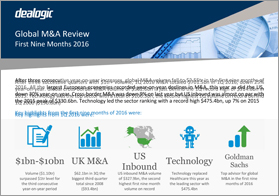
Among the headline figures contained in ‘Global M&A Review: Nine Months 2016’ is the 22 percent year-on-year (YOY) drop in M&A volume, down to $2.55 trillion from $3.27 trillion.  

In terms of key regional headline data, the report reveals that US targeted M&A volume was down 30 percent YOY. Furthermore, domestic US M&A volume fell 38 percent to $771.3bn.

Looking to M&A volume in Europe, the UK reached $62.1bn by the end of 3Q 2016, its highest recorded 3Q figure since 2008.

As far as global cross-border M&A volume is concerned, activity in the first nine months of 2016 was valued at $899.5bn, down 9 percent YOY. Furthermore, US inbound M&A was $327.9bn, only slightly behind the all time record of $330.6bn set in 2015.

In terms of M&A in the Asia Pacific region, China and Japan were the top acquiring Asian nations of US targets. Chinese acquisitions reached an annual record high for both volume and activity, with $35.7bn via 124 deals. Japan announced 132 deals worth $17.4bn, down 39 percent YOY.

Leading the M&A advisor rankings is Goldman Sachs with transactions totalling $613.3bn, followed by Morgan Stanley on $476.3bn and JPMorgan on $459.9bn.

Technology was the top sector (replacing healthcare) with a total of $475.4bn, just ahead of its previous record of $446.1bn in 2015. Conversely, healthcare, which also hit an annual record high in 2015, was down 48 percent YOY to $255.4bn.

The report also showcases the ‘Top 10 Announced M&A Transactions First Nine Months 2016’ with Bayer’s $66.3bn acquisition of Monsanto, announced in May 2016, top of the list. Second is the $46.7bn acquisition of Syngenta by China National Chemical Corp (ChemChina) in February 2016 - the largest ever cross-border transaction by a Chinese acquirer. In third place is the September 2016 deal which saw Enbridge Inc acquire Spectra Energy Corp for $43bn, in the largest Canadian outbound deal on record and the fifth largest utility & energy deal on record.

Finally, Dealogic confirms that the total of withdrawn M&A in the first nine months of 2016 was $752.8bn. This includes the $28.9bn Praxair/Linde deal and the $25.4bn Mondelez International/Hershey transaction.

Report: Dealogic – ‘Global M&A Review: First Nine Months 2016’
Bass Pros Shops catches Cabela’s in $5.5bn deal

BY Richard Summerfield

Fishing and hunting chain Cabela’s Inc. has agreed to be sold to rival Bass Pro Shops in a deal worth $5.5bn.

Under the terms of the deal announced on Monday, Bass Pro Shops has agreed to pay Cabela’s shareholders $65.50 per share held. The price represents a 19.2 percent premium to Cabela's most recent closing price on Friday. According to a joint statement released by the firms, the deal is expected to close in the first half of 2017.

In a separate deal, Capital One Financial Corp. has announced that it will be acquiring Cabela’s credit card business for an undisclosed amount. The sale of the credit card business will create a 10 year agreement which will allow Bass Pro Shops to issue credit cards to Cabela's customers.

News of the deal for Cabela’s has been welcomed not only by the company’s shareholders but also the markets. Indeed, Nebraska based Cabela’s, which has been in business since 1961, has endured a difficult few years which have seen the company’s larger stores outmanoeuvred by smaller, more dynamic rivals, including online retailers. The company’s difficulties have been reflected in its declining share price.

In light of the increased competition from a variety of sources, Cabela’s has experienced falling sales of apparel and footwear and has seen same-store sales growth in only one quarter in more than three years. The company had also been under pressure from activist hedge fund Elliott Associates LP, which revealed an 11.1 percent stake in the company a year ago.

Since rumours of a potential sale began to circle in December 2015 the company’s stock has risen 17 percent.

"Cabela’s is pleased to have found the ideal partner in Bass Pro Shops," said Tommy Millner, Cabela’s chief executive . "Having undertaken a thorough strategic review, during which we assessed a wide variety of options to maximise value, the Board unanimously concluded that this combination with Bass Pro Shops is the best path forward for Cabela’s, its shareholders, outfitters and customers. In addition to providing significant immediate value to our shareholders, this partnership provides a unique platform from which our brand will be extremely well positioned to continue to serve outdoor enthusiasts worldwide for generations to come."

The newly combined company will own more than 180 stores across the US and Canada.

“Today's announcement marks an exceptional opportunity to bring together three special companies with an abiding love for the outdoors and a passion for serving sportsmen and sportswomen," said Johnny Morris, founder and CEO of Bass Pro Shops. "The story of each of these companies could only have happened in America, made possible by our uniquely American free enterprise system. We have enormous admiration for Cabela’s, its founders and outfitters, and its loyal base of customers. We look forward to continuing to celebrate and grow the Cabela’s brand alongside Bass Pro Shops and White River as one unified outdoor family.”

News: Cabela’s Agrees to Buyout by Bass Pro in $5.5 Billion Deal

RBS agrees $1bn mortgage mis-selling deal

BY Richard Summerfield

Royal Bank of Scotland has agreed to pay $1.1bn to settle a number of legal claims in the US which alleged that the bank mis-sold mortgage securities in the run-up to the financial crisis.

RBS sold the securities to two credit unions, which failed after the US housing bubble burst in 2008. Accordingly, state-backed RBS, which has admitted no fault under the terms of the deal, has struck the settlement with the National Credit Union Administration Board (NCUA), which regulates credit unions.

The deal will see RBS resolve two lawsuits which had been filed in federal courts in California and Kansas by the NCUA, which had been acting as the liquidating agents for two failed credit unions.

Rick Metsger, chairman of the NCUA, said, "NCUA is pleased with today's settlement and fully intends to stay the course in fulfilling its statutory responsibilities to protect the credit union system and to pursue recoveries against financial firms that we maintain contributed to the corporate crisis."

The settlement brings the agency's recoveries against various banks to $4.3bn in lawsuits over their sale of mortgage-backed securities before the 2008 financial crisis.

Though RBS has finalised this deal with the NCUA, it is not yet out of the woods. The settlement with the NCUA board is just one of the three major issues that bank is currently facing regarding its selling practices in the build-up to the financial crisis. The bank must still address suits being brought against it by the Department of Justice and the Federal Housing Finance Agency (FHFA).

According to RBS, the settlement won’t have a material impact on the bank’s core capital ratio given that the $1.1bn payment will be “substantially covered by existing provisions”. In 2015 the bank agreed to pay $129.6m to settle a separate case with the NCUA. Though the most recent settlement will see the NCUA will dismiss its pending civil lawsuits against the bank, RBS is still defending against 15 civil lawsuits in the US, though it has not yet entered formal discussions with the DoJ.

Going forward, the bank is likely to have to pay out considerably more than $1.1bn to the DoJ and FHFA. Indeed, it is believed that ultimately the bank may be forced to pay a total of $13bn. Accordingly, RBS noted that it “may require additional provisions in future periods that in aggregate could be materially in excess of the provisions".

RBS is not alone in drawing the ire of the DoJ, with Deutsche Bank recently fined $14bn for mis-selling mortgage-backed securities.

News: RBS to pay $1.1 billion to resolve some of its U.S. mortgage claims

Lanxess to acquire Chemtura in $2.7bn cash transaction

BY Fraser Tennant

In a €2.4bn ($2.7bn) transaction that ranks as its largest ever takeover deal, German speciality chemicals company Lanxess AG has announced that it is to acquire US-based Chemtura Corporation, a global provider of high-quality flame retardant and lubricant additives.   

Under the terms of the definitive acquisition agreement, which will significantly expand Lanxess’ footprint in North America where approximately 45 percent of Chemtura’s revenue is generated, Chemtura shareholders will receive $33.50 per share in cash for each outstanding share of common stock held.

Furthermore, for Lanxess, the acquisition of Chemtura will be accretive to earnings per share in the first fiscal year and will be financed mainly through senior and hybrid bonds, as well as from existing liquidity.

“With this acquisition, we are forming a champion in the field of additives and are strengthening our already profitable portfolio,” said Matthias Zachert, chairman of Lanxess. “Through the acquisition, we are further implementing our strategy to become a more resilient and profitable chemical company, as well as significantly building on our competitive positioning in medium-sized markets.”

Once the transaction is complete, Lanxess, which currently has approximately 16,700 employees in 29 countries, will have built on its Rhein Chemie Additives business unit by adding Chemtura’s two additive segments to form a new performance additives with expected annual synergies of €100m by 2020.

Headquartered in Philadelphia, Pennsylvania, Chemtura encompasses 20 sites in 11 countries and approximately 2500 employees worldwide. In the last four quarters the firm reported sales of around €1.5bn.

“The transaction provides premium value to our shareholders and benefits our customers and employees by making Chemtura part of a much larger, stronger global enterprise with the resources to fully support a more diverse suite of specialty chemicals products and services,” said Craig A. Rogerson, president, chief executive and chairman of Chemtura.

The transaction,  expected to close around mid-2017, is subject to approval by Chemtura shareholders, required regulatory approvals and certain other customary closing conditions.

Recognising that his firm is set to become one of the world’s major actors in a growing market, Mr Zachert concluded: “Lanxess is taking a next and major step forward on its growth path.”

News: Germany's Lanxess to buy U.S. chemical firm Chemtura for $2.7 billion

Asian growth slower and profits elusory, says new EY/HBR Analytic Services report

BY Fraser Tennant

Opportunities for companies in the Asia-Pacific region to grow are fewer and profits more elusive, according to a new report by EY and Harvard Business Review (HBR) Analytic Services.

In ‘Asia: Time to Refocus’, EY/HBR Analytic Services note that despite Asia having been a major source of growth for multinationals and private equity firms for 20 years, expected profits have not materialised and the current outlook is that the land-grabbing strategies of old are no longer sustainable.

Moreover, the Asia-Pacific companies that once relied upon an almost unlimitless potential for growth but that are now struggling to adapt their products and value propositions, are being advised to adopt a ‘depth-over-breadth’ capital strategy in order to re-engage with the region’s complex business environment. 

“Asia today is not the Asia of 20 years ago, or 10 years ago, or even five years ago," said Vikram Chakravarty, EY’s Asia-Pacific capital transformation and operational transaction services leader. “It continues to grow faster than most developed economies, but more slowly than it did in the past.

“It remains a region of great opportunity, but also one where profitability remains elusive for those unwilling to invest the resources necessary to tailor their offerings and business models to its individual markets.”

The challenge for companies in the region, says Chakravarty, is for them to identify how and where they should be focusing their capital and other resources, and also where they should be taking a step back.

To do this, the EY/HBR Analytic Services report advises companies looking to transition to a new capital strategy in Asia to: (i) conduct a portfolio review; (ii) launch a large-scale cost-cutting initiative to improve profitability; (iii) right-size their go-to-market models; (iv) reorganise to emphasise country over category; (v) plan a path to exit, and limit losses, where market leadership and profitability are not realistic; and (vi) double down in priority countries by undertaking transformative deals — big-bang M&A transactions and partnerships — to boost market share quickly.

Chakravarty concluded: “Companies that have yet to see Asia’s promise cascade to the bottom line must determine where they have a path to profitability and focus their attention there. Depth, not breadth, will win the day.”

Report: ‘Asia: Time to Refocus’

©2001-2025 Financier Worldwide Ltd. All rights reserved. Any statements expressed on this website are understood to be general opinions and should not be relied upon as legal, financial or any other form of professional advice. Opinions expressed do not necessarily represent the views of the authors’ current or previous employers, or clients. The publisher, authors and authors' firms are not responsible for any loss third parties may suffer in connection with information or materials presented on this website, or use of any such information or materials by any third parties.