Period of ‘prolonged weakness’ for UK

BY Richard Summerfield

Since the UK voted in June to break away from the European Union, the country’s economy has been surprisingly resilient. That durability has made a mockery of the many apocalyptic predictions around Brexit which preceded the vote. Although sterling has tumbled in recent weeks, dropping under $1.21, the UK’s economy has been relatively trouble-free since the summer vote. Indeed, according to the 'EY ITEM Club Autumn Forecast' released this week, the UK’s economy is still expected to grow by 1.9 percent this year, driven by strong consumer spending, which is up by 2.5 percent, and very low inflation of 0.8 percent.

Yet despite of this positive outlook, the report claims that the UK is set for a period of ‘prolonged weakness’, thanks, in part to rapidly increasing inflation which is expected to reach 2.6 percent in 2017, before easing back to 1.8 percent in 2018. Consumer spending, too, is expected to slow to 0.5 percent in 2017 and 0.9 percent in 2018.

Uncertainty surrounding the nature of the UK’s future relationship with the EU is also likely to adversely affect corporate confidence. EY expects business investment to decline by more than 2 percent in 2017, after a drop of 1.5 in 2016.

Peter Spencer, chief economic advisor to the EY ITEM Club, comments: “So far it might look like the economy is taking Brexit in its stride, but this picture is deceptive. Sterling’s shaky performance this month provides a timely reminder that challenges lie ahead. As inflation returns over the winter it will squeeze household incomes and spending. The pressure on consumers and the cautious approach to spending by businesses mean that the UK is facing a period of relatively low growth.”

Though EY’s prediction is worrying, there is a silver lining: the pound’s weakened position is great news for the country’s exporters. Exports are likely to jump 4.5 percent in 2017 and 5.6 percent in 2018, according to the report. The resiliency of the export space is contingent, however, on the nature of the UK’s future relationship with the EU. Given that 45 percent of the country’s exports are to the EU, a ‘hard Brexit’ may spell trouble for the UK’s export industry.

Report: EY ITEM Club Autumn Forecast

Note fiasco sends Samsung profit up in smoke

BY Richard Summerfield

The smartphone industry is a fast moving and fickle market. As Samsung Electronics well knows, a company’s fortunes can rise and fall on the strength of a single device. When the company released its Galaxy S7 line of phones earlier this year, Samsung recorded its strongest profits in over two years.

In July, revenue of $45.2bn was up 5 percent on the previous year, while the firm’s operating profit was up 18 percent to $7.22bn.

However, as quickly as things can improve, they can fall apart. The debacle surrounding the release, replacement and subsequent recall of its Galaxy Note 7 device has plunged the company’s brand and reputation into chaos. Indeed, the furore surrounding Samsung’s exploding ‘phablet’ could not have come at a worse time for the South Korean firm, with major rivals Google and Apple launching competing devices in the last few weeks. It appears that Samsung’s brand and balance sheet may be adversely affected, contrary to what the company originally claimed.

Just last week, Samsung issued earnings guidance which claimed that the company’s recall of the device would not adversely impact its balance sheet. However, on Wednesday it said it expects third quarter profits of $4.7bn or 5.2 trillion won, around a third lower than its original estimate of 7.8 trillion won. The company has also dramatically reduced revenue expectations, cutting them by 2 trillion won to 47 trillion ($41.8bn).

Samsung also noted that in light of the difficulties it has had with the Note 7 device, it was stopping all sales and production of the phablet, citing consumer safety concerns. “For the benefit of consumers' safety, we have stopped sales and exchanges of the Galaxy Note 7 and have consequently decided to stop production," Samsung said in a statement.

The day before the company made the announcement, Samsung saw $18bn wiped off its market capitalisation. The following day the company’s shares continued to fall. How Samsung recovers from here will be telling. Undoubtedly, the momentum the firm built up through the release of the Galaxy S7 device has slowed considerably.

News: Samsung slashes profit forecast over Galaxy Note 7 crisis

The danger within: internal risks increasing, claims new PwC report

BY Fraser Tennant

Amid a complex and constantly changing risk landscape, internal cyber attacks are an increasing threat that can damage a company’s profits and reputation, according to PwC’s ‘Global State of Information Security Survey’, published this week.

Indeed, a multitude of data is lost each day in this way through mistakes, misuse or malicious attacks; however, the PwC survey contends that the threat to an organisation no longer comes purely from outsiders and that insider risk is now a matter of growing concern.

Drilling down, the top insider risk and source of security incidents for UK organisations is current employees, with former employees a close second. In addition, third parties, including service providers, consultants or contractors, are also now increasingly likely to be the cause of a cyber threat to a business.

In light of the reconfigured threat, the survey highlights four key trends: (i) digital businesses are adopting new technologies and approaches to cyber security; (ii) threat intelligence and information sharing have become business-critical; (iii) organisations are addressing risks associated with the internet of things (IoT); and (iv) geopolitical threats are rising.

“Organisations spend so much time focusing on protecting themselves from external threats that it’s often easy to forget the insider risk – stemming not only from employees, but also a wider ecosystem of business partners," said Richard Horne, cyber security partner at PwC. “Business leaders need to shine a light on who has access to their critical systems and data. Poor access governance and controls can damage not only your reputation but ultimately profit.”

The report also examines the likely impact of the EU’s General Data Protection Regulation (GDPR), which is due to come into effect in April 2018. In essence, the GDPR means an uptick in privacy demands that will require companies to refocus their data privacy arrangements.

“GDPR requires a level of internal control over privacy practices we’ve never seen before,” said Jay Cline, cyber security and privacy principal at PwC. “A half-billion EU citizens will be poised to hold multinationals accountable to this higher bar through new rights they will begin exercising one spring morning a year and a half from now.”

The ‘Global State of Information Security Survey’ showcases the views of more than 10,000 CEOs, CFOs, CIOs, CISOs, CSOs, VPs and directors of IT and security practices from more than 133 countries (34 percent of respondents are from North America, 31 percent from Europe, 20 percent from Asia Pacific, 13 percent from South America and 3 percent from the Middle East and Africa).

Report: Moving forward with cybersecurity and privacy - Key findings from The Global State of Information Security® Survey 2017

Global M&A volume down 22 percent YOY, reveals nine months review

BY Fraser Tennant

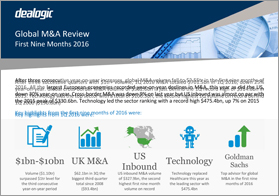
Mergers & acquisitions (M&A) activity during the first nine months of 2016 is the topic of a new report released this week by Dealogic.

Among the headline figures contained in ‘Global M&A Review: Nine Months 2016’ is the 22 percent year-on-year (YOY) drop in M&A volume, down to $2.55 trillion from $3.27 trillion.  

In terms of key regional headline data, the report reveals that US targeted M&A volume was down 30 percent YOY. Furthermore, domestic US M&A volume fell 38 percent to $771.3bn.

Looking to M&A volume in Europe, the UK reached $62.1bn by the end of 3Q 2016, its highest recorded 3Q figure since 2008.

As far as global cross-border M&A volume is concerned, activity in the first nine months of 2016 was valued at $899.5bn, down 9 percent YOY. Furthermore, US inbound M&A was $327.9bn, only slightly behind the all time record of $330.6bn set in 2015.

In terms of M&A in the Asia Pacific region, China and Japan were the top acquiring Asian nations of US targets. Chinese acquisitions reached an annual record high for both volume and activity, with $35.7bn via 124 deals. Japan announced 132 deals worth $17.4bn, down 39 percent YOY.

Leading the M&A advisor rankings is Goldman Sachs with transactions totalling $613.3bn, followed by Morgan Stanley on $476.3bn and JPMorgan on $459.9bn.

Technology was the top sector (replacing healthcare) with a total of $475.4bn, just ahead of its previous record of $446.1bn in 2015. Conversely, healthcare, which also hit an annual record high in 2015, was down 48 percent YOY to $255.4bn.

The report also showcases the ‘Top 10 Announced M&A Transactions First Nine Months 2016’ with Bayer’s $66.3bn acquisition of Monsanto, announced in May 2016, top of the list. Second is the $46.7bn acquisition of Syngenta by China National Chemical Corp (ChemChina) in February 2016 - the largest ever cross-border transaction by a Chinese acquirer. In third place is the September 2016 deal which saw Enbridge Inc acquire Spectra Energy Corp for $43bn, in the largest Canadian outbound deal on record and the fifth largest utility & energy deal on record.

Finally, Dealogic confirms that the total of withdrawn M&A in the first nine months of 2016 was $752.8bn. This includes the $28.9bn Praxair/Linde deal and the $25.4bn Mondelez International/Hershey transaction.

Report: Dealogic – ‘Global M&A Review: First Nine Months 2016’

Bass Pros Shops catches Cabela’s in $5.5bn deal

BY Richard Summerfield

Fishing and hunting chain Cabela’s Inc. has agreed to be sold to rival Bass Pro Shops in a deal worth $5.5bn.

Under the terms of the deal announced on Monday, Bass Pro Shops has agreed to pay Cabela’s shareholders $65.50 per share held. The price represents a 19.2 percent premium to Cabela's most recent closing price on Friday. According to a joint statement released by the firms, the deal is expected to close in the first half of 2017.

In a separate deal, Capital One Financial Corp. has announced that it will be acquiring Cabela’s credit card business for an undisclosed amount. The sale of the credit card business will create a 10 year agreement which will allow Bass Pro Shops to issue credit cards to Cabela's customers.

News of the deal for Cabela’s has been welcomed not only by the company’s shareholders but also the markets. Indeed, Nebraska based Cabela’s, which has been in business since 1961, has endured a difficult few years which have seen the company’s larger stores outmanoeuvred by smaller, more dynamic rivals, including online retailers. The company’s difficulties have been reflected in its declining share price.

In light of the increased competition from a variety of sources, Cabela’s has experienced falling sales of apparel and footwear and has seen same-store sales growth in only one quarter in more than three years. The company had also been under pressure from activist hedge fund Elliott Associates LP, which revealed an 11.1 percent stake in the company a year ago.

Since rumours of a potential sale began to circle in December 2015 the company’s stock has risen 17 percent.

"Cabela’s is pleased to have found the ideal partner in Bass Pro Shops," said Tommy Millner, Cabela’s chief executive . "Having undertaken a thorough strategic review, during which we assessed a wide variety of options to maximise value, the Board unanimously concluded that this combination with Bass Pro Shops is the best path forward for Cabela’s, its shareholders, outfitters and customers. In addition to providing significant immediate value to our shareholders, this partnership provides a unique platform from which our brand will be extremely well positioned to continue to serve outdoor enthusiasts worldwide for generations to come."

The newly combined company will own more than 180 stores across the US and Canada.

“Today's announcement marks an exceptional opportunity to bring together three special companies with an abiding love for the outdoors and a passion for serving sportsmen and sportswomen," said Johnny Morris, founder and CEO of Bass Pro Shops. "The story of each of these companies could only have happened in America, made possible by our uniquely American free enterprise system. We have enormous admiration for Cabela’s, its founders and outfitters, and its loyal base of customers. We look forward to continuing to celebrate and grow the Cabela’s brand alongside Bass Pro Shops and White River as one unified outdoor family.”

News: Cabela’s Agrees to Buyout by Bass Pro in $5.5 Billion Deal

©2001-2025 Financier Worldwide Ltd. All rights reserved. Any statements expressed on this website are understood to be general opinions and should not be relied upon as legal, financial or any other form of professional advice. Opinions expressed do not necessarily represent the views of the authors’ current or previous employers, or clients. The publisher, authors and authors' firms are not responsible for any loss third parties may suffer in connection with information or materials presented on this website, or use of any such information or materials by any third parties.