Outlook for global IPOs appears strong

BY Richard Summerfield

The global IPO market has belied the uncertainty surrounding the global economy, registering the most impressive Q1 in a decade, according to a new report from EY – 'Global IPO Trends: Q1 2017'.

EY’s report reveals that it was the most active first quarter by number of IPOs globally since 2007, with 399 IPOs raising $47.5bn. In terms of year-over-year growth, there was a 92 percent increase  in number over 2016, and a 146 percent increase in total value.

The technology sector was the biggest sectoral winner. The industry contributed $6.5bn despite not having the highest number of IPOs. The tech space saw 45 offerings compared to 66 in the industrial sector, which registered proceeds in excess of $4.1bn. By contrast, the telecommunications space was the least active sector, with only six IPOs raising just $351m.

In the US market, 24 IPOs raised $10.8bn, the region’s best performance since Q2 2015, when 72 IPOs raised $14.3bn. The region suffered in comparison to the Asia-Pacific area, which was led by Greater China. In total, Asia-Pacific generated 70 percent of the total number of IPOs, for $16.2bn. However, the US’ performance was still strong. "The first quarter of 2017 was one of the strongest for the US IPO market and established a solid runway for more deals for the remainder of the year”, said Jackie Kelley, EY Americas IPO Markets Leader. “This positive performance should attract more tech and unicorns to the public markets and further open the door for other sectors such as retail, energy, and real estate. With the market currently insulated from the political uncertainty, more companies are expected to enter the filing process."

Dr Martin Steinbach, EY Global and EY EMEIA IPO Leader, said: “This is a promising start to global IPO activity this year. In the face of sustained global economic uncertainty, the first quarter of this year has set the stage for accelerated growth in 2017. Economic fundamentals are improving in the major developed economies. Equity index performance and valuations are trending upward, with several major indices reaching all-time highs. Concurrently, volatility is low, underpinning positive IPO sentiment, which is also supported by the successful US listing of a large technology unicorn."

Report: Global IPO Trends: Q1 2017

$13.3bn “transformational event” sees ConocoPhillips asset sale to Cenovus

BY Fraser Tennant

In what has been described as a “truly transformational event”, Canadian oil company Cenovus Energy Inc. has agreed to the £13.3bn acquisition of the 50 percent interest held by multinational energy corporation ConocoPhillips in the Foster Creek Christina Lake (FCCL) Partnership – the companies’ jointly owned oil sands venture operated by Cenovus.

Once complete, the transaction, which also includes the majority of ConocoPhillips’s western Canada Deep Basin gas assets, will immediately make Cenovus Canada’s largest thermal oil sands producer and one of the country’s largest oil and gas producers.

“This is a significant, win-win opportunity for ConocoPhillips and Cenovus,” said ConocoPhillips chairman and chief executive Ryan Lance. “ConocoPhillips Canada will now focus exclusively on our Surmont oil sands and the liquids-rich Blueberry-Montney unconventional asset. Cenovus will assume sole ownership of FCCL and assume operations in the Deep Basin assets. This is truly a transformational event for both companies.”

With operations and activities in 17 countries, $90bn of total assets and approximately 13,300 employees, ConocoPhillips is the world's largest independent exploration and production company based on production and proved reserves. The transaction is expected to make an immediate and significant impact on ConocoPhillip’s value proposition by allowing it to rapidly reduce debt to $20bn and double share repurchase authorisation to $6bn.

“This means we will not only accelerate, but exceed, the three-year plan we laid out in November 2016,” continued Mr Lance. “The transaction is accretive to our cash margins and lowers the average cost of supply of our portfolio, with no impact to our estimate of cash provided by operating activities at $50 per barrel Brent price. We will retain upside to future oil price increases through our equity stake in Cenovus and an uncapped, five-year contingent payment.”

With a continued focus on total shareholder return, Cenovus intends to consider the optimal level of its dividend once the company’s divestiture of non-core assets is substantially complete – taking into account future production growth, realised cost reductions and sustained margin improvements.

“This transformational acquisition allows us to take full control of our best-in-class oil sands projects and to add a second growth platform across the prolific Deep Basin that provides complementary short-cycle development opportunities,” said Brian Ferguson, president and chief executive of Cenovus. “The purchase of these assets is consistent with Cenovus’s existing strategy and core and I am confident this transaction will create substantial shareholder value for years to come.”

News: ConocoPhillips sells oil and gas assets to Cenovus for $13.3 billion

Optimism returns: UK asset and wealth arena improves in Q1 2017

BY Fraser Tennant

Optimism returned to the UK asset and wealth arena in Q1 2017 following a period of intense pessimism throughout 2016, according to the latest CBI/PwC Financial Services Survey published this week.

The survey, a quarterly snapshot of the views of 98 UK firms, found that business volumes grew in the three months to March, although this growth is expected to slow over Q2. However, despite the expected slowdown, spreads and average fees and commissions are expected to rise, with profitability continuing to improve strongly.

Among the survey’s key findings were: (i) optimism in the financial services sector was broadly stable, following four consecutive quarters of declining sentiment (the longest period of falling sentiment since the global financial crisis of 2008); (ii) 33 percent of firms said they were more optimistic about the overall business situation compared with three months ago, while 29 percent were less optimistic; (iii) 34 percent of firms said that business volumes were up, while 17 percent said they were down; and (iv) looking ahead to Q2, growth in business volumes is expected to slow somewhat, with 23 percent of firms expecting volumes to rise next quarter, while 14 percent expect them to fall.

In terms of the overall business situation, optimism varied across sectors, with building societies, life insurers, insurance brokers and investment managers feeling more optimistic and finance houses and general insurers less so. In the banking sector sentiment was unchanged.

“The industry has picked itself up and feels in a stronger position than it did six months ago,” said Mark Pugh, UK asset and wealth management leader at PwC. “Nonetheless, the sector remains sensitive to uncertainty and potential market volatility.” Among the uncertainties are rising costs, technology spend and regulatory hurdles, with regulation and legislation also cited as constraints on business expansion for asset and wealth managers over the next 12 months.

Mr Pugh continued: “A slight reduction in the pace of technology spend could represent asset and wealth managers delaying large scale investment until they have more certainty on upcoming regulation such as MiFID II, PRIIPS and the FCA Market Study.”

Despite the potential delay in investment,  the ability to implement innovation quickly is driving consolidation in the sector – a trend which is expected to continue. “Anticipation of future consolidation seems to be a factor in the industry’s swing back towards optimism,” concluded Mr Pugh.

News: Optimism stabilises as financial services gets boost from solid economy – CBI/PwC

Dow and DuPont win EU regulatory approval

BY Richard Summerfield

The controversial $130bn ‘merger of equals’ between Dow Chemical and DuPont finally won approval from the European Union (EU) yesterday as they agreed to divest certain assets in order to get the deal done.

The combined company, which will be known as DowDuPont following the proposed merger, will split into three independent companies within two years of completion. The three businesses will focus on agriculture, materials and speciality products.

"We always look at what a merger would change not just today but also tomorrow," EU Competition Commissioner Margrethe Vestager told reporters at a Brussels press conference announcing the approval. "It is just as important to make sure mergers don’t reduce innovation for new and better products."

In a statement following the approval, Dow and DuPont said: “Longer term, the intended three-way split is expected to unlock even greater value for shareholders and customers and more opportunity for employees as each company will be a leader in attractive segments where global challenges are driving demand for their distinctive offerings."

DuPont has agreed to sell off its crop protection business, along with its associated research and development division. Dow has agreed to divest its acid copolymers and ionomers business.

According to Ms Vestager, the choice of buyer for the companies’ assets was up to Dow and DuPont, however, a potential purchaser would need to have the necessary resources to make the new business viable without triggering new antitrust concerns.

EU antitrust authorities were initially reluctant to approve the deal as they were concerned that competition and innovation in the European agriculture industry would be negatively impacted.

Though the EU’s approval is an important step in the approval process, the deal is still being examined by antitrust bodies in the US, Canada and Brazil. "The companies continue to work constructively with regulators in the remaining relevant jurisdictions to obtain clearance for the merger, which they are confident will be achieved," the Dow and DuPont statement continued.

News: EU antitrust regulators clear $130 billion Dow, DuPont merger

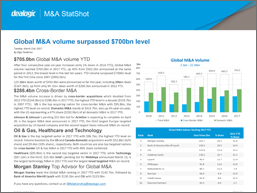
Global deal volume reaches $705bn

BY Richard Summerfield

Global mergers & acquisitions activity has been on the up, according to Dealogic, with consecutive year-on-year increases for the last four years. And 2017 may prove to be even busier. There have been $705bn worth of deals announced in the year to date, marking the first time since the onset of the financial crisis that the $700bn mark had been surpassed in same YTD period.

One of the major forces driving activity has been firms pursuing cross-border deals. Such transactions reached $288.4bn in 2017 YTD, up from $144.9bn in 2012 and the highest YTD level since the $324.7bn recorded in 2007. The US accounted for $95.8bn worth of overseas acquisitions, the highest YTD level on record. The $31.4bn offer for Swiss biotech company Actelion by American healthcare group Johnson & Johnson is the largest announced deal o date.

From a sectoral perspective, the oil & gas industry saw the most activity, with a record $96.7bn worth of announced deals to date. Of this total, $52.4bn and $9.4bn occurred in the domestic sectors of the US and Canada respectively.

The second most targeted industry was the healthcare sector, with $95.9bn,and technology was third with $87.1bn.

Morgan Stanley topped the adviser rankings in the YTD. Though the firm’s share of total deals fell from 22.0 percent to 20.2 percent, it was involved in $142.7bn of deals, far outstripping Bank of America Merrill Lynch, which had an 18.5 percent share – up from 14.4 percent in 2016 – and a total deal value of $130.3bn. Citi Bank advised on 17.6 percent of transactions YTD, up from 13.2 percent in 2016 for a total value of $123.9bn. Goldman Sachs, which topped the global advisory rankings this time last year, suffered the most in the early part of 2017. Last year the firm advised on nearly a third of deals; this year, however, it fell to fourth place, with its share of deals nearly halved to 16.7 percent, having been engaged on $118.2bn of transactions in the YTD.

Report: Dealogic M&A StatShot

©2001-2025 Financier Worldwide Ltd. All rights reserved. Any statements expressed on this website are understood to be general opinions and should not be relied upon as legal, financial or any other form of professional advice. Opinions expressed do not necessarily represent the views of the authors’ current or previous employers, or clients. The publisher, authors and authors' firms are not responsible for any loss third parties may suffer in connection with information or materials presented on this website, or use of any such information or materials by any third parties.