

MAGAZINE
November 2026 Issue
Financier Worldwide Magazine
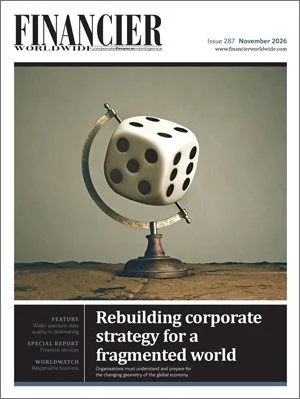
Click cover to download
(Subscriber-only password access)
Not a subscriber?
Click here to join the FREE mailing list and receive password access
COVER STORY
Rebuilding corporate strategy for a fragmented world
Businesses must develop operating models capable of balancing cost competitiveness with sufficient flexibility to withstand disruption. The precise balance will vary between industries and organisations, but many companies increasingly view these additional costs as an acceptable price for greater resilience.
![1. GRANT Ad[FWNov26].jpg](https://images.squarespace-cdn.com/content/v1/52d7b15be4b0bd82f382963c/1790778710739-SKVKQWPVKG7INS7F53PX/1.+GRANT+Ad%5BFWNov26%5D.jpg)
![2. ATOZ Ad[FWNov26].jpg](https://images.squarespace-cdn.com/content/v1/52d7b15be4b0bd82f382963c/1790778803599-1C0SFLJ95BJ3RGP51SFE/2.+ATOZ+Ad%5BFWNov26%5D.jpg)
![3.BDO Ad[FWNov26].jpg](https://images.squarespace-cdn.com/content/v1/52d7b15be4b0bd82f382963c/1790778823412-65IV70MPNGAYS1VVV6NX/3.BDO+Ad%5BFWNov26%5D.jpg)
![4.KPMG Ad[FWNov26].jpg](https://images.squarespace-cdn.com/content/v1/52d7b15be4b0bd82f382963c/1790778842852-QI4NI8ZNFQ0C9DBBMUTC/4.KPMG+Ad%5BFWNov26%5D.jpg)
![5.StoneTurn Ad[FWNov26].jpg](https://images.squarespace-cdn.com/content/v1/52d7b15be4b0bd82f382963c/1790778864313-8UIEGXXCDN521MW4GGPW/5.StoneTurn+Ad%5BFWNov26%5D.jpg)
![6.FTI Ad[FWNov26].jpg](https://images.squarespace-cdn.com/content/v1/52d7b15be4b0bd82f382963c/1790778972309-XR2OOHJEH8WXLNULDD19/6.FTI+Ad%5BFWNov26%5D.jpg)
Issue advertisers
FEATURES
Wider aperture: data quality in dealmaking
In an M&A context, the consequences of poor data quality can be particularly costly. Dealmakers rely on extensive quantitative and qualitative information to assess value, identify risks and shape future integration strategies.
Resurgent: UK defence M&A hits record pace
Previously cautious, UK defence-sector M&A began 2026 strongly, recording a record 84 trade transactions and 33 financial transactions during H1, underlining the sector’s growing attractiveness to investors.
Shifting dynamics: private credit versus banks
Traditional banks, particularly in the US, often face constraints that make financing more difficult for middle-market companies. Private lenders have greater flexibility to assess borrowers on a case-by-case basis, structure bespoke loans, tailor covenants and make relationship-driven lending decisions.
Managing AI governance across global operations
As AI becomes more deeply embedded in core business activities, responsibility for its governance is moving beyond technology teams and into the boardroom. Boards and senior executives must develop a sufficient understanding of AI to assess how it is being deployed, where material risks exist and whether appropriate controls are in place.
Cyber risk, corporate trust and the reputation challenge
Following a cyber breach, reputational challenges do not end when systems are restored. Organisations should therefore treat post-incident reviews as an opportunity to strengthen stakeholder confidence.
WORLDWATCH

The responsible business agenda is evolving from voluntary corporate social responsibility into a formal discipline rooted in reporting, governance and accountability. Meanwhile, geopolitical uncertainty, competitiveness pressures and regulatory fragmentation are prompting organisations to focus resources more strategically. FW moderates a discussion between Jill Shaw at A&L Goodbody LLP, Scott Janoe at Baker Botts L.L.P, Timothy Goh at Hogan Lovells Cadwalader Lee & Lee, and Sonia Struthers at McCarthy Tétrault LLP.
SPECIAL REPORT

Innovation, resilience and regulation in financial services
StoneTurn The growing importance of operational resilience continues to shape boardroom agendas across the financial sector. Recent disruptions affecting critical market infrastructure and payment systems have reinforced concerns regarding concentration risk, third party technology dependencies and interconnected digital ecosystems.
Q&A: Financial services resilience: technology, third parties and systemic risk
Financial institutions that cannot demonstrate a credible contingency plan for a key provider’s failure may face heightened scrutiny, regardless of how strong their internal controls otherwise are. FW discusses financial services resilience through the lens of technology, third parties and systemic risk, with Allen Applbaum, Michael Costa and Luke Tenery at StoneTurn.
TALKINGpoint

AI, deepfakes and financial crime
Voice cloning and deepfake videos are among the most effective fraud techniques today because they exploit trust and urgency rather than weaknesses in security systems. FW discusses AI, deepfakes and financial crime with Steven Taylor at BDO USA, P.C.
Navigating global tax reporting complexity
Technology, automation and data governance now play a central, rather than ancillary, role in enabling organisations to manage the scale and complexity of modern cross-border tax reporting obligations. FW discusses global tax reporting complexity with Romain Tiffon and Marie Bentley at ATOZ Tax Advisers.
Transfer pricing and the AI value chain
As AI becomes fully embedded in business as usual operations, transfer pricing frameworks must evolve at a similar pace. FW discusses transfer pricing and the AI value chain with Paul McSavage, Samit Shah, Keith To, Pascal Luquet and Charles Marais at Grant Thornton.
BRIEFINGroom

International trade and sanctions
While the imposition of sanctions means that certain enterprises can no longer engage in previously permitted transactions, they do not change the underlying economics of the commercial activity. FW discusses international trade and sanctions with Jan Dunin-Wasowicz at Bennink Dunin-Wasowicz, Patrick Murphy at Clyde & Co LLP, Adam M. Smith at Gibson, Dunn & Crutcher LLP, and Daniel Martin at Holman Fenwick Willan.
Retail transformation and consumer adaptation
The challenge is no longer simply offering the lowest price, but demonstrating why a product, service or brand is worth choosing in an increasingly crowded and price-sensitive market. FW discusses retail transformation and consumer adaptation with Chloe Forster at DLA Piper, Matthew Gregory at Norton Rose Fulbright LLP, and David Niemeyer at Skadden, Arps, Slate, Meagher & Flom LLP and Affiliates.
DEALfront

mergers & acquisitions
Victory Capital to acquire First Eagle in transformative $7bn deal
In a transaction set to create a diversified global asset manager with approximately $571bn in client assets, Victory Capital Holdings has agreed to acquire 100 percent of First Eagle Investments from Genstar Capital and First Eagle employees.
Goldman Sachs agrees $2.25bn acquisition of NEOS Investments
Goldman Sachs has agreed to acquire exchange-traded fund (ETF) platform NEOS Investments in a transaction valued at up to $2.25bn, strengthening its position in the growing market for actively managed income-focused ETFs.
private equity & venture capital
Apollo agrees £5.7bn acquisition of easyJet as takeover advances
Following months of uncertainty over its future, easyJet, one of Europe’s largest low-cost airlines, has agreed to be acquired by private equity (PE) firm Apollo Global Management in a deal valued at approximately £5.7bn ($7.7bn).
RBC and BMO agree C$2bn sale of Moneris to Francisco Partners
The Royal Bank of Canada (RBC) and the Bank of Montreal (BMO) have agreed to sell Canadian payments provider Moneris Solutions to technology-focused investment firm Francisco Partners in a transaction valued at approximately C$2bn, with the proceeds split equally between the two banks.
bankruptcy & corporate restructuring
Braskem Idesa enters Chapter 11 to cut debt by $920m
After securing support from creditors and shareholders for a comprehensive financial restructuring, Mexican petrochemical company Braskem Idesa, a joint venture between Brazil’s Braskem SA and Mexico’s Grupo Idesa, has filed for Chapter 11 bankruptcy protection in the US.
Casas Bahia seeks court-supervised restructuring amid R$17.3bn debt burden
Brazilian retailer Casas Bahia has filed for bankruptcy protection in a São Paulo court after experiencing mounting financial difficulties. The company and several subsidiaries have sought court-supervised reorganisation as they attempt to address a worsening liquidity crisis.
SPOTlight

Unseen activist: continuous shareholder surveillance in small and mid-cap healthcare
Alliance Advisors Regular stock surveillance gives management and boards an early-warning system: insight into who is buying, who is selling, how ownership is shifting and where pressure points may be building before they become public.
Governing the invisible: a practical framework for AI oversight
Gold Collins Edelman Advisors Much responsible-AI discussion has focused on model architecture: its accuracy, testing, biases and training. Despite those issues’ importance, they can lead boards toward governance myopia.
From compliance programme to criminal liability: the new EU Anti-Corruption Directive
Temime For companies, the significance of the Directive lies less in the harmonisation of the underlying offences than in the introduction of this additional basis of corporate liability.
Beyond intangibles: the next few years of transfer pricing
Norton Rose Fulbright The central question is gradually evolving from ‘who owns and controls the intangibles?’ to ‘what drives value in the business, and who controls the people, capital, assets and risks responsible for creating it?’ The shift is likely to shape the next generation of transfer pricing analysis and disputes.
CONTRIBUTORS
A&L Goodbody LLP
Alliance Advisors
ATOZ Tax Advisers
Baker Botts L.L.P
BDO USA, P.C.
Bennink Dunin-Wasowicz
Clyde & Co LLP
DLA Piper
Gibson, Dunn & Crutcher LLP
Gold Collins Edelman Advisors
Grant Thornton
Hogan Lovells Cadwalader Lee & Lee
Holman Fenwick Willan
McCarthy Tétrault LLP
Norton Rose Fulbright
Skadden, Arps, Slate, Meagher & Flom LLP and Affiliates
StoneTurn
Temime